The Drug That Made an ASCO Crowd Stand and Cheer for 42 Seconds
A daily pill nearly doubled survival in metastatic pancreatic cancer, turning ASCO's toughest crowd into a 42-second standing ovation. After 40 years of calling KRAS "undruggable," the lock just got picked.
Pancreatic cancer doesn't do miracles. It's the tumor type where oncologists measure progress in weeks, not years. Where the five-year survival rate sits at a brutal 13%. Where second-line chemotherapy buys patients, on average, about six months.
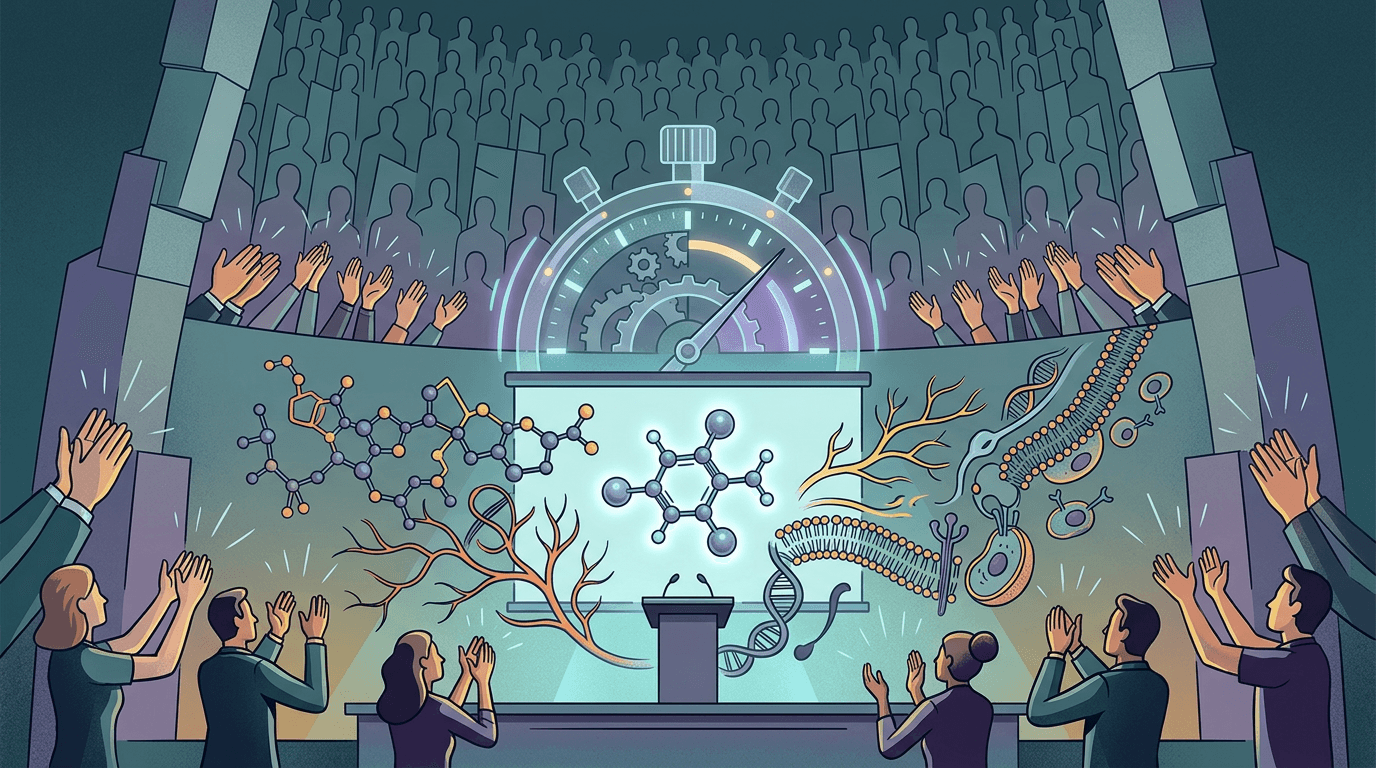
So when a plenary audience at ASCO 2026 leapt to their feet, cheering and whistling for 42 straight seconds after seeing a single survival curve, something genuinely unprecedented had just happened.
The Slide That Changed the Room
The drug is daraxonrasib, developed by Revolution Medicines. The trial is called RASolute 302: a global, randomized Phase 3 study pitting daraxonrasib against standard chemotherapy in patients with previously treated metastatic pancreatic cancer.
The results? Patients on daraxonrasib lived a median of 13.2 months. Patients on chemo lived 6.6 months. That's not an incremental gain. That's a near-perfect doubling of survival in a cancer where progress is usually measured in single-digit weeks.
The risk of death dropped by 60% compared to chemotherapy (hazard ratio of 0.40, for the stats nerds). And daraxonrasib hit every single endpoint it was designed to hit: overall survival, progression-free survival, response rate, quality of life. All of them.
ASCO's chief medical officer, Julie Gralow, didn't mince words. She called the data "not just a home run but a grand slam" and later described it as "probably the biggest advancement in the treatment of cancer in the past decade."
That's not a typo. Not pancreatic cancer. Cancer, period.
Cracking Biology's Most Stubborn Lock
To understand why this matters, you need to know about KRAS, the villain at the center of this story.
KRAS is a protein that tells cells to grow. When it mutates, it gets stuck in the "on" position, like a gas pedal jammed to the floor. Over 90% of pancreatic cancers carry a KRAS mutation, making it the single most important driver of the disease.
Get tomorrow's biotech intelligence before your competitors.
Join thousands of biotech professionals who start their day with our free, daily briefing.
For decades, scientists called KRAS "undruggable." The protein's surface is smooth and featureless; there's almost nowhere for a drug molecule to grab hold. Think of it like trying to stick a Post-it note to a bowling ball. A few years ago, researchers cracked the code for one rare KRAS variant called G12C, leading to drugs like sotorasib. But G12C accounts for only about 1-2% of pancreatic cancers. The common variants (G12D, G12V, G12R) remained untouchable.
Daraxonrasib takes a completely different approach. Instead of trying to stick directly to KRAS, it recruits a helper. The drug first binds to an abundant protein inside cells called cyclophilin A, forming a two-part complex. That complex then latches onto active, "switched-on" KRAS (which scientists call RAS(ON)), creating a three-part molecular sandwich.
The result: cyclophilin A physically blocks KRAS from talking to its downstream partners. It's like putting a giant bouncer between the gas pedal and the engine. No signal gets through, no matter which KRAS mutation is driving the tumor.
This "molecular glue" strategy is what makes daraxonrasib multi-selective: it works across KRAS G12D, G12V, G12R, and other variants simultaneously. For the first time, a single drug can target the full spectrum of KRAS mutations that make pancreatic cancer so deadly.
The Numbers Behind the Standing Ovation
RASolute 302 enrolled 500 patients across multiple countries. All had metastatic pancreatic cancer that had progressed after at least one prior chemotherapy regimen. About 92% carried a RAS G12 mutation, which tracks with the known biology of the disease.
Patients were randomized to either daraxonrasib (a once-daily pill, 300 mg) or the doctor's choice of standard chemo.
Beyond the headline survival number, the supporting data told a consistent story. Progression-free survival (how long before tumors started growing again) doubled too: 7.2 months versus 3.6 months for chemo. The objective response rate, meaning tumors that meaningfully shrank, was over 31% with daraxonrasib compared to roughly 11% with chemo.
And here's something that often gets lost in oncology data: patients on daraxonrasib felt better longer. The drug delayed deterioration in pain, global health, and quality of life compared to chemotherapy. In a disease this aggressive, that matters enormously.
Not a Free Ride, But a Better One
Daraxonrasib isn't without side effects. Rash and mouth sores (stomatitis) were the most common issues, with grade 3 or higher rash occurring in about 14% of patients and severe stomatitis in roughly 12%. The trial protocol actually recommends preventive antibiotics and topical steroids to manage skin toxicity before it becomes a problem.
But the comparison with chemo is striking. Severe treatment-related side effects hit 43.6% of daraxonrasib patients versus 57.5% on chemo. Only 1.2% of patients on daraxonrasib had to stop treatment because of side effects, compared to 11.2% on chemotherapy. There was one fatal case of lung inflammation (pneumonitis) in the daraxonrasib arm, a serious reminder that targeted therapies carry their own risks.
Still, the overall safety profile was notably cleaner than the chemo comparator. Patients could stay on treatment longer, with a median dose intensity of 87%.
What Wall Street and the Cancer World Are Saying
The results were published in the New England Journal of Medicine, the gold standard for medical evidence.
The reaction from experts was unequivocal. Rachna Shroff, the ASCO expert discussant, called it "a game changer in pancreatic cancer." Jennifer Knox of Princess Margaret Cancer Centre declared daraxonrasib "a new standard of care in the second-line setting." Anna Berkenblit, chief scientific and medical officer of the Pancreatic Cancer Action Network, called the results "jaw dropping" and "the most significant advance we have ever seen in pancreatic cancer."
Analysts piled on. H.C. Wainwright labeled the dataset "practice changing." Truist Securities said the data "derisks approval and supports rapid adoption," projecting a potential launch as early as the third quarter of 2026.
Revolution Medicines has already secured Breakthrough Therapy Designation and Orphan Drug Designation from the FDA for daraxonrasib in this setting. The company is moving toward a New Drug Application filing, though no specific approval date has been publicly announced.
The Bigger Picture
For decades, pancreatic cancer has been oncology's bleakest corner. The disease kills more than 50,000 Americans annually, and the treatment toolkit has been limited almost entirely to various combinations of cytotoxic chemotherapy. Second-line options, in particular, have been grim: response rates around 10-20%, progression-free survival under four months, and overall survival hovering near six months.
Daraxonrasib doesn't cure pancreatic cancer. Resistance will inevitably develop, and combinations with other agents are already being explored to extend the benefit further. But doubling survival in this setting, with better tolerability and improved quality of life, represents the kind of leap that rarely happens in this disease.
The standing ovation wasn't just for a good drug. It was for the cracking of a biological lock that the field had been picking at for 40 years. KRAS, the "undruggable" target, just got drugged in the cancer where it matters most.
Deals & M&A5 min read
UCB Just Bet $1.15 Billion That Brain Cells Can Stop Seizures
UCB is spending up to $1.15 billion on Neurona Therapeutics and its lab-grown brain cell therapy for drug-resistant epilepsy. The early clinical data is stunning, but the real test is just getting started.