Scientists Can Now Edit Human Embryos With Surgical Precision. That's the Problem.
Columbia scientists used next-gen CRISPR base editing to fix disease mutations in human embryos with unprecedented precision, but persistent errors and a deepening ethics war over "designer babies" mean the hardest questions are just getting started.
A Spell-Checker for Your DNA
Imagine fixing a single typo in a 3-billion-letter document without accidentally deleting a paragraph. That's basically what a team at Columbia University just pulled off in human embryos.
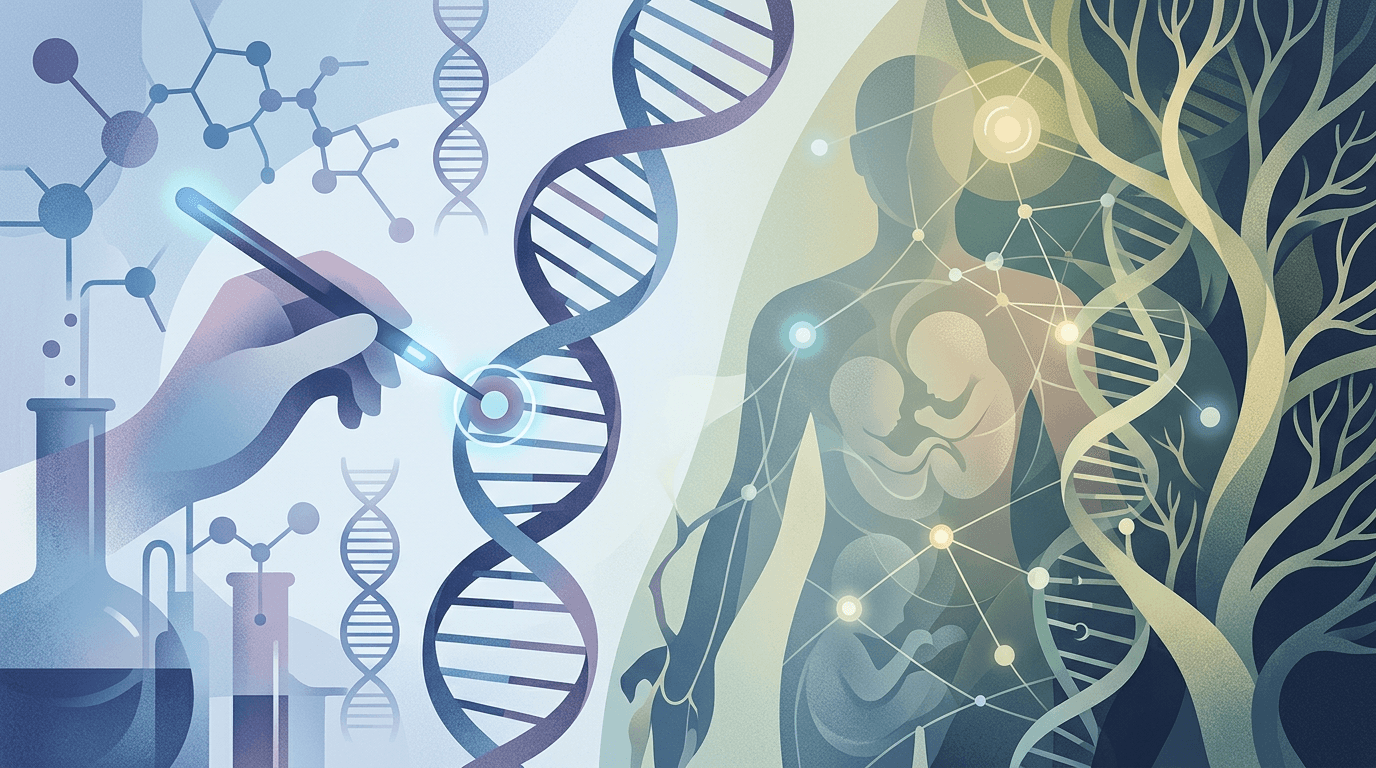
A group led by geneticist Dieter Egli used a next-generation CRISPR tool called base editing to correct disease-causing mutations in early human embryos. Unlike classic CRISPR, which works like molecular scissors (snipping both strands of DNA and hoping the cell stitches things back together correctly), base editing swaps one DNA letter for another without ever cutting the double helix. Think of it as a pencil eraser instead of a machete.
The results, posted as a preprint on bioRxiv and covered by STAT News, landed like a grenade in the already combustible ethics debate over editing the human germline: the DNA that gets passed to future generations.
What They Actually Did
Egli's team targeted two genes in donated IVF embryos that were never intended for pregnancy.
The first was PCSK9, a gene linked to high LDL cholesterol and heart disease risk. The second was HBG, which controls fetal hemoglobin production and is relevant to blood disorders like sickle cell disease. In some embryos, the team edited both genes simultaneously.
They delivered the base-editing machinery into fertilized eggs and two-cell embryos, then watched what happened. The embryos developed normally to the blastocyst stage (the roughly five-day-old ball of cells that could be implanted into a uterus). None were implanted.
The headline result: relatively high efficiency in correcting the target mutations, with no detectable aneuploidy (abnormal chromosome counts). That last part matters a lot. Earlier CRISPR-Cas9 experiments in embryos had a nasty habit of causing large deletions, chromosomal rearrangements, and other genomic carnage. One study found that roughly 16% of CRISPR-edited human embryos had unintended damage at the target site alone.
Get tomorrow's biotech intelligence before your competitors.
Join thousands of biotech professionals who start their day with our free, daily briefing.
Base editing appears to sidestep much of that destruction.
The Catch (There's Always a Catch)
Before anyone starts planning the genetic optimization of their future children, two stubborn problems remain.
Mosaicism is the first. Even with these improved tools, not every cell in the embryo got the memo. Some embryos ended up as patchworks: a mix of edited and unedited cells. If such an embryo grew into a person, different tissues could carry different genetic instructions. That's not a feature; it's a bug, and a potentially dangerous one.
Off-target edits are the second. Base editing dramatically reduced the kind of wholesale genomic damage seen with traditional CRISPR. But the Columbia team still detected unwanted single-base changes at sites other than the intended targets. Fewer errors, yes. Zero errors, no.
These aren't minor quibbles. For a technology that would permanently alter someone's DNA (and the DNA of every generation that follows), "mostly accurate" isn't the same as "safe."
Meanwhile, in Cambridge
Columbia wasn't the only team making news. A group at the University of Cambridge's Loke Center for Trophoblast Research used base editing to knock out a gene called NANOG in human embryonic cells. NANOG is a master switch for pluripotency, the ability of early cells to become any tissue in the body.
When they blocked NANOG, the cells couldn't form the epiblast, the structure that eventually becomes the fetus. It confirmed something scientists had seen in mice but never proven directly in human cells. The work was more about understanding early development than fixing diseases, but it showcased the same underlying technology.
Both studies point to a clear trend: base editing works better in human embryos than anything that came before it. And that's precisely what has ethicists losing sleep.
The Ghost of He Jiankui
You can't talk about editing human embryos without talking about He Jiankui, the Chinese researcher who in 2018 secretly used CRISPR-Cas9 to edit embryos that were then implanted, resulting in the birth of twin girls. He targeted the CCR5 gene, hoping to confer HIV resistance.
The scientific community was horrified. The editing was sloppy, the medical justification was weak (safer HIV prevention methods already existed), and the embryos showed mosaicism. He was convicted of illegal medical practice in China and sentenced to three years in prison.
He's experiment became the field's cautionary tale. China responded by criminalizing the implantation of gene-edited or cloned embryos in 2020. In the U.S., Congress bars the FDA from even reviewing applications for germline editing trials. The UK allows embryo editing research under license but makes it a criminal offense to implant a modified embryo.
Across 96 countries surveyed, not a single one explicitly permits creating a pregnancy from a gene-edited embryo. About 75 of those countries actively prohibit it.
The Ethics Are Getting Louder
The new Columbia results have split the community into two camps that are both getting more vocal.
On one side: three major gene-therapy organizations (the ASGCT, ISCT, and Alliance for Regenerative Medicine) proposed a 10-year moratorium on heritable human genome editing in May 2025. ASGCT's CEO, David Barrett, called the Columbia study "unfortunate," saying it "flies in the face of the moratorium." ISCT Ethics Committee chair Bruce Levine said he doesn't find the basic research itself concerning, but that what worries him is "the spin" around the preprint and the potential for misuse.
On the other side: researchers who argue that base editing could one day prevent devastating genetic diseases in families with no other options. Preimplantation genetic testing (selecting unaffected embryos during IVF) works for most cases, but rare situations exist where every embryo a couple produces carries a disease-causing mutation. For those families, editing might be the only path to a healthy biological child.
Then there's the slippery slope everyone worries about. If you can edit out sickle cell disease, can you edit in blue eyes? Higher IQ? Athletic ability? The line between therapy and enhancement is a lot blurrier than anyone would like to admit.
Where This Leaves Us
The science is advancing faster than the ethics can keep up. Base editing in human embryos is more precise, less destructive, and more efficient than anything researchers had five years ago. But it's still not precise enough for clinical use, and the regulatory and moral frameworks for heritable editing barely exist.
For now, the global consensus holds: research yes, babies no. Every edited embryo stays in a dish. No one is implanting anything.
But the gap between "technically possible" and "ethically permissible" is narrowing. And in a world where He Jiankui showed that one rogue scientist can outrun every guideline, the question isn't whether the tools will be ready. It's whether the rules will be.
Deals & M&A5 min read
UCB Just Bet $1.15 Billion That Brain Cells Can Stop Seizures
UCB is spending up to $1.15 billion on Neurona Therapeutics and its lab-grown brain cell therapy for drug-resistant epilepsy. The early clinical data is stunning, but the real test is just getting started.