Congress Just Told the FDA to Stop Requiring Lab Rats
The House just passed a bill forcing the FDA to stop defaulting to animal testing in its drug approval rules. With animal studies costing up to $1.1 billion per approved drug and adding years to development timelines, the biotech industry's preclinical playbook is about to get a serious rewrite.
Every new drug in America has a dirty little secret: before it ever touches a human, it probably killed a few thousand mice.
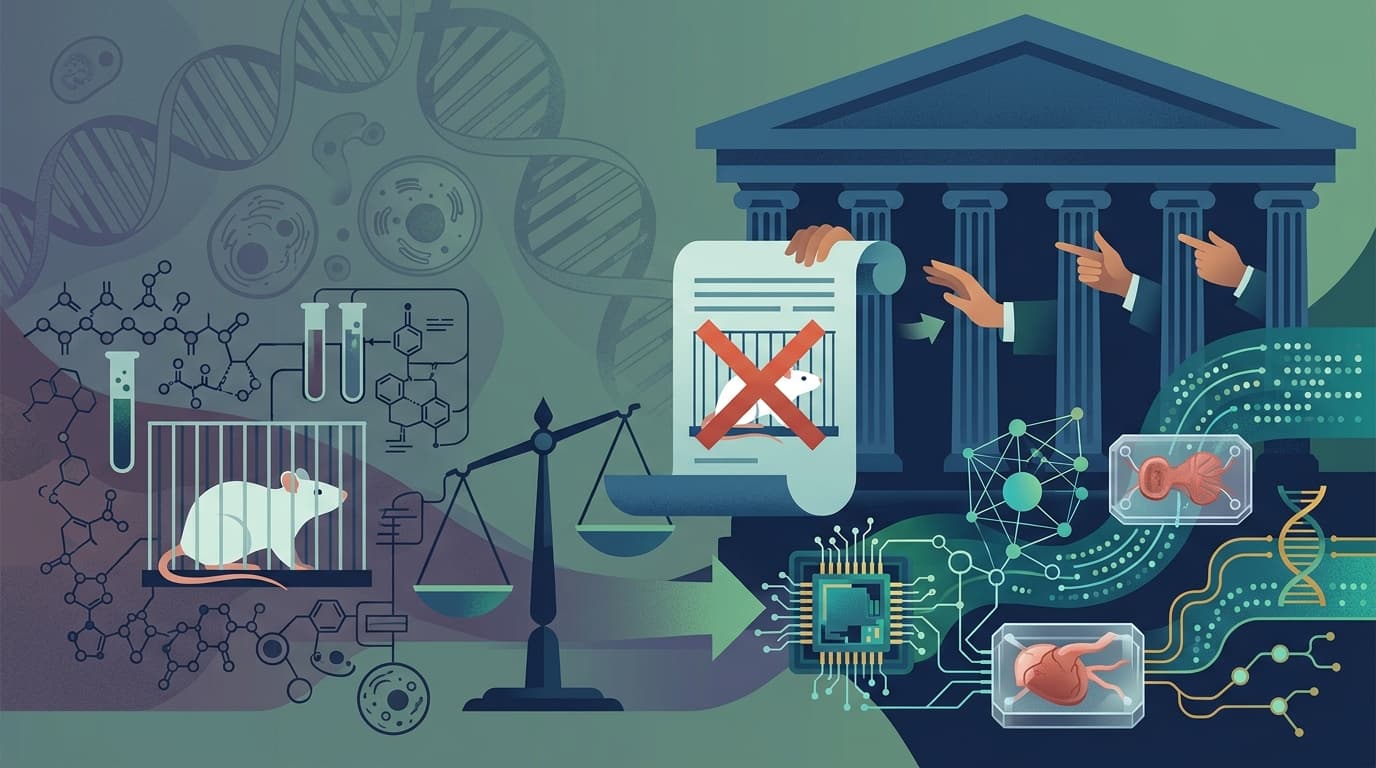
That's been the deal for nearly a century. The FDA's rulebook, written in 1938, basically assumed that if you wanted to prove a drug was safe, you had to test it on animals first. Rats, dogs, monkeys; the whole Noah's Ark of suffering. But on July 20, the House of Representatives voted to change that, passing the FDA Modernization Act 3.0 by voice vote on a motion to suspend the rules. Not a single member objected.
The bill doesn't ban animal testing. But it does something arguably more powerful: it forces the FDA to rewrite its own rules so they stop defaulting to animals.
The Regulatory Glitch That Wouldn't Die
To understand why this matters, you need to know about a bureaucratic quirk that's been driving biotech companies (and animal welfare groups) nuts for three years.
Back in 2022, Congress passed the FDA Modernization Act 2.0, which removed the legal requirement that new drugs be tested on animals. Companies could now submit data from cell-based tests, computer models, organ-on-a-chip devices, and other non-animal methods. Problem solved, right?
Not exactly. The statute changed, but the FDA's actual regulations, the nuts-and-bolts rules that reviewers follow when evaluating drug applications, still said "animal" everywhere. It's like Congress updated the building code, but the inspectors kept using the old checklist. Drug developers who wanted to skip animal studies found themselves in awkward conversations with FDA reviewers pointing at regulations that still explicitly referenced animal data.
FDA Modernization Act 3.0 fixes that glitch. It directs the FDA to publish an interim final rule within one year that replaces every reference to "animal" tests with "nonclinical" tests across key sections of the Code of Federal Regulations. That single word swap carries enormous weight, because "nonclinical" officially includes computer models, human cell systems, and organ-on-a-chip technology alongside traditional animal studies.
Get tomorrow's biotech intelligence before your competitors.
Join thousands of biotech professionals who start their day with our free, daily briefing.
Follow the Money (It's a Lot of Money)
If you're wondering why biotech cares about regulatory language, consider the economics.
Animal testing during drug development costs somewhere between $430 million and $1.1 billion per approved drug, depending on the therapy. A single two-year cancer study in rats runs about $2 to $3 million. Developing a typical monoclonal antibody requires around 144 non-human primates, with per-animal costs reaching $50,000 each.
Those numbers add up fast. And they don't just drain budgets; they eat time. Rodent cancer studies alone can add two to three years to a development timeline. For monoclonal antibodies, the average journey from lab to market takes roughly 12 to 13 years, with months of that timeline consumed by long-term animal toxicology studies.
Non-animal alternatives can be dramatically cheaper. Multiple analyses show animal tests cost 1.5 to 30 times more than comparable cell-based or computational methods. More importantly, those alternatives can run in parallel rather than sequence, potentially shaving months or years off the preclinical phase.
For small biotechs burning cash at terrifying rates, that's not a nice-to-have. It's existential.
The Technology Is Ready. (Mostly.)
The science behind non-animal testing has come a long way. Organ-on-a-chip devices, which are tiny microfluidic systems lined with human cells that mimic how real organs behave, can now model liver toxicity, heart effects, and lung responses. AI-powered models can predict how drugs will interact with human biology. Three-dimensional organoids (essentially miniature organs grown from stem cells) let researchers study disease and drug response in human tissue.
The FDA itself has been moving in this direction. In April 2025, the agency announced a plan to phase out animal testing for monoclonal antibodies, replacing those requirements with AI-based toxicity models and human cell systems.
But there's a catch. Most of these technologies are validated for specific uses, not as universal replacements. Organ-on-a-chip systems are described by researchers as "not yet fully validated" for broad regulatory decision-making. The FDA's own roadmap frames the transition as conditional on proper validation, case by case, test by test.
Think of it like electric cars in 2015: the technology clearly works, adoption is accelerating, but the infrastructure isn't fully built yet.
Who's Cheering, Who's Nervous
The bill's sponsor list reads like a bipartisan fantasy. Rep. Buddy Carter (R-GA) led the charge, with Rep. Nanette Barragán (D-CA) as the lead Democratic co-sponsor. Rep. Vern Buchanan (R-FL), who championed the original 2.0 legislation, signed on as well. The House Energy and Commerce Committee approved it 44-0 before it sailed through the full chamber.
Animal welfare organizations are thrilled. Groups like Humane World for Animals called the FDA's broader shift a "historic move." PETA praised it as a "significant step." Last Chance for Animals called it "welcome but long overdue."
Big pharma's reaction is more measured. During the 2.0 debate, only Teva publicly supported the legislation; Pfizer continued to call animals "an essential component" of drug discovery. The industry pattern looks familiar: large companies will welcome clearer guidance while keeping animal studies as a safety net for high-stakes programs. Smaller biotechs and NAM (new approach methodology) platform companies see a genuine competitive opening.
The National Association for Biomedical Research offered the sharpest pushback, warning that "there is currently no full replacement for animal models" and cautioning that policy decisions should be "grounded in science, not politics."
What Happens Next
The bill now heads to the Senate, where Sen. Cory Booker introduced companion legislation back in February 2025. Given the bipartisan momentum (and the fact that over 85% of American adults support phasing out animal experiments, according to survey data cited in the FDA's own roadmap), passage looks likely.
But the real test comes after the bill becomes law. The FDA will have one year to rewrite its regulations. How individual review divisions interpret "nonclinical" will determine whether this is a genuine transformation or just a cosmetic edit. Oncology reviewers might move fast; others might drag their feet.
For drug developers, the strategic calculus is already shifting. Companies that build credible, FDA-accepted packages using non-animal methods gain a real edge: faster timelines, lower costs, and a story that resonates with investors and the public alike. Contract research organizations are scrambling to add organoid testing, organ-on-a-chip platforms, and AI toxicology to their menus.
The 1938 playbook survived 88 years. Its replacement just cleared the House without a single "no" vote. The lab rats might finally be getting a retirement plan.
Clinical & Regulatory4 min read
Zepbound Just Got a Secret Back Door to Cheaper Prices
Eli Lilly is now selling the highest doses of Zepbound in single-dose vials for $449 per month, roughly 60% cheaper than the standard auto-injector pens. It's a strategic play in a GLP-1 pricing war that's reshaping who can actually afford obesity drugs.