Congress Wants to Cut Off China's Biotech Pipeline. Pharma Has a Problem.
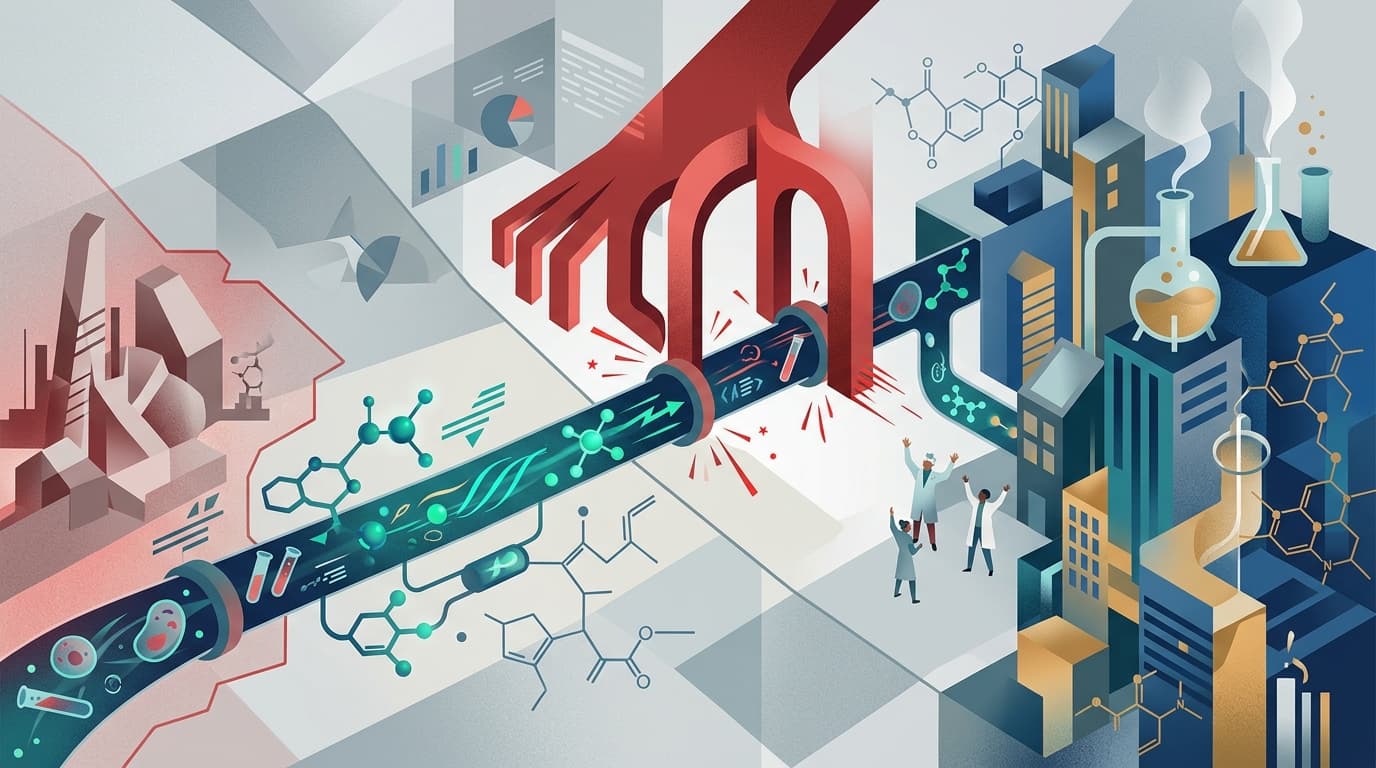
U.S. lawmakers want to add biotech to the COINS Act, which already restricts investment in AI and chips flowing to China. With nearly 40% of major pharma licensing deals involving Chinese biotechs, the move could fundamentally rewire how drugs get developed.
Nearly half the big pharma licensing deals signed last year had a Chinese biotech on the other end. Now, a group of U.S. lawmakers wants to make those deals a national security issue.
That collision between commerce and geopolitics just got a lot more real.
The Letter That Could Reshape Biotech Dealmaking
House Foreign Affairs Chair Brian Mast and House China Select Committee Chair John Moolenaar are pushing Treasury Secretary Scott Bessent to add biotechnology to the COINS Act, the 2025 law that already restricts U.S. outbound investment in sectors including AI, semiconductors, quantum technology, high-performance computing/supercomputing, and hypersonic systems flowing to China and other adversaries.
The ask isn't subtle. In a February 2026 letter co-signed by several Republican national security hawks, Mast argued that U.S. biotech investment and know-how are "building the scientific and industrial foundation" for foreign adversaries' military capabilities. Moolenaar followed up with his own letter on May 21, going even further. He wants Treasury to scrutinize not just traditional equity investments, but also the licensing of pharmaceutical IP, drug discovery platforms, clinical R&D capabilities, and biologics manufacturing know-how.
In other words: the deals that make modern pharma run.
The 38% Problem
To understand why this matters, look at how much Western pharma depends on Chinese biotech right now. According to J.P. Morgan data, 38% of large-cap biopharma's major licensing deals in the first half of 2025 involved Chinese companies. Those deals accounted for 27% of total upfront payments.
The pipeline has been growing fast. The upfront value of cross-border licensing deals for Chinese biotech products surged from $1.1 billion to $5.6 billion between 2022 and 2025.
Think of it like a restaurant that sources nearly 40% of its ingredients from a single supplier. If regulators suddenly said that supplier posed a safety risk, you wouldn't just lose some menu items. You'd have to rethink how you cook.
Get tomorrow's biotech intelligence before your competitors.
Join thousands of biotech professionals who start their day with our free, daily briefing.
This Isn't About Equity Anymore
What makes the Mast-Moolenaar push different from previous China hawks' efforts is the scope. The original COINS Act regime focuses on traditional investment: equity stakes, venture funding, debt instruments. If you're a U.S. fund writing a check to a Chinese AI chip startup, Treasury wants to know about it (or wants to stop you).
But biotech's cross-border ties don't look like semiconductor investments. They look like licensing agreements, platform access deals, and manufacturing partnerships. When AbbVie licenses a molecule from a Chinese biotech, or when a U.S. startup uses WuXi Biologics as its contract manufacturer, no equity changes hands. Yet technology, data, and capabilities still flow across borders.
Moolenaar is specifically asking Treasury to use Section 809 of the COINS Act, a provision that gives the executive branch broad authority to expand the program to cover "any other transaction" that contributes to an adversary's military, intelligence, or surveillance capabilities. It's a legal hook that doesn't require new legislation; Treasury can act on its own.
The deadline for final COINS Act regulations is March 13, 2027, which means these letters are designed to shape the rules while they're still being written.
The Deals in the Crosshairs
The Chinese biotechs most intertwined with Western pharma read like a who's-who of global drug development. Legend Biotech partnered with Johnson & Johnson's Janssen unit to develop Carvykti, a CAR-T cell therapy (a treatment that reprograms a patient's own immune cells to fight cancer) now approved by both the FDA and EMA. BeiGene has struck multi-billion-dollar deals with Novartis, Amgen, and the former Celgene (now part of Bristol Myers Squibb) around its cancer pipeline.
Then there's WuXi Biologics, the massive contract research and manufacturing organization that works with 12 of the world's top 20 pharma companies. WuXi doesn't just build drugs for Western clients; it increasingly licenses its own antibodies to companies like GSK. It's both the kitchen and the chef.
If biotechnology becomes a covered sector under COINS, all of these relationships face new friction. Some could face outright prohibition.
Pharma Is Split, and Washington Knows It
The biotech industry's reaction is best described as a tug-of-war. On one side, national security advocates argue that U.S. pharma has become structurally dependent on Chinese assets, trading away long-term domestic competitiveness for short-term pipeline fixes. The American Economic Liberties Project has warned that market forces alone won't correct this trend.
On the other side, trade groups like BIO and many large pharma companies argue that restricting Chinese partnerships would deprive American patients of next-generation therapies, particularly in oncology and immunology where Chinese biotechs have been prolific innovators. Some industry voices call the approach a "fool's errand," insisting that U.S. leadership is better preserved by outcompeting in an open global market than by fragmenting it.
Domestic biotech founders occupy an awkward middle ground. They've watched U.S. capital flow overseas to license cheaper Chinese assets while they struggle to compete. But they also worry that blocking China won't increase deal liquidity; it might just shrink the overall pie.
The Chill Before the Freeze
Policy analysts don't expect an immediate blanket ban on all biotech transactions with China. The more likely near-term scenario is a mandatory notification or screening framework for certain deal types, particularly those involving core IP, discovery platforms, and manufacturing know-how.
But even a notification regime carries real bite. Filing requirements add months to deal timelines and significant legal costs. Regulatory uncertainty makes boards hesitant to approve China-linked transactions in the first place. Analysts expect a "chilling effect" that gradually reshapes behavior even before any formal prohibition takes hold.
Some companies are already adapting. Chinese CDMOs like WuXi have been building facilities in Ireland and the U.S. to mitigate geopolitical risk. Western pharmas are diversifying their manufacturing networks, adding Korean, Indian, and European suppliers. Licensing deals are being structured with flexible manufacturing rights to avoid single-country dependence.
It's a slow-motion decoupling, happening one contract clause at a time.
What Comes Next
The COINS Act gives Treasury until early 2027 to finalize its rules. Between now and then, the biotech industry faces a period of sustained uncertainty. Dealmakers are already pricing in regulatory risk, especially for long-dated collaborations where rule changes could bite mid-contract.
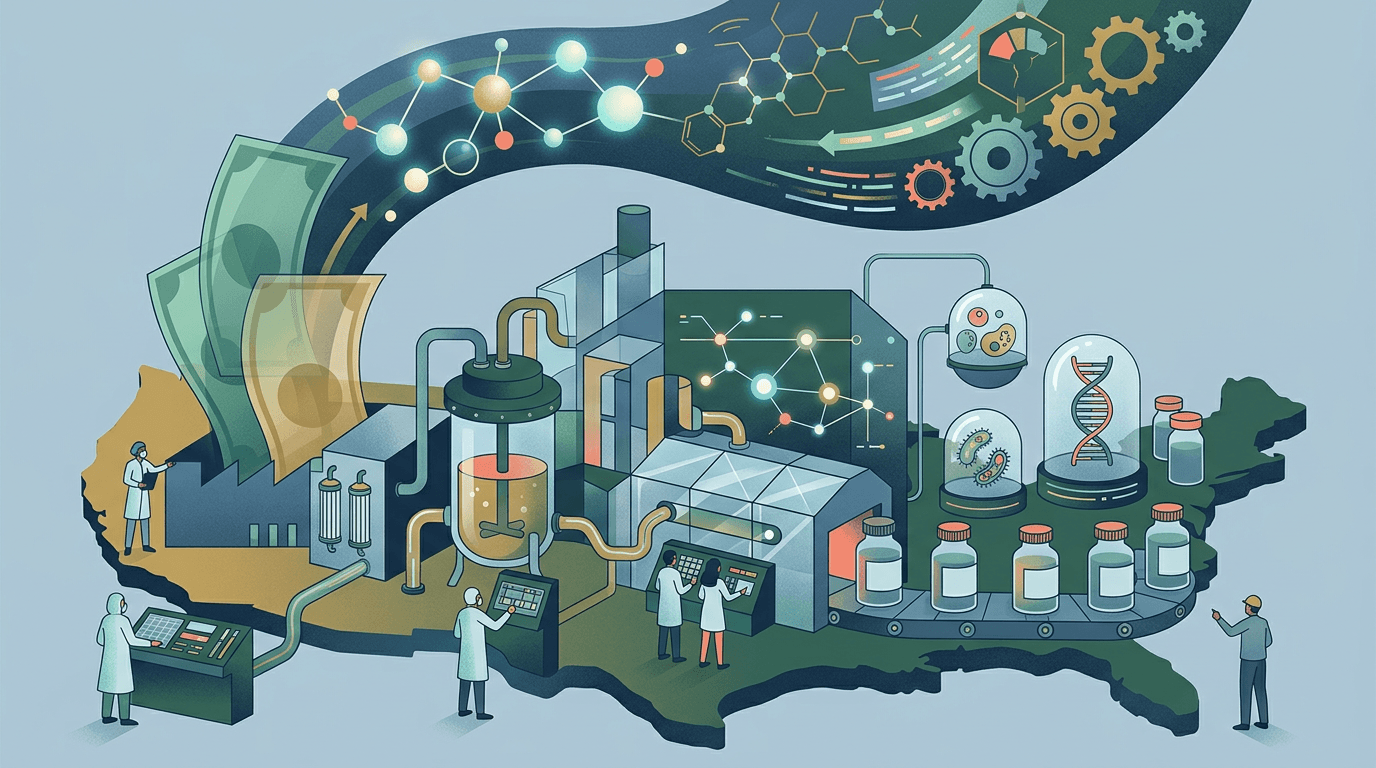
The bigger picture is hard to miss. Congress has been building a layered biotech security stack: the BIOSECURE Act restricts which Chinese firms can serve U.S. government contracts (the supply side), while COINS targets what U.S. entities can fund or transfer abroad (the capital side). Together, they represent a systematic attempt to rewire biotech's cross-border plumbing.
For an industry that spent the last decade globalizing its R&D, the message from Washington is clear: the era of frictionless U.S.-China biotech collaboration may be ending. The question isn't whether new restrictions are coming. It's how much they'll cost, and who pays the price.
Deals & M&A5 min read
The $7 Billion Bet That Could Reshape Nuclear Medicine
Curium Pharma just slid a $7 billion offer across the table to Lantheus Holdings, the company behind prostate cancer imaging blockbuster Pylarify. If the deal goes through, it would create a global radiopharmaceutical powerhouse and mark one of the biggest PE-backed moves into oncology infrastructure ever.