A tiny startup just raised $62 million to repurpose cancer's most powerful cell-killing technology against autoimmune disease. The monkey data look stunning, but the real test is just getting started.
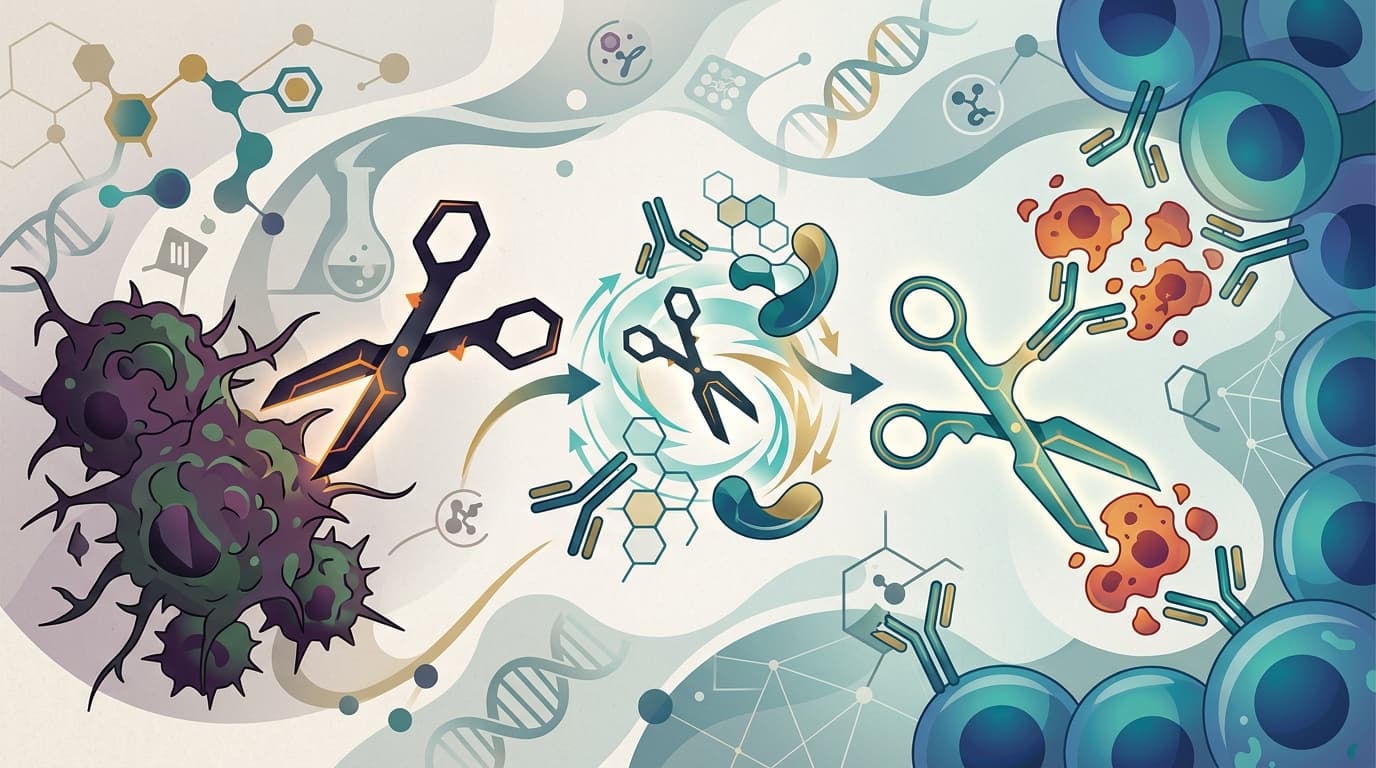
For the past decade, T-cell engagers have been oncology's secret weapon. These engineered proteins grab a killer T cell with one hand and a cancer cell with the other, forcing an introduction that ends badly for the tumor. They've become a backbone of blood cancer treatment.
Now a tiny startup thinks the same trick can cure autoimmune disease. And it just raised $62 million to prove it.
The Autoimmune Heist
Oblenio Bio, a Cambridge-based biotech barely 18 months old, is building something that doesn't really exist yet: a trispecific T-cell engager designed from scratch for autoimmune disease, not cancer. Their molecule, LBL-051, grabs onto three targets at once. Think of it like a molecular bouncer with three arms, each one latching onto a different troublemaker.
Two of those arms reach for CD19 and BCMA, proteins found on B cells and plasma cells. These are the immune cells that, in autoimmune diseases, go rogue and start producing antibodies against your own body. The third arm grabs CD3 on T cells, recruiting them to destroy those malfunctioning B cells and plasma cells on contact.
Why three targets instead of two? Existing bispecific engagers (like blinatumomab, a cancer drug) only grab CD19. That clears out most B cells, but it misses long-lived plasma cells, the stubborn factories that keep churning out harmful antibodies even after the B cells are gone. It's like pulling weeds but leaving the roots in the ground. LBL-051 is designed to pull both.
Monkey Business (the Good Kind)
Oblenio presented preclinical data at EULAR 2026, the big European rheumatology conference, and the results were striking. In nonhuman primates, LBL-051 achieved complete depletion of B cells and plasma cells in both blood and tissue. Not partial. Not "encouraging trends." Complete.
But the really interesting part came after the wipeout. When the immune system started rebuilding, the new B cells that showed up were : fresh recruits with no grudges. The old autoreactive clones (the ones attacking the body) were gone. Immunoglobulin levels dropped in a dose-dependent fashion, confirming that the plasma cell factories had actually shut down.
Get tomorrow's biotech intelligence before your competitors.
Join thousands of biotech professionals who start their day with our free, daily briefing.
immature and non-memory cells
This pattern mirrors what doctors have observed in autoimmune patients who achieve long-lasting, drug-free remissions after aggressive B-cell depletion. It's the biological signature of an immune "reboot."
And here's the kicker: no cytokine release syndrome. CRS is the nasty inflammatory reaction that makes many T-cell engagers dangerous; it's the reason cancer patients on these drugs sometimes end up in the ICU. Oblenio says they engineered around this problem by fine-tuning the potency of each binding arm, dialing down the CD3 grip enough to avoid a cytokine storm while keeping it strong enough to kill.
For a drug class with a reputation for hitting hard, that's a big deal.
Follow the Money
The $62 million Series B closed in June 2026, led by Pfizer Ventures. That name alone tells you something. When one of the world's largest pharma companies puts its venture arm out front, it signals more than financial interest; it signals strategic curiosity.
The rest of the syndicate included Deep Track Capital, GV (Alphabet's venture capital arm), and Aditum Bio, the venture creation firm that built Oblenio in the first place. The round was oversubscribed, meaning investors were fighting to get in.
Aditum Bio deserves a closer look here. Founded by Joe Jimenez (former CEO of Novartis) and Mark Fishman (former head of Novartis research), Aditum's model is simple: find a promising clinical asset, wrap a company around it, and run. Oblenio was built around a molecule licensed from Leads Biolabs, a clinical-stage biotech in Nanjing, China.
The deal gave Oblenio exclusive worldwide rights to develop and sell LBL-051. In return, Leads Biolabs gets an equity stake plus up to $579 million in milestones and royalties if everything works out. That's a big payday for a preclinical asset, but it reflects the size of the opportunity.
Why Oncology's Toolkit Is Invading Autoimmunity
Oblenio isn't operating in a vacuum. A quiet revolution is underway across the industry. Tools built to fight cancer, including T-cell engagers, CAR-T cells, and targeted antibodies, are being repurposed for autoimmune diseases at an accelerating pace.
The logic is straightforward. Many autoimmune diseases are driven by the same rogue B cells and plasma cells that blood cancers are made of. The weapons designed to destroy those cells in cancer should, in theory, work in autoimmunity too. Early clinical data with blinatumomab (a CD19 bispecific from oncology) and teclistamab (a BCMA bispecific) in refractory autoimmune patients have shown real responses, validating the concept.
But those are cancer drugs being borrowed, not purpose-built autoimmune therapies. They carry oncology-grade side effects and weren't optimized for patients who need a different risk-benefit calculation. Companies like Gilead, Sanofi, UCB, and Boehringer Ingelheim are all investing in the space, alongside smaller players like Cullinan Therapeutics.
Oblenio's pitch is that LBL-051 was designed for autoimmunity from day one. It's not a hand-me-down from oncology. The trispecific architecture, the tuned CD3 engagement, the step-up dosing strategy: all of it was built for patients who are chronically ill, not terminally ill.
The Hard Part Hasn't Started Yet
Let's be clear about what we're looking at. This is preclinical data in monkeys. The graveyard of biotech is full of molecules that worked beautifully in primates and flopped in humans.
The transition from NHP immune reset to durable, drug-free remission in human autoimmune disease involves a long list of unknowns. Human autoimmune repertoires are messier and more heterogeneous than anything you see in a healthy primate. The absence of CRS in monkeys is encouraging but not a guarantee; human immune systems have their own ideas about cytokine storms.
Then there are the long-term questions: infection risk from deep B-cell depletion, dangerously low antibody levels (hypogammaglobulinemia), and whether the immune "reset" truly holds or whether pathogenic clones eventually creep back.
Oblenio hasn't yet disclosed which specific autoimmune diseases it will target first in clinical trials, though the smart money is on severe, refractory conditions where aggressive intervention is easier to justify: think lupus, systemic sclerosis, or certain types of vasculitis.
The Bottom Line
Oblenio Bio is making a bold bet: that the most powerful cell-killing technology from cancer can be reengineered into a cure for autoimmune disease. The monkey data are genuinely impressive. The investor syndicate is serious. And the timing, with the entire industry leaning into this convergence, couldn't be better.
But $62 million buys you a ticket to the clinic, not a finish line. The real test starts when LBL-051 meets a human immune system for the first time. If the "reset" works as advertised, it could change how we treat millions of patients living with diseases that current drugs only manage, never cure.
That's a big "if." It's also exactly the kind of "if" that makes biotech worth watching.
Clinical & Regulatory4 min read
Zepbound Just Got a Secret Back Door to Cheaper Prices
Eli Lilly is now selling the highest doses of Zepbound in single-dose vials for $449 per month, roughly 60% cheaper than the standard auto-injector pens. It's a strategic play in a GLP-1 pricing war that's reshaping who can actually afford obesity drugs.