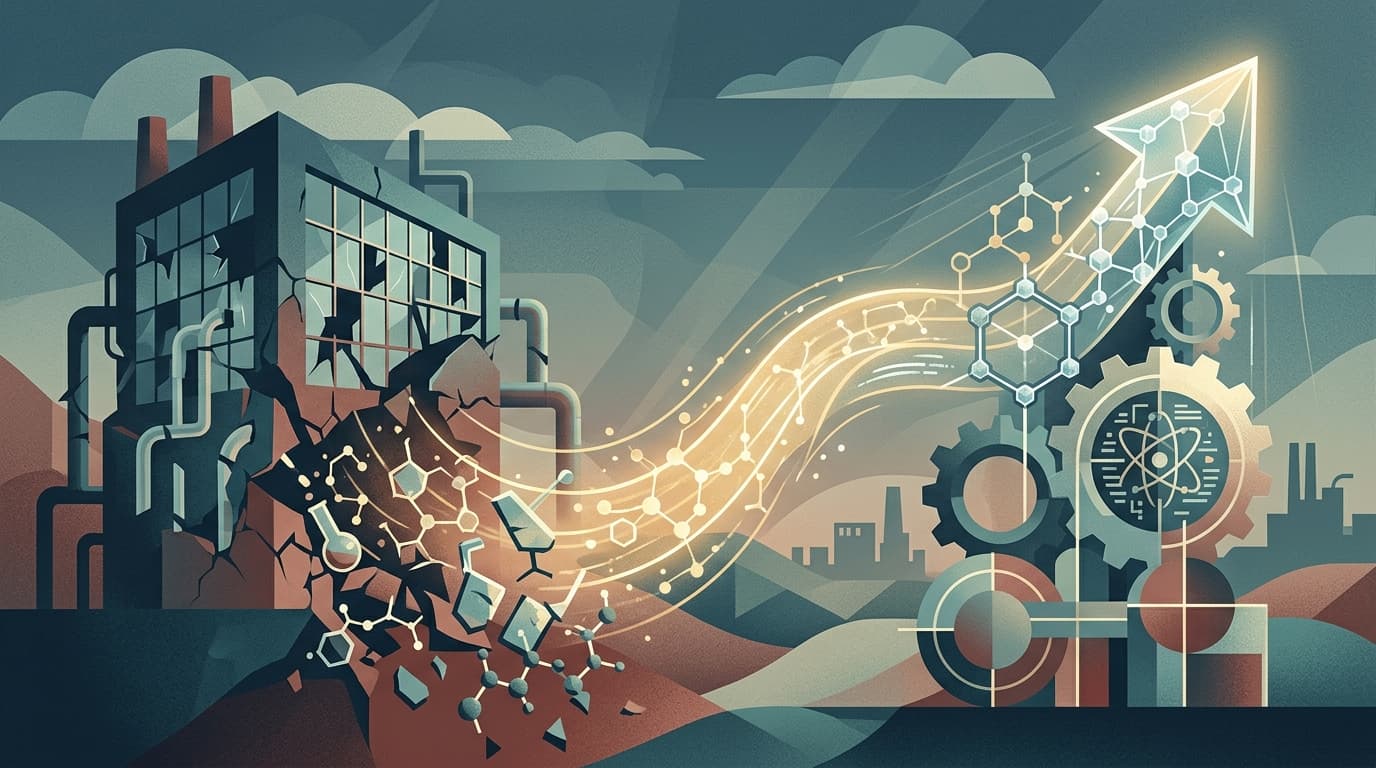

BioCryst is shutting down its 40-year-old internal drug discovery operation and betting everything on external deals. The rare-disease biotech is profitable, growing, and making a deliberate strategic gamble that could redefine what a mid-cap biotech looks like.
Imagine spending 40 years building a kitchen from scratch, learning every recipe, perfecting your knife skills, and then one day announcing: "We're closing the kitchen. From now on, we order in."
That's basically what BioCryst Pharmaceuticals just did.
The rare-disease biotech, founded all the way back in 1986, is shutting down its internal drug discovery operations and closing its Discovery Center of Excellence in Birmingham, Alabama by the end of 2026. No more early-stage research in-house. No more hunting for new molecules from the ground up. The company is pivoting entirely to external innovation: in-licensing deals, partnerships, and acquisitions.
For a company that literally built its identity on discovering drugs, this is a seismic shift. And new CEO Charlie Gayer thinks it's the smartest move BioCryst has ever made.
Gayer took over as CEO in January 2026 after serving as BioCryst's president. So he's the sales guy who got promoted to the top job, and one of his first big moves was to dismantle the research engine. That's a bold statement about where he thinks value gets created.
His argument is straightforward: external innovation is more capital-efficient and nimble than running a full internal discovery operation. Rather than funding dozens of scientists chasing early-stage leads that might take a decade to reach patients, BioCryst will use its financial muscle to acquire or license programs that are already further along.
Think of it like real estate. You can spend years and millions building a house from scratch. Or you can buy one that's already framed, plumbed, and wired. You still customize it, but you skip the riskiest, most expensive phase.
BioCryst isn't doing this from a position of desperation. The company is actually having a pretty great year.
Second-quarter total revenue came in at $218.3 million, and GAAP operating profit hit $98.5 million. That's real profitability, not the "adjusted EBITDA if you squint" kind. The company raised its full-year revenue guidance to , up from the original range of $635 million to $660 million.

Epicrispr just completed enrollment in the first-ever epigenetic editing trial for muscular dystrophy, a therapy that silences disease genes without cutting DNA. Twelve patients are dosed, early signals look promising, and the implications stretch far beyond one rare disease.


Join thousands of biotech professionals who start their day with our free, daily briefing.
The restructuring also trims costs. BioCryst lowered its 2026 operating expense guidance by $30 million at the midpoint, bringing it down to a range of $420 million to $440 million. That's money freed up for deals instead of pipettes.
BioCryst isn't abandoning everything. The company is keeping its existing clinical programs intact, and the portfolio still has some interesting cards to play.
ORLADEYO (berotralstat) is the crown jewel: an approved oral drug for hereditary angioedema, or HAE. That's a rare genetic condition that causes severe, potentially life-threatening swelling attacks. ORLADEYO was the first oral therapy specifically approved to prevent those attacks, and it's the engine behind BioCryst's revenue growth. The company also recently resolved a manufacturing delay on a pediatric formulation (oral pellets for kids aged 2 to under 12), which was expected to launch in early August 2026.
Navenibart is a Phase 3 antibody that targets the same kallikrein-bradykinin pathway (the biological cascade that triggers HAE swelling). The pivotal study finished enrollment in June 2026, with top-line results expected in Q3 2027. If it works, BioCryst could have a second major HAE product on its hands.
BCX17725 is the earlier-stage bet: a Phase 1 drug for Netherton syndrome, a rare and painful skin disorder. Dosing is ongoing in up to 12 patients, with proof-of-concept data expected by end of 2026.
So BioCryst still has things cooking. It just won't be starting any new recipes from scratch.
BioCryst isn't the only mid-cap biotech rethinking the vertically integrated model. The 2025 and 2026 landscape has been brutal for companies trying to do everything in-house.
Fierce Biotech's 2025 "graveyard" counted 16 biotech companies that shut down entirely, with 19 total when you include those circling the drain. Layoffs have been widespread, especially in R&D roles. The culprit: a tightening capital market that punishes companies burning cash on early discovery without near-term revenue.
The surviving playbook increasingly looks like what BioCryst is proposing: keep a lean core, commercialize what you have, and source future pipeline through deals. PwC's 2026 midyear outlook noted that focused mid-cap biotech transactions remain the "sweet spot" for biopharma M&A. In other words, the buyers are circling, and there's no shortage of programs to acquire.
But there's an important distinction. Many biotechs that cut internal R&D do it because they're running out of money. BioCryst is doing it while profitable and growing. That's a strategic choice, not a survival tactic.
Bulls will say: BioCryst is doing what smart capital allocators do. Why spend $30 million a year on discovery when you can deploy that money into later-stage assets with clearer risk profiles? The company has revenue, profitability, and a commercial infrastructure already built for rare diseases. It's the perfect platform for bolt-on acquisitions.
Bears will say: You just gave up your competitive moat. Internal discovery is what makes a biotech company a biotech company, not a holding company with a sales force. And now your entire future pipeline depends on finding, evaluating, and winning external deals in a competitive market. If BioCryst overpays for a bad asset, or if the deals dry up, there's no backup plan.
Gayer also brought in new leadership to execute this vision, appointing Sandeep Menon as chief R&D officer. The role will presumably be less about running labs and more about evaluating external opportunities.
But the harder question is this: can a company that spent 40 years building internal research culture successfully reinvent itself as a deal shop? The skills are completely different. Discovering drugs requires patience, curiosity, and tolerance for failure over long timelines. Licensing and acquiring them requires speed, negotiation savvy, and the ability to evaluate someone else's science with confidence.
It's the difference between being a chef and being a restaurant critic. Both require expertise, but they're fundamentally different jobs.
BioCryst has the financial foundation to make this work. Revenue is growing. Profitability is real. The rare-disease commercial platform is established. But the clock is ticking: navenibart data won't arrive until late 2027, and beyond that, the pipeline is whatever BioCryst can find on the open market.
The kitchen is closed. Now we find out if BioCryst has taste.
A molecule designed entirely by AI just got cleared for clinical trials in Parkinson's disease across three continents. Insilico Medicine's ISM8969 could validate generative AI drug discovery, but Parkinson's has a nasty habit of humbling even the most promising drugs.