The Government Wants to 3D-Print Your RNA Medicine
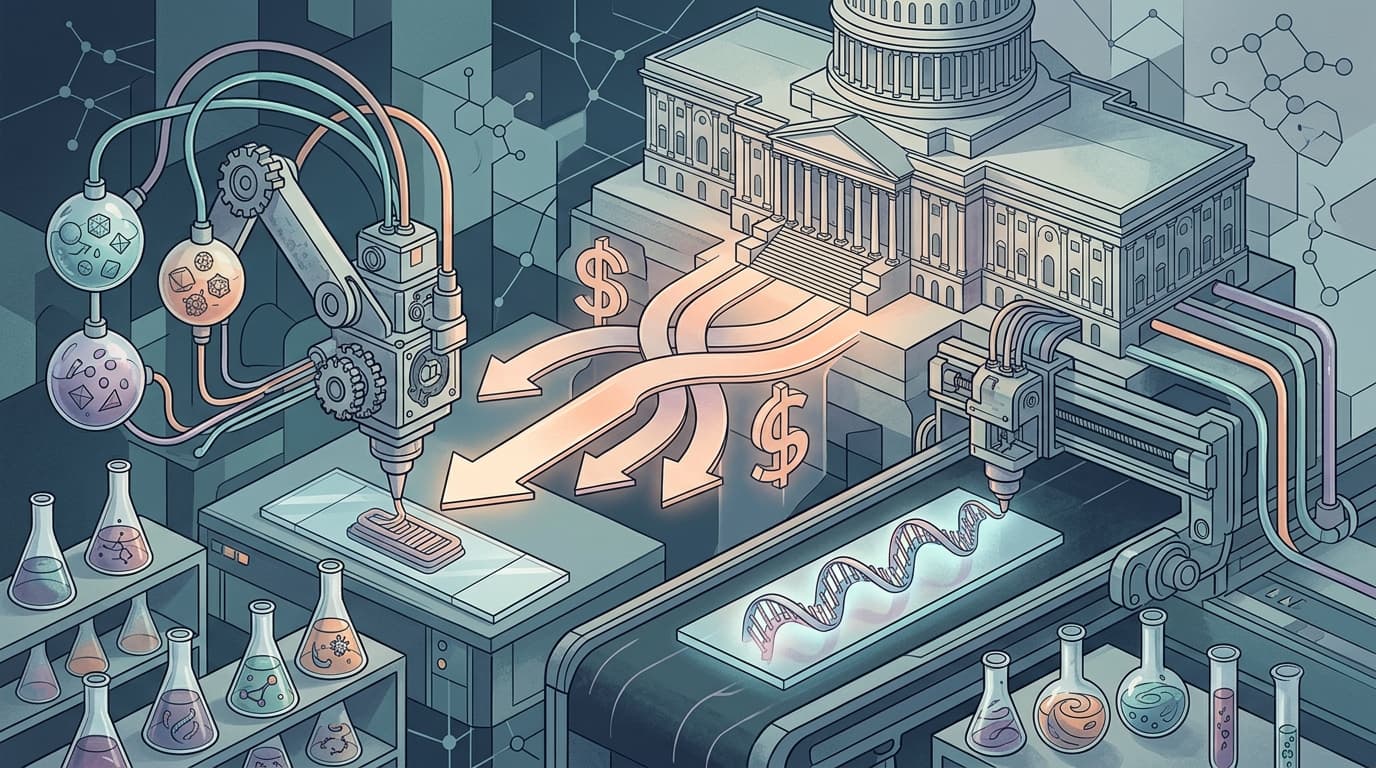
ARPA-H just dropped $125 million to fund five teams building automated, point-of-care RNA drug factories. If it works, personalized medicine could go from a nine-week wait to something closer to on-demand. The implications for rare diseases, cancer vaccines, and pandemic prep are massive.
A Pharmacy That Prints Your Drugs on the Spot
Imagine walking into a hospital and getting a treatment designed just for you, manufactured right there, that same week. Not shipped from a centralized plant three states away. Not after a nine-week wait. Made on demand, like a custom pizza order, except the toppings are lipid nanoparticles and messenger RNA.
That's the vision behind a $125 million bet the U.S. government just placed on RNA medicine. ARPA-H, the federal agency created to fund moonshot health projects, announced on September 25 that it's backing five teams to build something the biotech world has never had: a distributed, automated manufacturing network for personalized RNA therapies.
The program is called GIVE (Genetic Medicines and Individualized Manufacturing for Everyone), and its ambition is enormous. It wants to replace the slow, expensive, centralized model of making genetic medicines with something closer to a utility. Think of it like the difference between mailing a letter and sending an email. Same message, radically different infrastructure.
Why RNA Manufacturing Is Stuck in 2015
COVID proved that mRNA vaccines can be made at massive scale. Billions of doses rolled off production lines. But here's the catch: those were all the same product. Making billions of copies of one recipe is a fundamentally different challenge than making one unique batch for one patient.
Personalized RNA therapies (think cancer vaccines tailored to your specific tumor, or treatments for ultra-rare genetic diseases) still take six to eight weeks from sample collection to administration. Each batch requires its own quality-control gauntlet. The reagents are expensive. The purification is finicky. And because every patient's treatment is different, you can't just crank up the volume knob.
The cost? Personalized genetic medicines can run into the hundreds of thousands of dollars per patient, partly because the manufacturing process was designed for an era of one-size-fits-all drugs. It's like trying to run a custom tailor shop using a factory assembly line. The tools don't match the task.
Get tomorrow's biotech intelligence before your competitors.
Join thousands of biotech professionals who start their day with our free, daily briefing.
Quality control is arguably the biggest chokepoint. When a single batch serves a single patient, traditional release testing (the process of verifying a drug is safe and pure before it ships) becomes a bottleneck that can eat up days or weeks all by itself.
Five Teams, One Mission
ARPA-H didn't hand $125 million to one company and say "figure it out." It split the funding across five performers, each tackling different pieces of the puzzle:
Centillion Biosciences is building a unified end-to-end system covering DNA and RNA manufacturing, fill-finish (the final step of putting the drug in its container), quality testing, and digital process management.
HDT Bio Corp. is working on an integrated platform that combines automated DNA synthesis, chip-based RNA production, and robotics-enabled quality control. Yes, robots checking your medicine.
Massachusetts General Hospital is developing a single-use, all-fluidics chip system for continuous manufacturing and quality testing. Think of it as a lab-on-a-chip, but for drug production.
Waterfall Scientific is going for the holy grail: a fully automated, benchtop, continuous-flow system that handles everything, from DNA production to RNA synthesis to formulation to fill-finish to quality control. One box. Whole drug.
University of Utah is focusing specifically on the quality-control bottleneck, building a platform that could compress full release testing into as little as one day. If they pull it off, that alone could shave weeks off the timeline.
The Three-Phase Playbook
GIVE isn't structured as a single lump-sum grant. It's a phased program with clear milestones, more like a startup accelerator than a traditional government contract.
Phase 1 (about six months) covers engineering and software design. Blueprint mode.
Phase 2 (about 24 months) requires non-GMP demonstration runs of at least three different RNA products. Proof that the machines actually work.
Phase 3 (another 24 months) escalates to GMP-quality runs (the gold standard for pharmaceutical manufacturing), commercialization planning, and regulatory readiness. This is where the FDA gets deeply involved.
That regulatory piece matters more than it might sound. One of the biggest unresolved questions in distributed manufacturing is whether regulators will actually allow drugs to be made in hospital-adjacent facilities instead of traditional factories. ARPA-H is positioning the FDA to develop frameworks in parallel with the technology, rather than after it.
Why This Isn't Just Another Government Grant
ARPA-H has been on a spending spree since Congress stood it up with $1 billion in its first year. It launched CUREIT for mRNA-based immune training. It committed $100 million to women's health. Its THRIVE program pledged up to $160 million for rare-disease cures.
But GIVE stands out because it's not funding a drug. It's funding the infrastructure to make drugs. That's a fundamentally different kind of investment, more analogous to building highways than designing cars.
The timing also aligns with a broader federal push on RNA. BARDA (the government's biodefense procurement arm) expanded its commitment to Moderna's pandemic influenza mRNA program to up to $590 million in early 2025. NIH continues to fund rare-disease translational work. Congress has acknowledged investing billions in mRNA platforms over the years.
But none of those investments solved the manufacturing problem for personalized products. GIVE is specifically aimed at that gap.
The Bull Case and the Bear Case
The optimistic read: if even one or two of these five teams deliver a working, automated, point-of-care manufacturing system, it could fundamentally change the economics of personalized medicine. Rare diseases affecting tiny patient populations could become commercially viable. Pandemic response could shift from months to days. Cancer vaccines could move from research curiosity to clinical reality.
The skeptical read: distributed manufacturing for pharmaceuticals is hard. Regulatory frameworks for it don't fully exist yet. And ARPA-H programs are designed to take big swings, which means some of them will miss. Building a benchtop drug factory that meets GMP standards is the kind of engineering challenge that sounds simple in a press release and turns into a five-year headache in practice.
What to Watch
The next milestone is Phase 1 completion, roughly six months out. That's when we'll see whether these teams have viable designs or just ambitious PowerPoints. The real test comes in Phase 2, when they need to demonstrate actual RNA production runs across multiple products.
If this works, the implications go way beyond the five teams that got funded. Every biotech company developing personalized RNA therapies (and there are a lot of them) would benefit from cheaper, faster, decentralized manufacturing. It's the kind of rising-tide investment that could reshape how the entire industry thinks about making medicines.
For now, $125 million is a down payment on a future where your RNA therapy gets made down the hall, not across the country. That future is still years away. But the blueprints are officially being drawn.
Science & Discovery
5 min read
Arsenal Bio Just Torched Its Own Playbook. Here's Why.
Arsenal Biosciences just fired 99 employees, killed its clinical programs, and bet everything on a technology that barely exists in the clinic. When a company backed by $630 million torches its own playbook, it tells you something important about where cell therapy is headed.