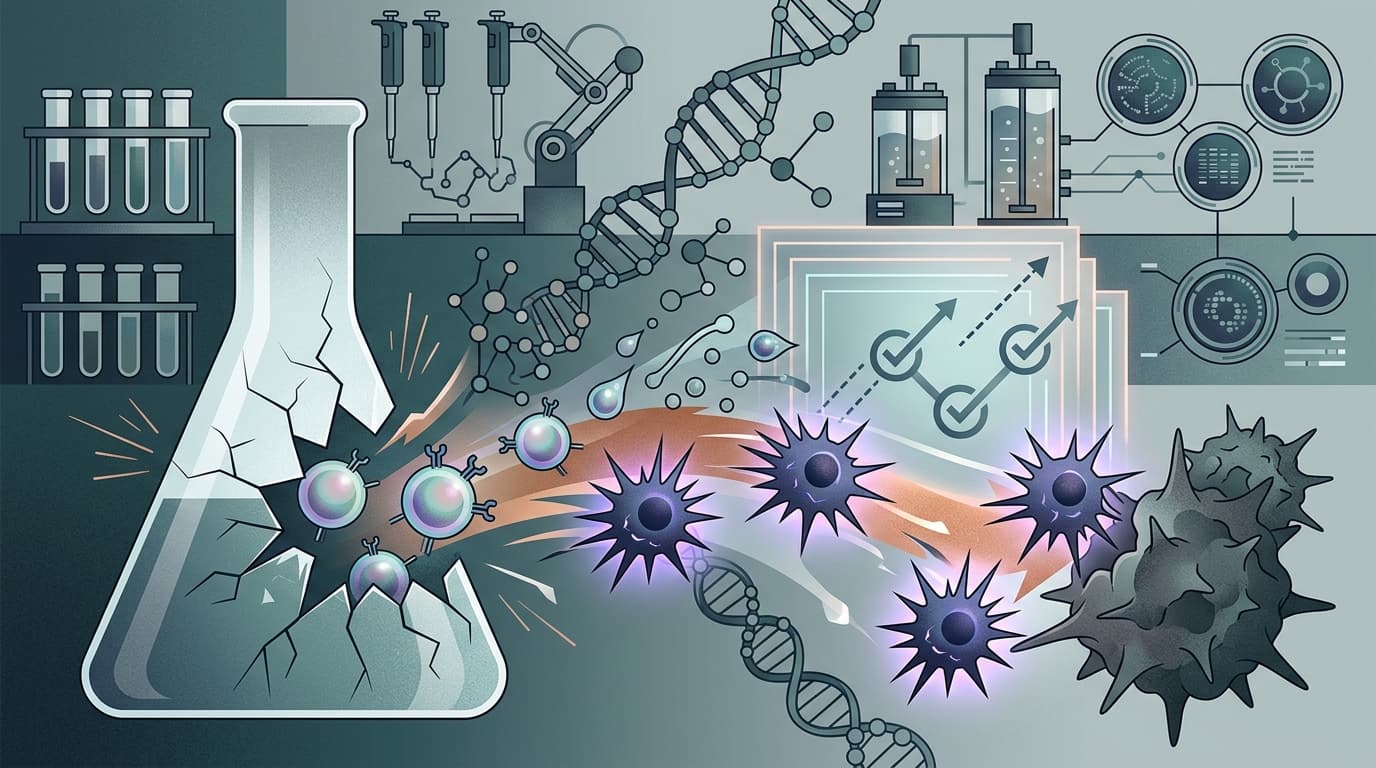
The Off-the-Shelf Cancer Killer That Wasn't Supposed to Work
Allogene's ALLO-316 just did what no off-the-shelf CAR-T therapy has done before: produce durable remissions in metastatic solid tumors. The Phase 1 data, published in the Journal of Clinical Oncology, could redraw the boundaries of cell therapy.
The Wall That Cell Therapy Couldn't Climb
For years, CAR-T cell therapy had a dirty secret. It could perform miracles in blood cancers, sending leukemia and lymphoma patients into deep remissions. But solid tumors? The ones that actually kill most cancer patients? Those were a different beast entirely.
Now Allogene Therapeutics says it has punched through that wall. A publication in the Journal of Clinical Oncology reports that ALLO-316, an off-the-shelf CAR-T therapy, produced the first durable remissions ever seen with an allogeneic cell therapy in metastatic solid tumors. Some patients have been in remission for over 18 months after a single infusion.
That's not just a good data readout. It's a proof-of-concept that could reshape how we think about cell therapy's ceiling.
Why Solid Tumors Are Cell Therapy's Final Boss
To understand why this matters, you need to know why solid tumors have humiliated CAR-T for so long.
CAR-T works by engineering immune cells to hunt cancer. In blood cancers, that's relatively straightforward: the cancer cells float around in the bloodstream, easy targets wearing bright molecular jerseys (like the CD19 protein). The engineered T cells find them, lock on, and destroy them. Seven FDA-approved CAR-T products work this way.
Solid tumors play a completely different game. They build fortresses. Dense walls of tissue, suppressive chemical signals, low oxygen environments, abnormal blood vessels that block T cells from getting in. Think of it like trying to deliver a package to a house with no address, surrounded by a moat, guarded by dogs. Even if your delivery truck (the CAR-T cell) is perfect, it can't reach the front door.
On top of that, solid tumors are shape-shifters. They express their target proteins unevenly, so some cancer cells wear the molecular jersey and some don't. The ones that don't? They survive and keep growing. Dozens of clinical trials have tried CAR-T in solid tumors over the past decade. None have produced an approved product.
Get tomorrow's biotech intelligence before your competitors.
Join thousands of biotech professionals who start their day with our free, daily briefing.
ALLO-316 isn't just fighting solid tumors. It's doing it as an allogeneic product, meaning the T cells come from a healthy donor rather than the patient themselves.
Traditional (autologous) CAR-T requires harvesting a patient's own immune cells, shipping them to a manufacturing facility, engineering them, and shipping them back. The process takes weeks and costs hundreds of thousands of dollars. Allogeneic CAR-T skips all that. It sits in a freezer, ready to go, like a blood transfusion.
The tradeoff: the patient's immune system recognizes these foreign cells and tries to reject them. That's why allogeneic CAR-T products have generally shown shorter persistence and weaker activity than their autologous cousins. Allogene uses gene editing (knocking out the T-cell receptor) to reduce rejection risk, but it remains an open question whether off-the-shelf cells can stick around long enough to matter.
ALLO-316 just answered that question, at least provisionally.
The Numbers Behind the Breakthrough
The Phase 1 TRAVERSE trial enrolled patients with advanced clear cell renal cell carcinoma (kidney cancer) who had already failed multiple treatments. These were heavily pretreated patients; the median number of prior therapy lines was four. Nearly half had already tried belzutifan, one of the newest options in the space.
ALLO-316 targets a protein called CD70, which is highly expressed on the surface of many kidney cancer cells. In patients whose tumors had high CD70 expression (a tumor proportion score of 50% or higher), the confirmed response rate hit 31%. Disease control was seen in roughly half of all Phase 1b patients.
But the durability is what turns heads. The median duration of response hasn't been reached yet, which in clinical trial language means most responders are still responding. The longest ongoing remission has lasted more than 18 months, all from a single infusion. Median overall survival in the high CD70 group couldn't even be calculated because not enough patients had died.
For context, these are patients who had exhausted checkpoint inhibitors, multiple targeted therapies, and sometimes experimental drugs. A one-and-done infusion keeping them in remission for over a year is not what anyone expected.
The Safety Question (So Far, So Good)
CAR-T therapy carries real risks: cytokine release syndrome (CRS), where the immune system goes into overdrive; neurotoxicity; and severe drops in blood cell counts. For an allogeneic product, there's also the specter of graft-versus-host disease (GvHD), where donor cells attack the patient's healthy tissues.
ALLO-316's safety profile looks manageable. CRS was common but predominantly low-grade. No severe neurotoxicity. No GvHD. The main side effects were blood count drops: neutropenia, anemia, and low platelets. Serious, but expected and treatable in centers experienced with cell therapy.
The Asterisks You Can't Ignore
Before anyone starts engraving the Nobel Prize, some important caveats.
This is a Phase 1 trial. The numbers are small. Patient selection was tight, favoring those with high CD70 expression and good fitness levels. Phase 1 data almost always looks better than what follows in larger, more diverse trials.
The biomarker dependency is a double-edged sword. Yes, selecting for CD70-high tumors enriches for responders. But how common is CD70-high expression across the broader kidney cancer population? How stable is it over time, especially under treatment pressure? If the eligible pool is tiny, ALLO-316 becomes a niche therapy rather than a paradigm shift.
There's also no comparator arm. We don't know how these patients would have fared on available alternatives. A 31% response rate in heavily pretreated kidney cancer is respectable, but it's in the same ballpark as some later-line targeted therapies that don't require conditioning chemotherapy or specialized CAR-T centers.
What Wall Street Thinks
Allogene's stock trades in the low single digits, a reminder that the market hasn't fully bought the dream yet. Analyst consensus sits at "Moderate Buy" with 12-month price targets averaging around $8.50, implying over 300% upside from current levels.
But most of that modeled value comes from Allogene's lead hematologic program, ALPHA3 (cema-cel in lymphoma), not ALLO-316. TD Cowen called the ALPHA3 data a "home run." ALLO-316 is treated more as upside optionality: valuable if it works, but not yet baked into base-case models.
The company has cash runway into late 2027, which buys time to advance both programs without an immediate financing crunch.
The Bigger Picture
Zoom out, and ALLO-316's significance extends well beyond kidney cancer. If an off-the-shelf CAR-T can achieve durable remissions in any solid tumor, it validates the entire engineering platform. CD70 is expressed in other cancers too. And the principles (gene-edited donor cells, targeted lymphodepletion, biomarker selection) could apply to next-generation constructs against different targets.
The solid tumor CAR-T space is crowded with early-stage competitors: Legend Biotech, CARsgen, Minerva, academic programs at Mass General and elsewhere. But none have published durable remission data with an allogeneic product in this setting. Allogene just planted a flag.
Is it a cure? No. Is it ready for prime time? Not yet. But for a field that has spent a decade trying and failing to crack solid tumors with cell therapy, "not yet" sounds a lot better than "never."
Clinical & Regulatory
4 min read
J&J Just Built a Robot That Hides Under the Operating Table
J&J's OTTAVA just became the first table-integrated surgical robot to earn FDA authorization, creating an entirely new device category. After a decade of delays, billion-dollar lawsuits, and a $900 million write-down, the fight for Intuitive Surgical's robotic surgery throne just got real.