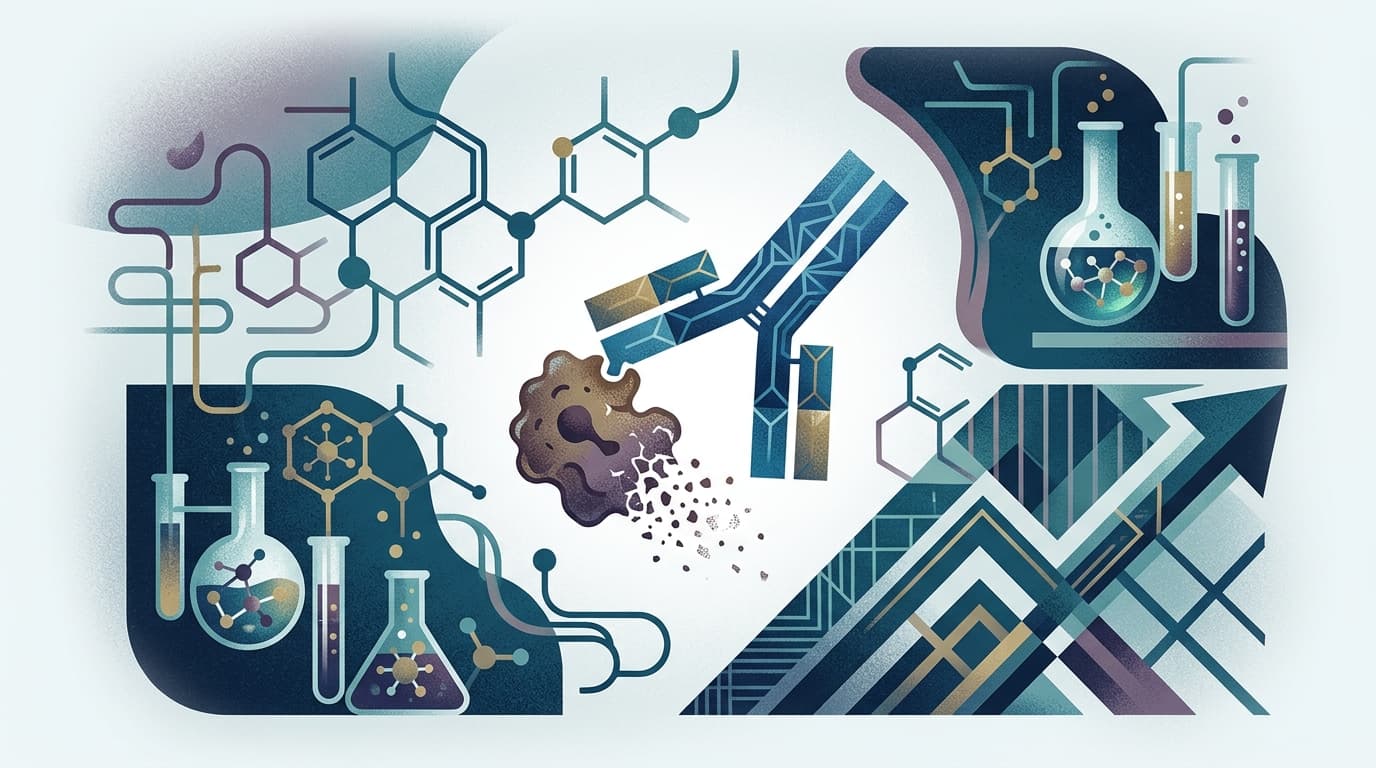

Akari Therapeutics just partnered with WuXi XDC to manufacture its cancer drug, right as Washington tightens the screws on Chinese biotech. The preclinical data looks promising, but the geopolitical math is anything but simple.
Most biotechs try to avoid controversy. Akari Therapeutics just leaned into it.
On April 6, the tiny Nasdaq-listed company announced a partnership with WuXi XDC, the Chinese contract manufacturer that's become something of a political lightning rod in Washington. The goal: develop and manufacture Akari's lead antibody-drug conjugate (ADC) for cancer. The timing? Let's just say it's bold.
The BIOSECURE Act became law in December 2025, giving the U.S. government new powers to restrict American companies from working with Chinese biotech service providers deemed national security risks. WuXi's parent entities have been at the center of that debate for years. And here's Akari, a company that only pivoted into oncology about 18 months ago, choosing this partner to help bring its first cancer drug to patients.
So what's going on?
To understand the deal, you need to understand Akari's wild reinvention. Until late 2024, this was a company focused on autoimmune and inflammatory diseases. Its lead asset, nomacopan, targeted complement activation and inflammation. Think rare blood disorders and eye diseases, not tumors.
Then the company pivoted. Hard. By November 2024, Akari had rebranded itself as an "oncology-focused biotechnology company" built around a novel payload technology called PH1. If you think of an ADC as a guided missile (an antibody that finds the cancer cell, attached to a toxic drug that kills it), the payload is the warhead. PH1 works by disrupting the spliceosome, the molecular machinery that cancer cells use to read their own genetic instructions. Mess that up and the cell produces garbled proteins, triggering its own death while also waving a red flag to the immune system.
In preclinical studies, Akari's lead candidate AKTX-101, which targets a protein called Trop-2 on tumor cells, showed superior tumor shrinkage and even complete remissions compared to other ADCs. The company is aiming to file an IND (the application that lets you start testing in humans) by late 2026, with a Phase 1 trial in metastatic urothelial cancer (advanced bladder cancer) potentially starting by early 2027.

Novo Nordisk launched a higher-dose Wegovy at $399 per month, undercutting Eli Lilly's Zepbound by 40% and igniting an all-out pricing war in the obesity drug market. With subscription plans as low as $249/month and 20.7% weight loss in trials, the GLP-1 landscape is being rewritten in real time.


Join thousands of biotech professionals who start their day with our free, daily briefing.
Akari also has a second program, AKTX-102, targeting a protein called CEACAM5 across pancreatic, colon, lung, and stomach cancers. That one's still earlier stage.
This is where it gets interesting. WuXi XDC isn't just any contract manufacturer. It's one of the biggest ADC specialists on the planet, holding roughly 22% of the global bioconjugate manufacturing market. The company operates as a joint venture between WuXi Biologics and WuXi STA, with GMP facilities that can handle everything from antibody production (up to 2,000-liter bioreactors) to conjugation, fill-and-finish, and quality control. It won "Best CDMO" at the World ADC Awards three years running.
For a small biotech like Akari, that kind of infrastructure is like renting a Formula 1 pit crew instead of trying to change your own tires. You get world-class manufacturing without building your own factory. WuXi XDC's CEO Jimmy Li highlighted the company's ADC expertise, while Akari's CEO Abizer Gaslightwala called the partnership a "major milestone" validating the PH1 technology.
No financial terms were disclosed, which is standard for these kinds of CDMO deals.
But there's a reason this partnership raised eyebrows. The BIOSECURE Act, signed into law as part of the FY2026 National Defense Authorization Act, was designed to limit U.S. government contractors and federal funding recipients from working with designated "biotechnology companies of concern" (BCCs). The original drafts of the bill explicitly named WuXi AppTec and WuXi Biologics.
The final version, however, removed specific company names. Instead, it created a process: the Office of Management and Budget has until roughly December 2026 to publish a formal BCC list. Companies already on the Department of Defense's "Section 1260H" list of Chinese military companies (which currently includes BGI Group and MGI, but not WuXi entities) face immediate restrictions. Others designated through the OMB process would get a five-year wind-down period for existing contracts.
So as of right now, WuXi is not officially designated as a company of concern. But the risk isn't zero. The DoD updates its 1260H list periodically, and OMB's designation process is still playing out. If WuXi lands on either list, Akari could find itself scrambling to relocate its entire manufacturing relationship.
Akari isn't alone in making this bet. Across the industry, biotech companies are doing the geopolitical math and arriving at different answers. Some smaller biotechs have publicly announced supply chain shifts away from China, using it as a selling point for investors. Larger firms have been more ambiguous, "reoptimizing" their chains without fully divesting.
The core tension is simple: the ADC market is booming, with projections ranging from $14 to $18 billion in 2026 and forecasts reaching as high as $39 billion by 2035. Six ADC products crossed the billion-dollar sales mark in 2025. There are over 530 ADC candidates in development globally, with 21 already approved. And WuXi XDC is one of the best in the world at making them.
For a company like Akari, which is pre-clinical and racing to file an IND, speed matters enormously. Finding an alternative manufacturer with comparable ADC expertise would take time, and time is the one thing small biotechs never have enough of.
There's a reasonable case for this deal. WuXi isn't currently designated. The OMB list isn't out yet. The BIOSECURE Act primarily targets companies with federal contracts or funding, and Akari (as a small, commercially pre-revenue biotech) may not be directly affected even if WuXi does end up on the list. The five-year wind-down provision for newly designated BCCs also provides a buffer.
But "reasonable" and "risk-free" aren't the same thing. If the political winds shift, or if WuXi gets added to the 1260H list before Akari's IND filing, this partnership could become a liability overnight. Investors watching this space should pay close attention to the OMB's timeline and the next DoD list update.
Akari's pivot from complement inhibition to cancer ADCs was already an audacious move. Partnering with WuXi in the current climate doubles down on that audacity. The preclinical data for AKTX-101 looks promising, and WuXi XDC's manufacturing chops are genuinely hard to match. But in biotech, the science is only half the battle. Sometimes the biggest risks aren't in the lab; they're in the headlines.
Gilead just paid $45 million to license a cancer drug that doesn't block bad proteins; it destroys them entirely. The Kymera Therapeutics deal could be worth up to $750 million, and it's part of a much bigger bet on protein degradation reshaping oncology.