These AI-Built Proteins Sit Quietly Until They Smell Trouble
An international team just published AI-designed proteins that sit dormant until they detect a specific molecular target, then snap to life like programmable switches. The implications for diagnostics, drug delivery, and precision medicine are enormous, and the framework is what really changes the game.
A Protein That Thinks Before It Acts
Imagine a smoke detector that only turns on when there's actually a fire. No false alarms at 3 a.m. because you burned toast. No blaring sirens when you open the oven. It just sits there, silent and inert, until the exact moment it's needed.
That's essentially what an international team of researchers just built, except at the molecular level. Published in Nature Biotechnology, their paper describes AI-designed proteins that act like programmable sensors, lying dormant until they detect a specific target molecule. When the right signal shows up, the protein flips on like a light switch. When the signal disappears, it goes dark again.
The study, led by Kirill Alexandrov at Queensland University of Technology, brought together seven research teams across Australia, the U.S., and the U.K. Among the collaborators: David Baker's legendary Institute for Protein Design at the University of Washington, which contributed the AI-designed binding domains that make the whole thing work.
How You Build a Molecular Smoke Detector
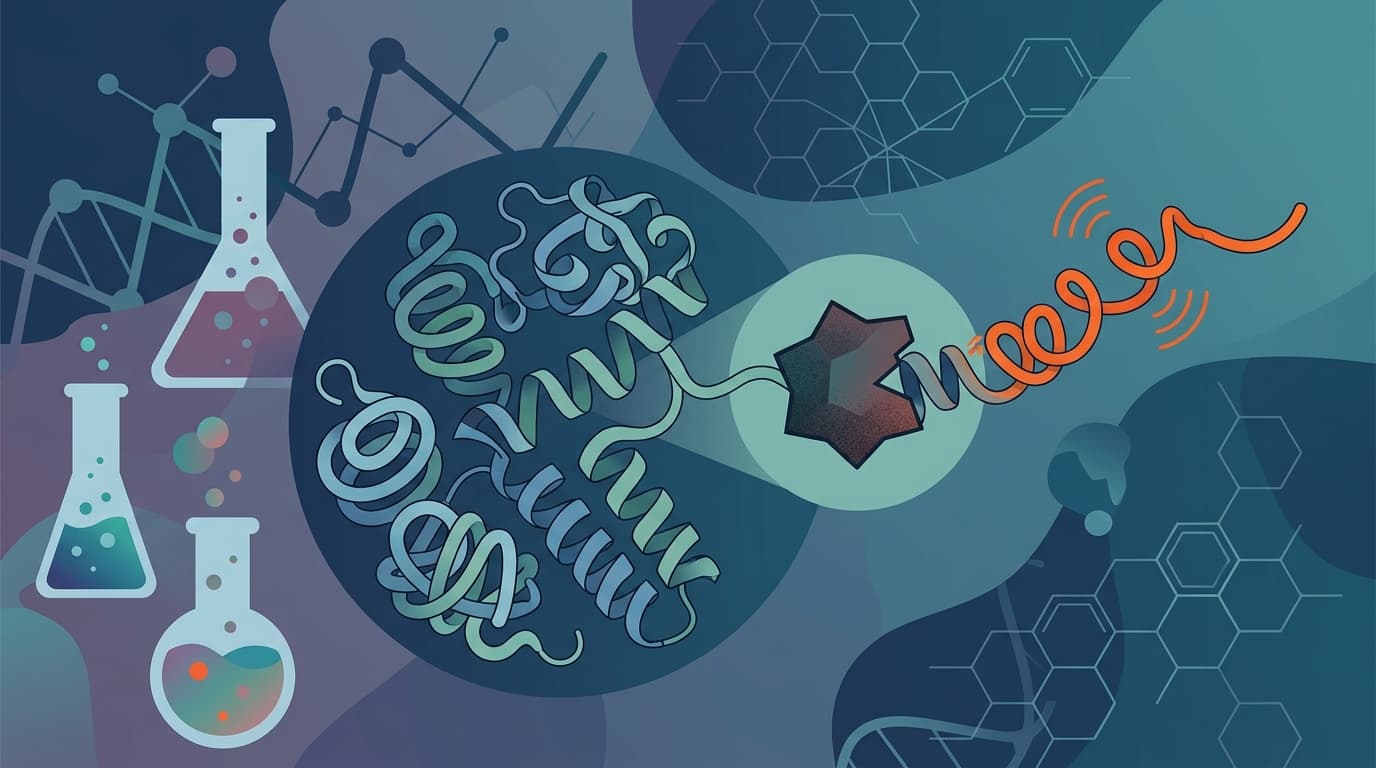
The core idea is surprisingly elegant. The team used machine learning to design tiny proteins (called binding domains) that grab onto specific molecules with high precision. Think of these as custom-built keyholes, each one shaped to fit exactly one molecular key.
They then fused those keyholes to reporter enzymes: proteins that produce a measurable signal, like a color change, a flash of light, or an electrical current. When the target molecule slots into its keyhole, the whole protein changes shape just enough to activate the reporter. No target? No signal. It's that simple.
What's clever about the mechanism is what it doesn't do. Most natural molecular sensors rely on big, dramatic shape changes to flip between "on" and "off" states. These AI-designed switches use something subtler: entropy-driven activation. The binding domains are rigid, single-state structures. When the target binds, it reduces the protein's conformational wiggle room, and that reduction alone is enough to trigger the output. It's like tightening a guitar string; the structure doesn't change much, but the behavior changes completely.
Get tomorrow's biotech intelligence before your competitors.
Join thousands of biotech professionals who start their day with our free, daily briefing.
The Numbers That Matter
The performance is genuinely impressive. Some of these switches achieved dynamic ranges exceeding 200-fold, meaning the difference between the "off" signal and the "on" signal was enormous. In sensor design, that's the difference between squinting at a maybe and seeing a flashing neon sign.
The team didn't stop at test tubes, either. They wired their protein sensors to graphene electrodes and built electrochemical devices that detected steroid hormones at sub-nanomolar concentrations. For context, that's like finding a single sugar cube dissolved in an Olympic swimming pool. These devices were reusable, too, which matters a lot if you're thinking about real-world diagnostics.
Perhaps most impressively, the switches worked inside living cells. When expressed in E. coli bacteria, the steroid-sensing proteins gave those cells steroid-dependent antibiotic resistance. The bacteria essentially became programmable living sensors, surviving or dying based on whether a specific hormone was present.
Why This Isn't Just Another Cool Paper
The real breakthrough here isn't any single sensor. It's the framework. The team built what amounts to a modular design pipeline: pick your target molecule, use AI to design a binding domain for it, plug that domain into the reporter system, and you've got a new sensor. The inputs and outputs are programmable. The architecture is reusable.
That modularity opens doors across multiple industries. In diagnostics, imagine a single handheld device (think glucose meter) that swaps protein cartridges to test for different diseases: cortisol today, a cancer biomarker tomorrow, a pathogen next week. Because the design happens in silico, spinning up a new test could take weeks instead of years.
The team also demonstrated logic-gate behavior by combining multiple binding domains. That's the kind of specificity that precision medicine dreams about.
From Sensors to Smart Drugs
The implications stretch well beyond diagnostics. If you can build a protein that activates only when it detects a specific molecule, you can imagine swapping out the reporter enzyme for something therapeutic. A protease that opens a drug-loaded cage. An enzyme that converts an inactive prodrug into its active form. A signaling molecule that wakes up nearby immune cells.
In each case, the drug would sit inert throughout the body and activate only where the disease signature is present. It's the holy grail of targeted drug delivery: systemic safety with local potency.
Related work from David Baker's group has already shown this is more than theoretical. Their team built AI-designed switches that control IL-2 (a powerful immune signaling molecule), turning it off on demand with an effector molecule. They demonstrated a SARS-CoV-2 sensor that responded roughly 70 times faster than previous protein-based coronavirus tests.
The Catch (Because There's Always a Catch)
Before anyone starts planning their Nobel acceptance speech, some significant hurdles remain. Most of these sensors have been tested in diluted samples (around 5% serum), and performance tends to drop in the messy complexity of real blood or plasma. Matrix effects, as scientists call them, are the gap between a beautiful lab result and a reliable bedside test.
There's also the binder problem. Each new sensor needs a sequence-characterized binding protein for its target. You can't just grab any off-the-shelf antibody; you need precise structural data to feed the AI design pipeline. That adds time and cost to each new application.
And regulators haven't yet figured out how to evaluate algorithmically designed protein diagnostics. These aren't traditional antibody tests with decades of precedent. They're novel molecular architectures generated by machine learning, functioning in formats that don't fit neatly into existing regulatory boxes.
The Bigger Picture
This work sits at the intersection of two accelerating trends: AI-powered protein design and programmable biology. Over the past three years, tools like RFdiffusion and ProteinMPNN have transformed protein engineering from an artisanal craft into something closer to software development. Design a backbone. Generate a sequence. Validate with AlphaFold. Iterate.
The Nature Biotechnology paper shows that this pipeline can now produce proteins with sophisticated regulatory behavior, not just shapes that fold correctly. We've gone from "can AI design a protein that exists?" to "can AI design a protein that thinks?" The answer, increasingly, is yes.
Diagnostics will likely be the first commercial proving ground, because the risk profile is lower than injecting AI-designed proteins into patients. But the long game is much bigger: programmable molecular systems that sense, decide, and act. Biology as software, with proteins as the code.
The smoke detector analogy breaks down in one important way. Smoke detectors do exactly one thing. These proteins can be reprogrammed to do almost anything. And that's what makes this paper worth paying attention to.
Clinical & Regulatory4 min read
Zepbound Just Got a Secret Back Door to Cheaper Prices
Eli Lilly is now selling the highest doses of Zepbound in single-dose vials for $449 per month, roughly 60% cheaper than the standard auto-injector pens. It's a strategic play in a GLP-1 pricing war that's reshaping who can actually afford obesity drugs.