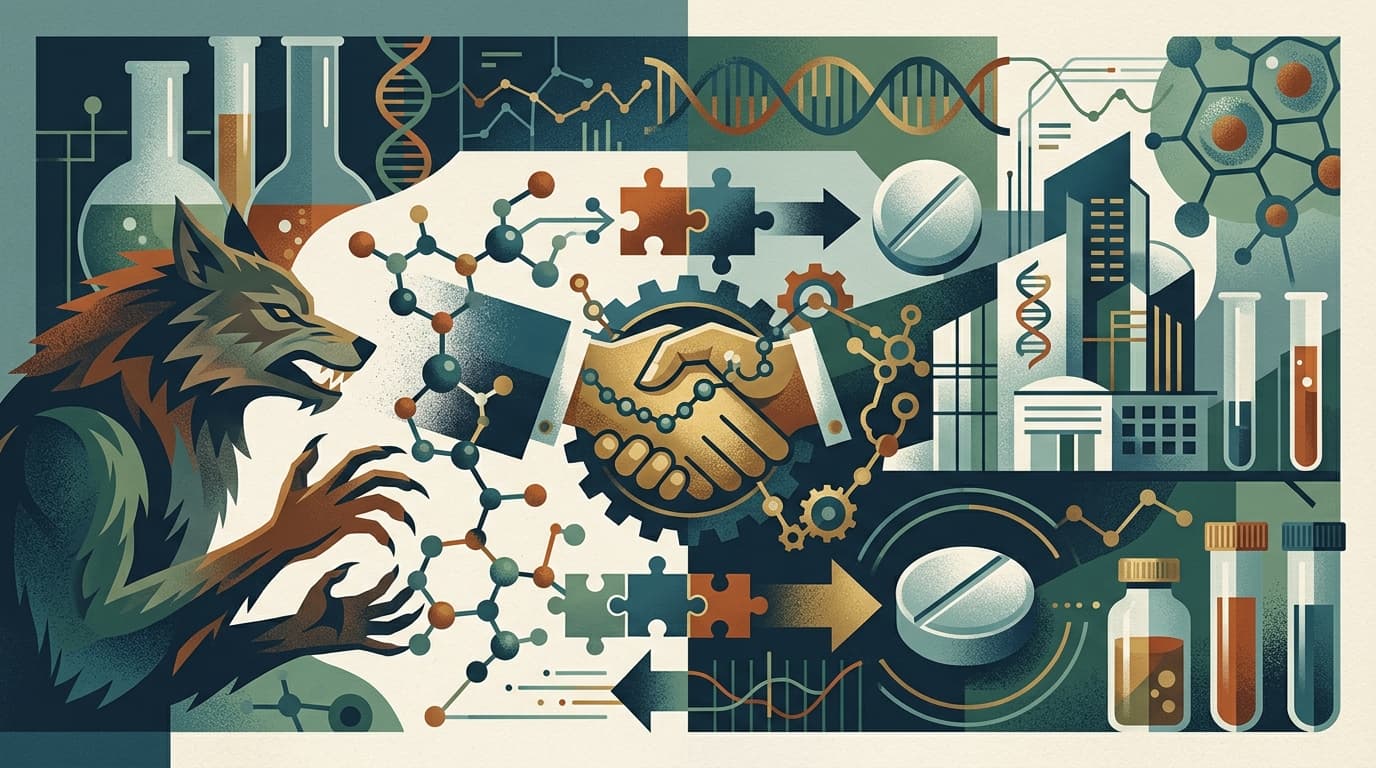

Werewolf Therapeutics just agreed to a $150 million reverse merger with Ambros Therapeutics, ditching cancer immunotherapy for a non-opioid painkiller. The deal was oversubscribed, the pivot is dramatic, and it's part of a much bigger trend reshaping how biotechs go public.
Imagine spending years training to become a surgeon, then one day announcing you're pivoting to become a pastry chef. That's roughly what just happened in biotech.
Werewolf Therapeutics, a company built around next-generation cancer immunotherapies, just agreed to merge with Ambros Therapeutics, a private company developing a non-opioid painkiller. The deal is an all-stock reverse merger that will transform Werewolf from an immuno-oncology shop into a pain management company trading under a completely new name and ticker.
It's one of the sharpest strategic pivots you'll see in biotech. And yet, investors are lining up to fund it.
The mechanics are straightforward, even if the strategy is surprising. Ambros will become a wholly owned subsidiary of Werewolf through an all-stock transaction. But make no mistake: Ambros is the one in charge here.
The ownership split tells you everything. Ambros stockholders will own roughly 71.7% of the combined company. Investors in the concurrent private placement (more on that in a second) will hold about 21.5%. And Werewolf's existing shareholders? They get just 6.8%.
That's the reverse merger playbook in action. The private company gets a public listing without the hassle of a traditional IPO. The public shell gets a reason to exist. Everyone shakes hands.
The combined company will operate as Ambros Therapeutics and trade on Nasdaq under the ticker AMBX. Werewolf's implied valuation in the deal is $47.5 million, while Ambros is valued at $500 million. If this were a merger of equals, it would need a much better disguise.
The financing package is what turns this from a curiosity into a credible story. Werewolf and Ambros secured $150 million in a concurrent private placement, and it was oversubscribed. Meaning: more investors wanted in than there was room for.
The roster reads like a who's who of healthcare investing. and co-led the round, with participation from Aberdeen Investments, Adage Capital Partners, Enavate Sciences (Patient Square Capital's platform), SilverArc Capital, Sphera Healthcare, Woodline Partners, and several others.

Sandoz just dropped up to $322 million on a licensing deal with Shanghai's Henlius Biotech for as many as ten biosimilar products. It's the latest power move in the company's post-Novartis strategy to dominate the global biosimilar market, and it says a lot about where Western pharma is finding its next blockbusters.


Join thousands of biotech professionals who start their day with our free, daily briefing.
The deal includes a minimum cash closing condition of $100 million, so the company won't close unless it has real funding secured. The transaction is expected to wrap up in Q1 2027.
Ambros' lead drug is neridronate, a bisphosphonate being developed for complex regional pain syndrome type 1, or CRPS-1. If you've never heard of CRPS, consider yourself lucky. It's a debilitating condition that typically follows a limb injury, causing severe, chronic pain that far outlasts the original trauma. Patients describe it as one of the most painful conditions in medicine.
Neridronate works differently from most pain drugs you've heard of. It's not targeting nerve signals the way Vertex's blockbuster Journavx (suzetrigine) does with sodium channels. Instead, it concentrates at the site of injury during the active inflammatory phase, where it reduces bone loss and inflammation. Think of it as calming the fire at its source rather than cutting the phone line that reports the fire.
The company is advancing neridronate into a pivotal Phase 3 trial called CRPS-RISE, designed to enroll about 270 patients with warm-type CRPS-1. Enrollment was planned to begin in Q1 2026, with topline data expected in 2028.
Werewolf's backstory makes this pivot less surprising than it first appears. The company was founded in 2017 around its PREDATOR platform, which designed conditionally activated immunotherapies (cancer drugs that activate only in the tumor environment, reducing side effects). Its lead candidates, WTX-124 and WTX-330, targeted IL-2 and IL-12 pathways in solid tumors.
Cool science. Expensive science. And by late 2025, the math stopped working.
Werewolf disclosed that its cash wouldn't last beyond 2026 and began exploring "strategic alternatives," which is corporate code for "we need a lifeline." In February 2026, the company cut 64% of its workforce in a restructuring plan designed to preserve whatever runway remained. The writing wasn't just on the wall; it was in bold, underlined, and highlighted.
Werewolf isn't alone. Reverse mergers have become one of the hottest transactions in biotech, and 2026 is shaping up to be a banner year. By mid-2026, seven biotech reverse mergers had already raised roughly $1.9 billion in concurrent financing.
The deals keep getting bigger. Boundless Bio merged with Serapha Bio alongside a $230 million placement. Damora Therapeutics and Yarrow Bio closed reverse mergers in late 2025 with $285 million and $200 million in financing, respectively. Slate Medicines found its way to public markets through Fulcrum's shell.
The logic is simple: when the IPO window is selective and unpredictable, a reverse merger offers something founders crave. Certainty. You negotiate your valuation, lock in financing, and skip the roadshow roulette. The public shell provides the listing; the private company provides the pipeline. It's like buying a fixer-upper house for the address, then gutting everything inside.
The non-opioid pain market has a new king: Vertex's Journavx, which won FDA approval in January 2025 as the first new non-opioid pain medicine in over two decades. But Journavx is approved for acute pain, not the chronic, syndrome-specific condition Ambros is targeting.
That distinction matters. CRPS-1 is a niche indication with limited treatment options and desperate patients. If neridronate's Phase 3 data hold up, Ambros wouldn't be competing head-to-head with Vertex. It would be carving out its own territory in a space where patients currently have few good choices.
The pipeline for non-opioid pain is growing (Tris Pharma's cebranopadol, Eli Lilly's STC-004), but most competitors are targeting broader acute or chronic pain populations. Ambros' specificity could be a strategic advantage, or it could limit the drug's commercial ceiling. That's the bet investors are making with their $150 million.
A company named after mythical monsters is becoming a painkiller developer. The irony writes itself. But strip away the name and the narrative, and the deal structure is sound: a well-funded private biotech gets a public listing with $150 million in committed capital, backed by top-tier healthcare investors.
The real question isn't whether the merger makes sense (it does, for both sides). It's whether neridronate can deliver the Phase 3 data to justify a $500 million valuation. We won't know until 2028. Until then, the werewolf has officially hung up its fangs.
Capricor's cell therapy for Duchenne muscular dystrophy faces a likely FDA rejection after advisors voted 9-to-3 against it, and activist investor Kaos Capital is simultaneously demanding a full boardroom overhaul. It's a two-front war that could determine the company's survival.