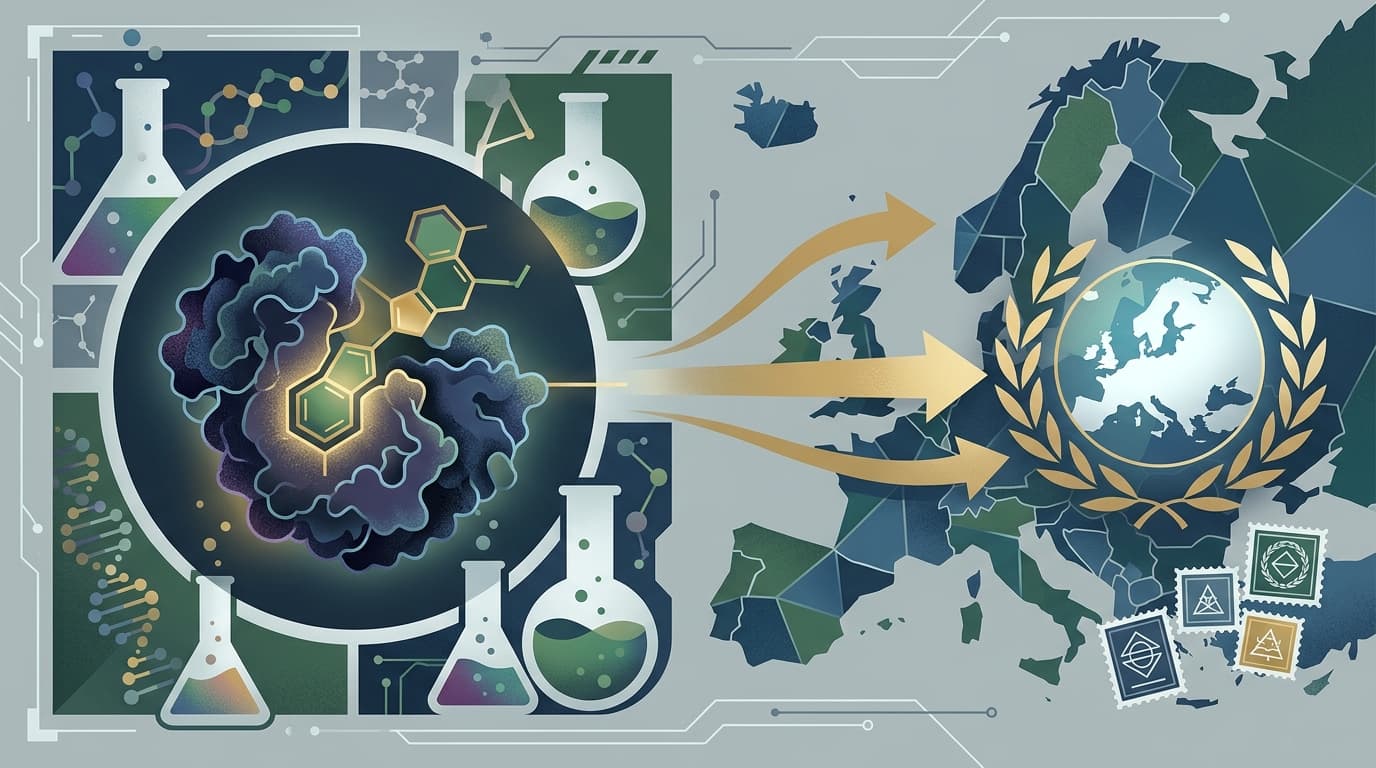

For 40 years, scientists called KRAS "undruggable." Now European regulators have recommended approval of the first broad KRAS inhibitor for pancreatic cancer, a disease where most patients survive less than a year. The clinical data is turning heads on both sides of the Atlantic.
For four decades, scientists had a name for KRAS: undruggable. Mutations in the broader RAS family of proteins drive roughly a quarter of all human cancers, and nobody could figure out how to shut them off. It was like trying to pick a lock with no keyhole. Researchers identified KRAS as a cancer-causing gene back in the early 1980s, and for the next 30-plus years, every attempt to target it directly came up empty.
That changed in 2013, when a lab at UCSF found a hidden pocket on one version of the protein. The floodgates opened. By 2021 and 2022, the first two KRAS-targeting drugs (sotorasib and adagrasib) earned FDA approval. But those drugs only worked on one specific KRAS mutation, called G12C, which is most common in lung cancer.
Pancreatic cancer? Still waiting.
Until now.
On October 15, 2026, European regulators handed Revolution Medicines a milestone that would've seemed like science fiction a decade ago. The CHMP (the committee that recommends drug approvals in Europe) issued a positive opinion for Rasonque, the company's oral, once-daily RAS GTPase family inhibitor, for adults with metastatic pancreatic cancer who've already tried at least one other treatment.
A CHMP positive opinion isn't technically final approval; it still needs a rubber stamp from the European Commission. But that step is largely a formality. When the Commission signs off, Rasonque will be available across EU member states plus Iceland, Norway, and Liechtenstein.
This comes less than two months after the FDA approved Rasonque on August 26, 2026, making it the first approved drug from Revolution Medicines' RAS(ON) inhibitor platform. The transatlantic one-two punch is rare, and it signals just how strong the clinical data looked to regulators on both sides of the ocean.
Pancreatic cancer is the disease that humbles oncology. About 80% of patients are diagnosed with advanced disease, far too late for surgery. In the UK, average life expectancy at diagnosis sits at a brutal . Five-year survival for metastatic patients? Roughly .

Daiichi Sankyo and Merck pulled their FDA application for a promising lung cancer ADC before the agency could reject it. The move reveals a tougher regulatory landscape for accelerated approvals and reshuffles the competitive race in small cell lung cancer.


Join thousands of biotech professionals who start their day with our free, daily briefing.
The standard treatments, FOLFIRINOX and gemcitabine plus nab-paclitaxel, extend life compared to older options but remain far from transformative. Patients cycle through toxic chemotherapy regimens with modest gains. The unmet need here isn't just large; it's enormous.
So when Revolution Medicines reported results from its Phase 3 RASolute 302 trial, the numbers turned heads.
Rasonque didn't just nudge the needle. In the pivotal trial comparing it to chemotherapy, the drug showed a 60% reduction in the risk of death, with a hazard ratio of 0.40 across the full study population. To put that in everyday terms: patients on Rasonque were dying at less than half the rate of patients on standard chemo.
Reuters described the effect as nearly doubling survival versus chemotherapy. In a disease where gains are usually measured in weeks, that's seismic. It's the kind of result that gets regulatory agencies moving fast, and clearly, they did.
What makes Rasonque (generic name: daraxonrasib) different from earlier KRAS drugs like sotorasib and adagrasib? Think of it like this.
The first-generation drugs were snipers. They targeted one very specific KRAS mutation (G12C) only when the protein was in its "off" state, the inactive, GDP-bound form. That strategy worked in lung cancer, where G12C is relatively common. But in pancreatic cancer, G12C isn't the dominant mutation. The earlier drugs were aiming at the wrong target.
Revolution Medicines took a different approach with its RAS(ON) platform. Instead of waiting for KRAS to switch off, these inhibitors bind the protein while it's actively signaling (the GTP-bound, "on" state). And rather than locking onto just one mutation, they're designed to suppress multiple KRAS variants at once. It's the difference between a sniper rifle and a smart shotgun: broader coverage, aimed at the protein when it's actually causing damage.
That broader approach matters enormously in pancreatic cancer, where KRAS mutations are nearly universal but come in several flavors.
Revolution Medicines priced Rasonque at $39,800 per month in the U.S. (wholesale acquisition cost), which works out to roughly $477,600 per year before discounts and rebates. Some analysts had expected a price tag in the $25,000 to $30,000 monthly range, so the actual number came in higher than anticipated. Jefferies analyst Faisal Khurshid estimated the net price (after payer negotiations) would land around $28,000 to $32,000 per month.
European pricing hasn't been disclosed yet and will be negotiated country by country once the European Commission grants formal approval. The company plans to commercialize Rasonque directly in Europe rather than licensing it to a partner, a sign of confidence in the drug's market potential.
For 2026, Wall Street is modeling partial-year U.S. launch revenue as prescriber adoption ramps up. The real inflection point could come in 2027, when a full year of U.S. sales combines with the start of European reimbursement. The addressable population is substantial: pancreatic cancer with limited treatment options and almost universal KRAS involvement.
Rasonque's approval validates something the field has been betting on for years: that next-generation KRAS drugs, ones that go beyond G12C and target the active protein, can deliver meaningful clinical benefit in cancers that first-generation inhibitors couldn't touch.
The competitive landscape is heating up fast. Multiple companies are chasing KRAS G12D-selective inhibitors, pan-KRAS agents, and combination strategies pairing KRAS drugs with other targeted therapies or immunotherapy. Resistance remains a challenge (just as it was for sotorasib and adagrasib), and the field knows that combinations will likely be needed to keep patients responding longer.
But for right now, Revolution Medicines is first across the finish line in pancreatic cancer. They cracked a target that the entire industry called impossible, brought it to patients in one of oncology's hardest-to-treat diseases, and got regulators on two continents to agree within weeks of each other.
Forty years of "undruggable." That word needs a new definition.
Bristol Myers Squibb is dropping $1.5 billion in cash on Orbital Therapeutics, a preclinical-stage startup with zero approved drugs and zero revenue. The bet says everything about Big Pharma's platform fever and the desperate race to fill patent cliffs.