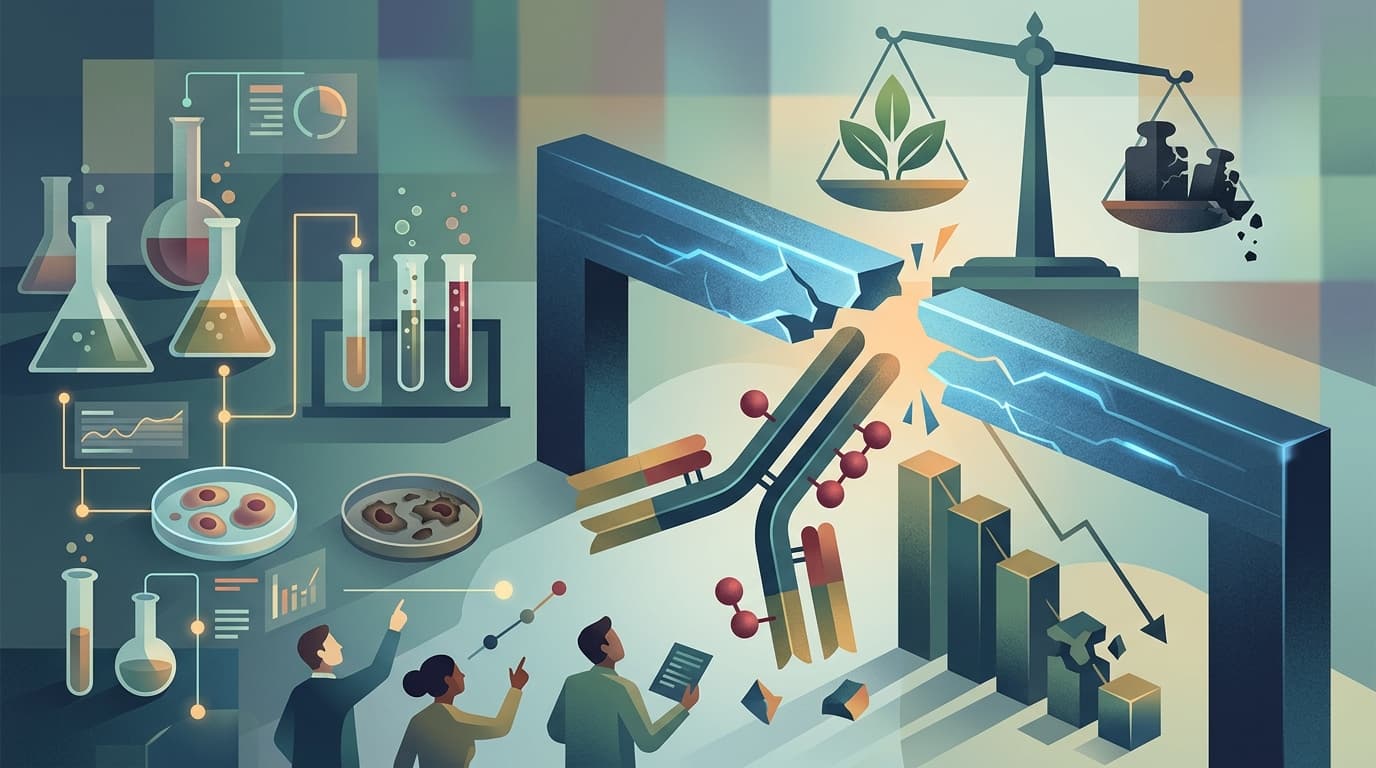
Daiichi Sankyo and Merck pulled their FDA application for a promising lung cancer ADC before the agency could reject it. The move reveals a tougher regulatory landscape for accelerated approvals and reshuffles the competitive race in small cell lung cancer.
Imagine training for the Olympics for years, only to scratch from the event the day before because you know you won't qualify. That's essentially what just happened to one of the most-watched cancer drugs in biotech.
Daiichi Sankyo and Merck voluntarily withdrew their U.S. application for ifinatamab deruxtecan (I-DXd) in small cell lung cancer, pulling the plug before the FDA's October 10 decision date. The reason? After talking it through with regulators, the companies concluded their data simply weren't strong enough for approval.
It's a bruising moment for two pharma heavyweights and a reality check for the red-hot antibody-drug conjugate (ADC) space.
What Actually Happened
Let's back up. Daiichi Sankyo and Merck had filed a Biologics License Application (basically, the formal "please approve our drug" paperwork) seeking accelerated approval for I-DXd in adults with extensive-stage small cell lung cancer (ES-SCLC) whose tumors had progressed after platinum-based chemotherapy. Think of accelerated approval as a fast lane: the FDA lets a drug onto the market based on early evidence that it's likely to help, before a massive confirmatory trial is finished.
The problem is that "likely to help" still requires convincing evidence. And the FDA looked at the data from the Phase 2 IDeate-Lung01 trial and said, in effect, "not enough."
So rather than face a formal rejection, Daiichi Sankyo and Merck withdrew the application themselves. It's the biotech equivalent of pulling your college application before you get denied: the outcome is the same, but the optics are slightly less painful.
Decent Data, But Not Decent Enough
The frustrating part? The drug actually showed real activity. In the IDeate-Lung01 trial, the 12 mg/kg dose produced a confirmed response rate of 48.2% across 137 patients, with nearly 88% of patients experiencing some degree of disease control. In a smaller cohort of 42 patients at the same dose, the response rate was even higher: 54.8%.
Get tomorrow's biotech intelligence before your competitors.
Join thousands of biotech professionals who start their day with our free, daily briefing.
For small cell lung cancer, a notoriously vicious disease where second-line options are scarce, those numbers aren't bad at all. Patients on the 12 mg/kg dose had a median progression-free survival of 5.5 months and median overall survival of 11.8 months.
But the FDA isn't grading on a curve. The agency needs to be convinced that the surrogate endpoint (in this case, response rate) is reasonably likely to predict genuine clinical benefit. A mid-stage trial with moderate durability of response, where the median duration of response was just 5.3 months, apparently didn't cross that threshold.
In other words: the drug shrank tumors, but the shrinkage didn't last long enough to persuade the FDA it was truly changing the game.
The Accelerated Approval Bar Is Getting Higher
This withdrawal didn't happen in a vacuum. Over the past few years, the FDA has been tightening the screws on accelerated approvals in oncology, and the trend accelerated (pun intended) after Congress passed the FDORA legislation.
The new rules give the agency expedited procedures to yank approvals when confirmatory trials fail. The FDA now expects that confirmatory studies should be well underway at the time of filing, and it has signaled a clear preference for stronger evidence packages, including randomized trials where feasible.
For years, single-arm trials (studies with no comparison group) were a reliable ticket to accelerated approval in cancer. You showed a high response rate, promised to run a bigger trial later, and got your drug on the market. That playbook is getting harder to run. The FDA still allows it, but the bar for what counts as "persuasive" keeps rising.
Think of it like a credit score. The minimum to qualify technically hasn't changed, but lenders are scrutinizing applications more carefully. A borderline score that would have gotten you approved five years ago might not cut it today.
Why This Hurts More for Daiichi Sankyo
Merck will feel this as a sting, not a wound. Ifinatamab deruxtecan is a partnered pipeline asset for them, not a core revenue driver. Their stock might dip modestly, but the company's broader oncology franchise (hello, Keytruda) provides plenty of cushion.
For Daiichi Sankyo, the calculus is different. The Japanese pharma giant has staked its entire transformation story on the DXd ADC platform. Their blockbuster Enhertu (a HER2-targeted ADC) and Datroway (a TROP2-targeted ADC) are both commercially marketed, but the company needs the rest of the pipeline to deliver if it wants to justify its ambitions as a global oncology leader.
I-DXd was supposed to be one of those next chapters. The BLA withdrawal doesn't kill the program; the Phase 3 IDeate-Lung02 trial is still enrolling. But it pushes the timeline out considerably, transforming what could have been a 2026 launch into something that's years away.
In a competitive race, voluntarily dropping out of the sprint means everyone else gains ground.
The SCLC ADC Race Is Far From Over
And make no mistake: this race is crowded. Small cell lung cancer has become one of the hottest battlegrounds in oncology, with multiple companies chasing ADC approaches across different targets.
DLL3 is the most popular target, partly because Amgen's tarlatamab (a bispecific T-cell engager, not an ADC) validated the biology. Now several companies are trying to prove that an ADC aimed at the same target can do even better. IDEAYA's IDE849 is prepping a Phase 3 trial that's designed to include patients who've already been treated with tarlatamab, essentially betting that an ADC can clean up where the bispecific leaves off.
B7-H3 is another target gaining serious traction. GSK has a late-stage ADC (risvutatug rezetecan, also known as GSK5764227) in relapsed ES-SCLC, with orphan drug momentum signaling that the company sees a real path to approval.
Then there's AbbVie's ABBV-706, targeting SEZ6, which posted an eye-catching 82% response rate in a small cohort of relapsed/refractory SCLC patients. That program is already in a randomized Phase 2 study for untreated extensive-stage disease.
The takeaway: ifinatamab deruxtecan's stumble doesn't mean ADCs can't work in SCLC. It means this particular evidence package at this particular time wasn't convincing enough. Other programs with different targets, different data, or bigger trials could still succeed.
What Happens Next
The Daiichi Sankyo/Merck partnership isn't falling apart over this. Both companies confirmed that the Phase 3 IDeate-Lung02 trial continues, and they'll keep evaluating the drug's potential. If that larger, randomized study delivers strong results, a future filing on more solid ground is entirely possible.
But the opportunity cost is real. An accelerated approval would have meant revenue in 2026 or 2027, commercial experience with the drug, and a head start on building a market presence before rivals arrive. All of that advantage has evaporated.
For investors, the signal is clear: the FDA is not handing out accelerated approvals like participation trophies anymore. Phase 2 data with moderate durability, even in a desperate-need cancer, may not be enough. Companies will increasingly need to show up with either jaw-dropping response rates or robust confirmatory data already in hand.
The Bigger Picture
ADCs are still the most exciting drug class in oncology. Enhertu has proven the concept works brilliantly in the right setting. But the I-DXd withdrawal is a reminder that even the most powerful platform technology doesn't guarantee smooth regulatory sailing.
Not every arrow in the quiver will hit the target. Daiichi Sankyo's DXd platform has produced genuine winners, but it's also facing the natural growing pains of a company trying to expand one technology across a dozen different cancers and targets. Some of those bets will pay off handsomely. Others, like this one (at least for now), will require more patience.
The ADC revolution isn't over. But the era of easy approvals might be.
Clinical & Regulatory5 min read
Novartis Just Pulled the Plug on Fabhalta's Biggest Ambition
Novartis quietly killed its mid-stage Fabhalta trial in lupus nephritis, citing only "strategic considerations." The $505 million drug is thriving in other kidney diseases, but its biggest expansion play just evaporated, and the company isn't explaining why.