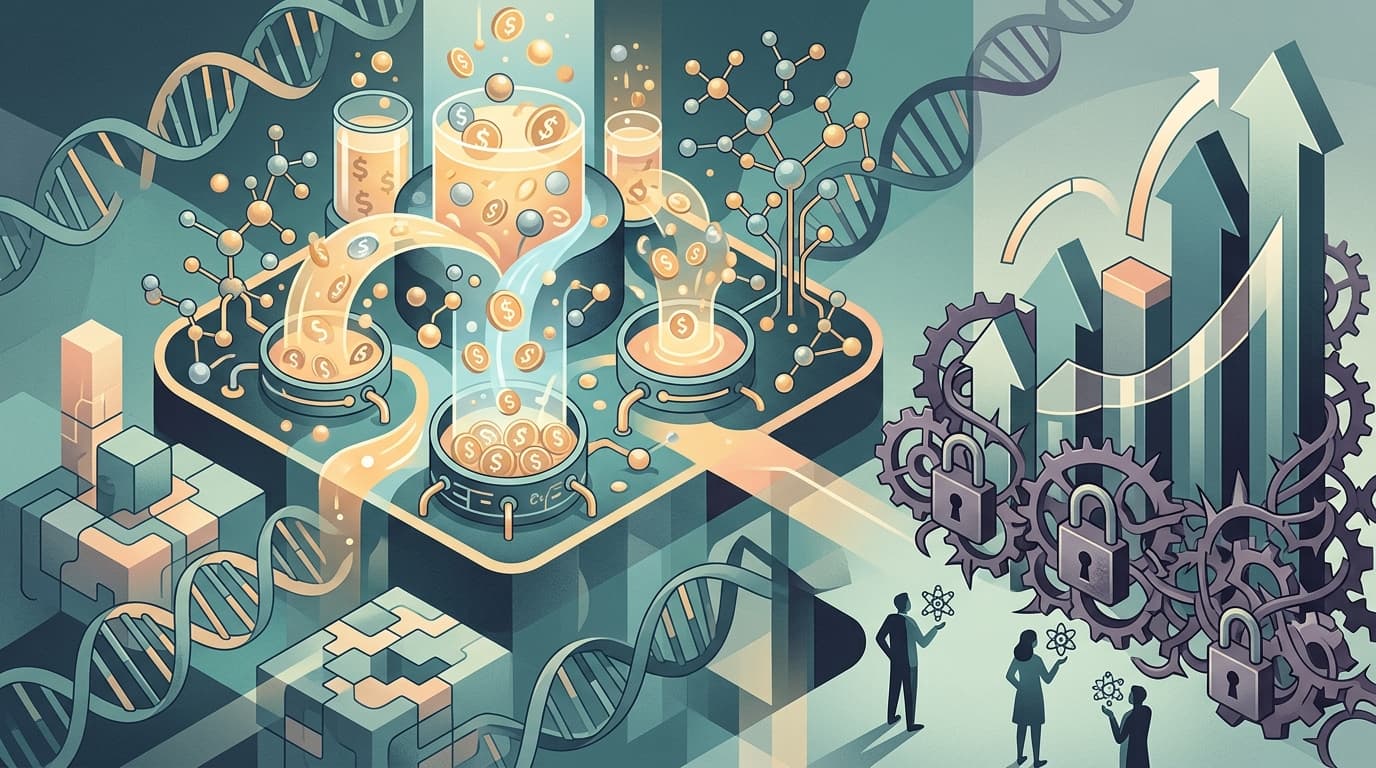

UK biotech raised over half a billion pounds in Q1 2026, with venture capital surging 17% quarter-over-quarter. But zero companies have gone public. The disconnect between a thriving private market and a dead IPO scene tells a bigger story about where British biotech is headed.
Imagine throwing a party where everyone shows up with bottles of champagne, but nobody will pop a cork. That's the UK biotech scene right now: private investors are pouring money in, yet the public markets sit in total silence. Not a single British biotech has gone public in 2026.
Zero IPOs. In a country that claims to want the best life sciences sector in Europe by 2030.
The numbers on the private side tell a different story entirely. UK biotech companies pulled in £552 million in total equity financing during Q1 2026, an 18% jump from the previous quarter's £466 million. Venture capital accounted for a staggering 93% of that total, hitting £516 million across 25 deals. The BioIndustry Association called it a "sustained recovery," and frankly, the data backs them up.
So why the split personality? Private money says "go." Public markets say "absolutely not."
London's AIM market (the stock exchange where smaller, growth-stage companies typically list) has become a ghost town for biotech. The last meaningful UK biotech IPO was Exscientia's 2021 listing, and that one happened on Nasdaq, not in London. Since then? Crickets.
The reasons aren't mysterious; they're structural. AIM simply can't compete with the depth of American capital markets. Nasdaq offers more investors, bigger checks, and a community of analysts who actually understand biotech risk. UK management teams know this, which is why even European success stories like Agomab Therapeutics chose to list on Nasdaq in early 2026, raising $200 million in the process.
It's a bit like being a talented musician in a small town. Sure, you could play the local pub. But if Nashville is calling, you pack your bags.
The private investment picture deserves a closer look, because the headline numbers can be misleading.
Q1 2025 saw £924 million in total financing, which makes Q1 2026's £552 million look like a step backward. But that earlier figure was heavily inflated by a couple of megadeals (think Verdiva Bio and Isomorphic Labs) that skewed everything. Strip those out, and Q1 2026 actually shows spread across more companies.

Eli Lilly's new obesity pill Foundayo logged just 1,390 prescriptions in its first week, sending shares down 2% while rival Novo Nordisk climbed. But history says blockbuster drug launches almost never start with a bang, and the real test comes on April 30.


Join thousands of biotech professionals who start their day with our free, daily briefing.

That's the key detail. Deal count jumped 67% year-on-year, with 25 separate rounds in Q1 2026 compared to the prior year. Average deal sizes are smaller, but the money is reaching more startups at more stages. Think of it as the difference between one person buying the entire bar a round versus twenty people each buying their own drinks: the second scenario means a lot more people are actually drinking.
The UK also punches above its weight in European context. British biotechs captured 57% of all European biotech venture capital in Q1 2026. That's not a rounding error; that's dominance.
Before we pile on London too much, it's worth noting that the IPO window worldwide is only cracked open, not flung wide. The U.S. saw at least 12 biotech IPOs in all of 2025. Early 2026 brought some encouraging signs (four major listings raised roughly $1 billion combined), but access remains restricted to companies with late-stage clinical data and clear paths to profitability.
The median U.S. biotech IPO size in Q1 2026 hit $287.5 million, more than double the 2025 figure. Translation: only the big kids get to play. Preclinical companies haven't successfully gone public since 2024. If you don't have meaningful clinical results, public investors don't want to hear from you.
Analysts predict 30 to 35 global biotech IPOs for the full year. That's a recovery from the bottom, sure, but it's a far cry from the 2021 boom when companies could practically IPO on a napkin sketch and a dream.
The UK government launched its Life Sciences Sector Plan in July 2025, pledging over £2 billion in initial funding with ambitions to make Britain Europe's leading life sciences economy. The plan includes faster clinical trial setup (under 150 days), up to £520 million for manufacturing, and streamlined regulatory pathways through the MHRA.
Some of these moves are already creating ripple effects. British Patient Capital has committed £160 million to six UK life sciences venture funds and invested £89 million directly into 11 growth-stage companies. Pension funds are starting to participate too, a structural shift that could unlock enormous pools of patient capital. The British Growth Partnership Fund I hit a £200 million first close involving UK pension funds, marking real progress under the Mansion House Accord.
But policy alone can't fix a broken public market. When Merck pulled £1 billion in expansion plans from London in 2025, it sent a clear signal that government enthusiasm doesn't automatically translate into corporate confidence. And the UK still trails the U.S. and China significantly in total venture financing, despite leading within Europe.
The optimists see a tipping point approaching. Some experts have predicted at least two London biotech listings in 2026, though nothing has materialized yet. The macro backdrop is improving: the Nasdaq hit all-time highs, investor sentiment is warming, and a UK-U.S. pharmaceutical trade deal has added tailwinds.
The pessimists (or realists, depending on your perspective) point out that the fundamental problem hasn't changed. Why would a UK biotech endure the limitations of AIM when Nasdaq offers a deeper pool and better valuations? Until London can offer something genuinely competitive, the best British biotechs will keep doing what Exscientia did five years ago: list in America.
The money is there. The science is there. The companies are there. What's missing is a public market that can match the ambition. Until that changes, the UK biotech story remains a tale of two halves: a thriving private ecosystem feeding into a public market that refuses to open its doors.
That champagne isn't going to pop itself.
Filspari just became the first FDA-approved treatment for FSGS, a rare kidney disease that's been without an approved therapy forever. The twist? The pivotal trial technically missed its main goal. How Travere pulled off the approval anyway is a story worth reading.