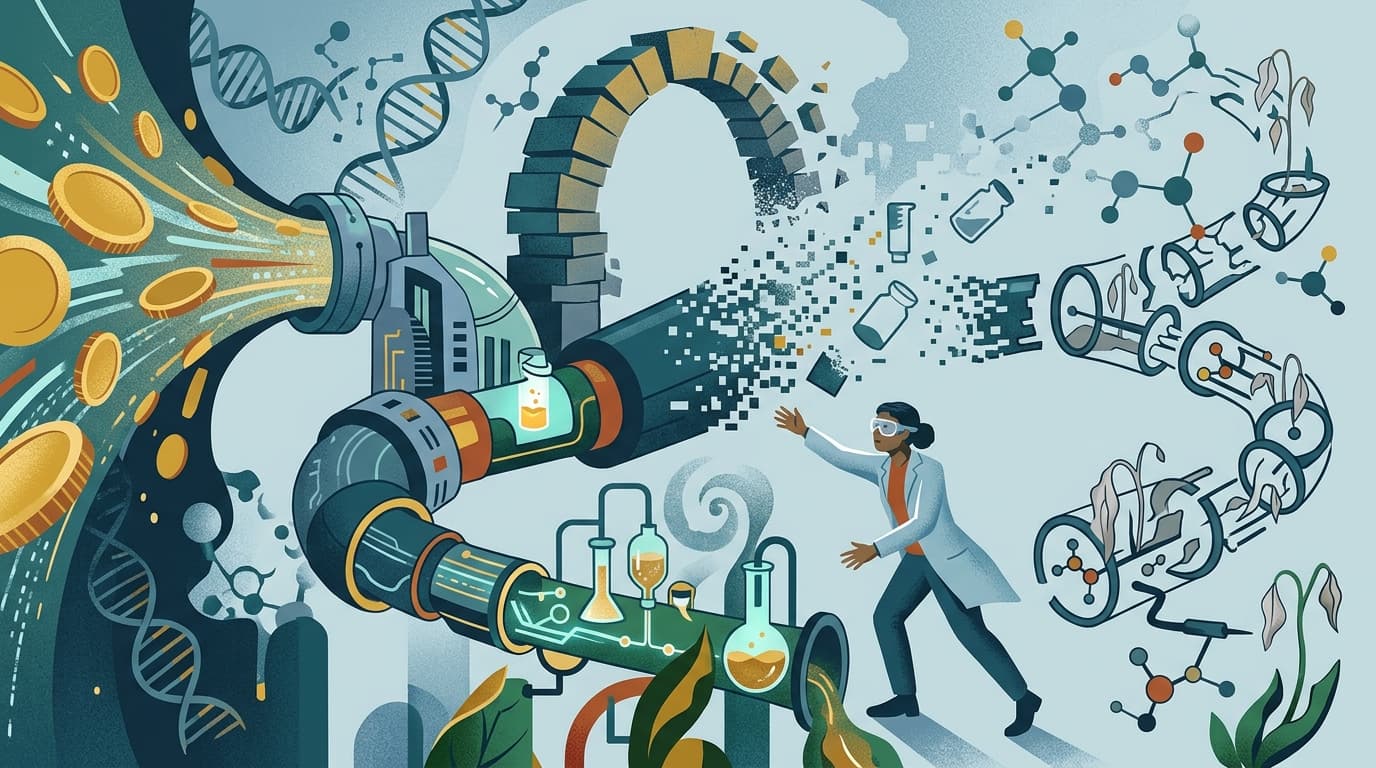

The Trump administration just used a rare budget trick to claw back nearly $1 billion in approved spending, and the biotech world is watching nervously. The move didn't directly hit NIH, but it sets a dangerous precedent for an industry whose innovation pipeline starts with federal grants.
Imagine you run a biotech startup. Your lead compound came from a university lab, funded by a federal grant, built on years of basic science nobody else would pay for. Now imagine the government deciding, with one procedural trick, to yank nearly $1 billion of that kind of money off the table.
That's not hypothetical. It just happened.
The Trump administration invoked something called a pocket rescission, a rare budget maneuver that lets the president ask Congress to cancel spending it already approved. Think of it like writing a check, handing it to someone, and then calling the bank to cancel it before they can cash it.
Under the Impoundment Control Act of 1974, the president can send Congress a rescission request and withhold the funds for up to 45 days while lawmakers decide. If Congress doesn't act, the money is supposed to be released. That's the law.
The catch? The administration timed this request near the end of the fiscal year, leaving Congress almost no practical window to respond before the funds expired. Critics say that turns a "request" into a de facto veto of spending Congress already authorized. The Government Accountability Office has previously said pocket rescissions like this are unlawful.
The biggest target was the Department of Health and Human Services, which absorbed somewhere between $547 million and $567 million of the total clawback (the exact figure varies by report, because some outlets tally the full package differently). Most of that HHS money was earmarked for refugee services, unaccompanied minor programs, and related grants.
Other agencies got hit too: $56 million from HUD's housing counseling programs, roughly $95 million from the Department of Education (split between migrant student programs and international education grants), $10 million from Commerce's Minority Business Development Agency, and in foreign debt relief tied to climate policies. The Justice Department and Homeland Security also took cuts, though specific dollar amounts weren't always detailed.

Eli Lilly just agreed to pay up to $2.875 billion for a four-year-old biotech with one Phase 1 drug and zero revenue. The deal is the latest in Lilly's multi-billion-dollar immunology shopping spree, and it says a lot about where big pharma thinks the next blockbusters will come from.


Join thousands of biotech professionals who start their day with our free, daily briefing.
The administration framed the whole package as cutting "wasteful" spending, arguing the money was no longer needed because border crossings had fallen. Congress, predictably, disagreed.
You might look at those line items and think: refugee services, housing counseling, migrant education. What does any of this have to do with drug development?
The answer is precedent.
This rescission didn't directly slash NIH's budget. But it lands in the middle of a sustained assault on federal research funding that has the biotech world on edge. The administration's FY2026 budget request proposed a 41% cut to NIH, roughly $19.6 billion stripped from the agency's approximately $48 billion budget. Congress rejected that proposal and kept NIH funding near prior levels, but the fight isn't over.
A competing Republican spending bill for HHS proposed a $7 billion cut (about 6% below 2025 levels), along with a 19% cut to the CDC and the complete elimination of AHRQ, the Agency for Healthcare Research and Quality. Meanwhile, thousands of NIH grants have already been terminated or frozen in the current cycle, with renewals running behind historical pace.
The rescission power is a tool. And once a tool works, it gets used again.
For people outside biotech, it's easy to underestimate how much of the drug industry's innovation starts with federal money. NIH grants fund the basic science: understanding disease mechanisms, identifying targets, running early proof-of-concept experiments. University researchers do the risky, unglamorous work that no venture capitalist would touch.
That academic research becomes the foundation for biotech startups. A professor discovers a new pathway; a company spins out to develop it; eventually a drug reaches patients. Cut the grants, and you're not just hurting professors. You're thinning the startup funnel, delaying clinical trials, and reducing the number of new therapies that reach the market five or ten years from now.
J. Craig Venter, one of the scientists who helped sequence the human genome, put it bluntly: cutting NIH budgets is like a biotech company slashing its own pipeline. He called it "a disaster for the U.S. economy." And leading cancer research organizations have warned that the president's budget could devastate the U.S. research enterprise.
These aren't fringe voices. They're the people who build the science that becomes your medicine.
The legal and political backlash has been bipartisan, which is notable in an era when almost nothing is. Senate Appropriations Chair Susan Collins called the rescission a clear violation of the law and a usurpation of Congress's appropriations powers. She pointed out that OMB withheld the money for months, then sent the package with no warning. Senator Patty Murray called it "theft from the American people, plain and simple." Even Republican Senator Lisa Murkowski voiced criticism.
The constitutional question at the heart of this fight is straightforward: does the president get to decide which programs Congress funds? Article I of the Constitution says no. The Impoundment Control Act was written specifically to prevent this kind of executive overreach, after Nixon tried the same thing in the 1970s.
But the Supreme Court hasn't ruled definitively on pocket rescissions. A prior emergency intervention sidestepped the core legality question, which means this tactic could face a fresh legal challenge. If it does, the outcome will shape how much power future presidents have to redirect (or simply destroy) congressionally approved spending.
This $1 billion clawback didn't directly touch NIH grants. But it doesn't have to. The signal it sends is clear: appropriated funds aren't safe, and the executive branch is willing to use obscure procedural tools to override Congress's spending decisions.
For an industry that depends on stable, long-term federal research investment, that uncertainty is poison. Fewer grants mean fewer discoveries. Fewer discoveries mean fewer startups. Fewer startups mean fewer drugs. The biotech pipeline doesn't start in a boardroom; it starts in a lab funded by taxpayer dollars. And right now, the faucet is getting harder to turn on.
Novo Nordisk just dropped $1.4 billion on a macrocycle startup days after another billion-dollar delivery deal. The injection giant is betting its future on pills, and the reason has everything to do with Eli Lilly.