The Trump administration just dropped 100% tariffs on foreign-made brand-name drugs, the biggest forced shakeup of pharmaceutical supply chains in history. The policy rewards companies that build U.S. factories and punishes those that don't, but the timeline is wildly out of sync with how long it actually takes to move drug production.
Imagine walking into a pharmacy and paying double for your prescription. Not because the drug got better, but because it crossed a border.
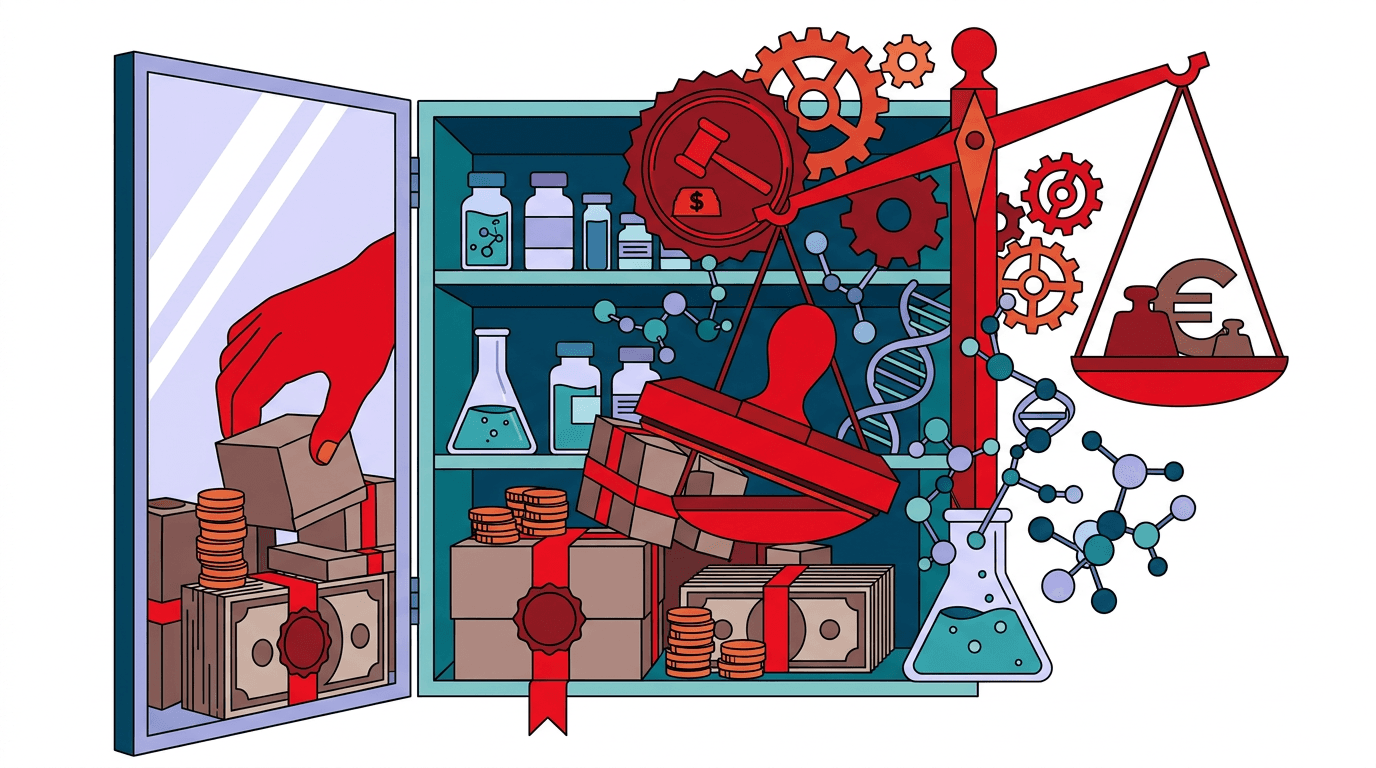
That scenario just got a lot more real. On April 2, 2026, the Trump administration signed a sweeping proclamation slapping up to 100% tariffs on patented, brand-name drugs manufactured outside the United States. The legal basis: Section 232 of the Trade Expansion Act, the same national security authority previously used for steel and aluminum. The message to pharma companies is simple: build your factories here, or pay up.
This isn't a negotiating tactic disguised as policy. It's policy disguised as a negotiating tactic. And the implications for drug prices, supply chains, and the entire biotech ecosystem could be massive.
The Tariff Playbook, Decoded
The structure of the new tariffs reads like a choose-your-own-adventure book for pharma executives, except every path costs money.
The default rate is 100% on imported patented drugs and their active pharmaceutical ingredients (APIs). Large companies have 120 days before the tariffs kick in; smaller ones get 180 days. That's the stick.
The carrot? Companies that sign "most favored nation" pricing agreements with the government (essentially promising to match the lowest prices they charge in other developed countries) and commit to building U.S. manufacturing can get their tariff rate down to zero percent. At least 17 major firms, including Pfizer, Eli Lilly, and Novo Nordisk, have already signed such deals and received exemptions through January 2029.
Companies that commit to onshoring but skip the pricing agreements start at 20%, which ratchets up to 100% over four years. Think of it like a parking meter: the longer you stall, the more you pay.
There are also country-specific carve-outs. The EU, Japan, South Korea, and Switzerland face a 15% rate on patented drugs. The UK negotiated an even sweeter deal: 10%, dropping to zero under future trade agreements. Generic drugs and biosimilars? Exempt, for now. But the White House plans to .
Get tomorrow's biotech intelligence before your competitors.
Join thousands of biotech professionals who start their day with our free, daily briefing.
reassess that exemption within one year
Why This Hits Different Than Steel Tariffs
Tariffs on steel affect construction costs and car prices. Tariffs on pharmaceuticals affect whether someone can afford their cancer medication.
The administration's stated goal is compelling on paper: roughly 65-70% of patented drugs distributed in the U.S. are produced abroad, and the upstream dependency goes even deeper. China controls a staggering share of the world's active pharmaceutical ingredients, supplying roughly 95% of U.S. ibuprofen imports and around 70-74% of acetaminophen imports. India, which fills roughly 61% of America's generic oral prescriptions, depends on China for 60-80% of its own raw drug ingredients.
So even a pill labeled "Made in India" often has a chemical backbone that's "Made in China." It's like buying a car assembled in Ohio with an engine from Shenzhen: the label tells you where it was finished, not where it was born.
The national security argument writes itself. In a geopolitical crisis (say, a conflict over Taiwan), China could restrict exports of chemical precursors and cripple drug supplies across multiple allied countries simultaneously. China has already done this with rare earth minerals. There's no reason to assume pharmaceuticals are off the table.
The Problem With Building a Pharmacy Overnight
But knowing why you want domestic manufacturing and actually getting domestic manufacturing are very different things.
The investment numbers look impressive. Eli Lilly is pouring roughly $6 billion into a new API plant in Alabama. AstraZeneca committed approximately $4.5 billion to a factory complex in Virginia. Across the industry, analysts estimate U.S. pharma production capacity could grow 20-30% by 2030 from projects already announced.
The catch: pharmaceutical plants aren't coffee shops. You can't just sign a lease and start brewing. A new biologics facility takes years to build, validate, and get through FDA inspection. Every manufacturing site change triggers regulatory filings, stability studies, and process validation. The policy's 120-to-180-day timeline is laughably short compared to the multi-year reality of actually moving production.
The FDA seems aware of the gap. Its new PreCheck initiative, launched in August 2025, aims to speed up planning and regulatory review for new domestic facilities. The administration's proposed budget includes a $325 million increase for domestic pharmaceutical manufacturing infrastructure. These are real steps, but they operate on a timeline measured in years, not the months the tariff clock allows.
Big Pharma Shrugs, Small Biotech Panics
The reaction from industry has been predictably split along size lines.
Large multinationals are annoyed but not panicking. They have existing U.S. plants they can expand, deep pockets to fund construction, and enough negotiating leverage to secure favorable deals with the administration. Many had already started building domestic capacity in 2025, partly as a hedge against exactly this kind of policy.
Small and mid-size biotechs are in a very different position. These companies often outsource manufacturing to contract organizations in Europe or Asia. They don't have the capital to build U.S. plants, the regulatory bandwidth to rapidly transfer manufacturing processes, or the political clout to negotiate bespoke tariff exemptions.
The Biotechnology Innovation Organization (BIO) has been blunt in its criticism, arguing that tariffs will divert capital away from R&D, delay new treatments, and ironically "weaken American biotech against China's rising industry." Their core objection: tariffs penalize existing structures but don't create new capacity. Targeted subsidies and streamlined FDA pathways, they argue, would have been far more effective.
The Real Risk Nobody's Talking About
Analysts are flagging a regulatory time bomb buried in this policy. Every time a company shifts a manufacturing site to dodge tariffs, it triggers what the industry calls a CMC supplement (chemistry, manufacturing, and controls). That means new filings with the FDA: stability data, process validation, potentially new inspections.
For mid-size companies with limited regulatory teams, this isn't just expensive; it forces impossible trade-offs. Do you spend your regulatory resources onshoring your top-selling drug, or do you keep advancing your pipeline? Some firms may have to shelve development programs just to handle the paperwork of moving existing products to new facilities.
And if companies can't move fast enough, the result isn't just higher prices. It's drug shortages. Products could get stuck in tariff classification disputes at customs. Low-margin specialty drugs might simply get pulled from the U.S. market if the math no longer works.
Where This Goes From Here
The next 12 to 24 months will be messy. Expect a scramble of supply chain reconfiguration, exemption negotiations, and a wave of co-manufacturing partnerships as smaller companies try to piggyback on larger firms' U.S. facilities. Some analysts predict a surge in M&A activity as companies acquire domestic manufacturing capacity they can't build fast enough.
The medium-term picture (two to five years) could actually look promising: more U.S. manufacturing, genuine supply chain resilience, and a more geographically diversified industry. Advanced manufacturing technologies, like continuous flow production, could even make domestic plants cost-competitive with overseas alternatives.
But here's the tension at the heart of this policy. The administration wants two things that pull in opposite directions: lower drug prices and domestic manufacturing, which is inherently more expensive than production in India or China. Tariffs can force companies to move. They can't repeal the economics of why companies left in the first place.
The bet is that enough carrots (exemptions, streamlined approvals, budget dollars) combined with a very large stick (100% tariffs) will reshape an industry that spent decades optimizing for low-cost global supply chains. It's the biggest forced migration in pharmaceutical history. Whether it lands as a masterstroke of industrial policy or a self-inflicted wound on American patients depends entirely on the execution.
Clinical & Regulatory
5 min read
The White House Just Went All-In on Magic Mushrooms
The Trump administration just made psychedelic therapies a federal healthcare priority, committing $50 million in funding and fast-track review vouchers for psilocybin and related compounds. It's the biggest shift in U.S. psychedelic policy in half a century, and the implications for patients, investors, and the future of psychiatry are enormous.