
The Trump administration just made psychedelic therapies a federal healthcare priority, committing $50 million in funding and fast-track review vouchers for psilocybin and related compounds. It's the biggest shift in U.S. psychedelic policy in half a century, and the implications for patients, investors, and the future of psychiatry are enormous.
Fifty years ago, the federal government declared psychedelics public enemy number one. Last month, the White House called them a national healthcare priority.
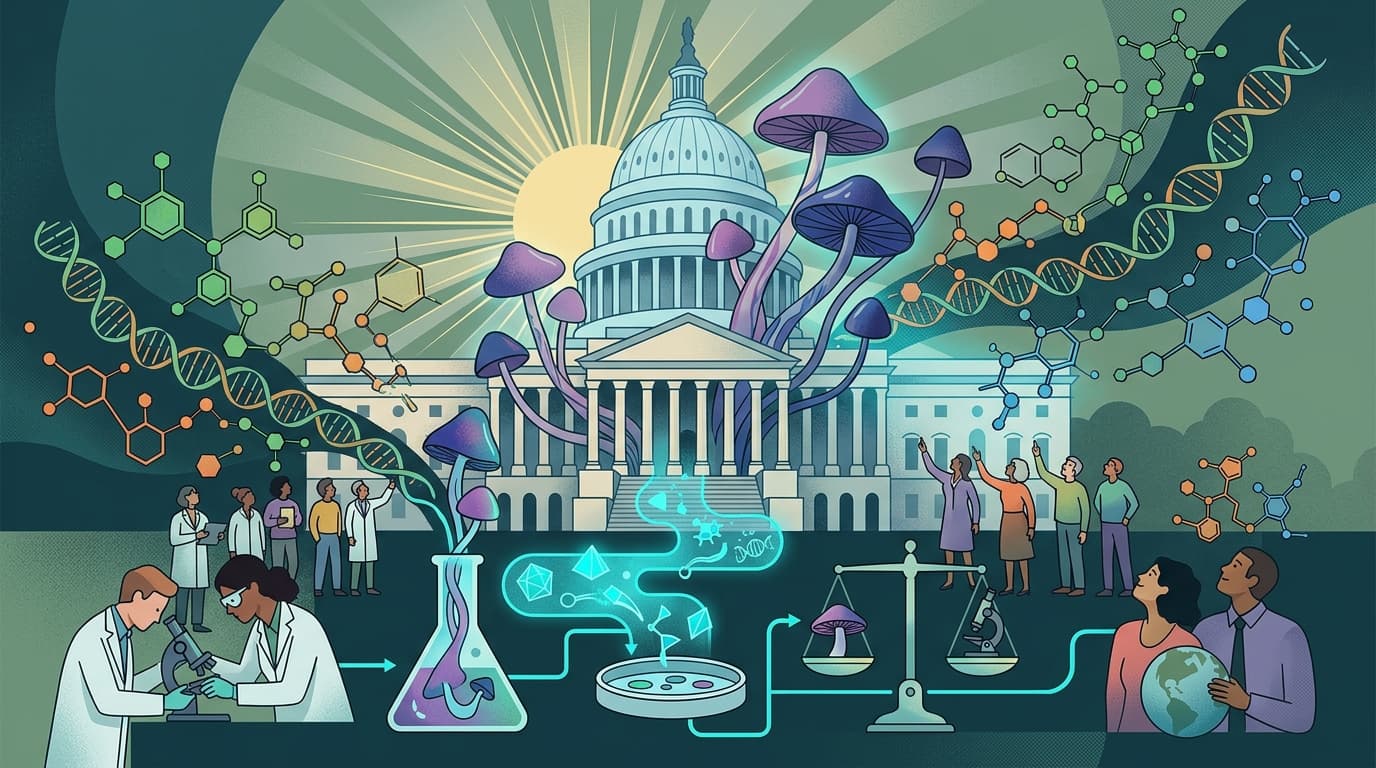
That's not a typo. On April 18, 2026, the Trump administration signed Executive Order 14401, titled "Accelerating Medical Treatments for Serious Mental Illness." It directs the FDA, DEA, VA, and HHS to fast-track psychedelic therapies for conditions like PTSD, treatment-resistant depression, and severe addiction. It commits $50 million in federal funding through ARPA-H. And it tells the DEA to start rescheduling these drugs the moment they clear Phase 3 trials.
This isn't a press release about "exploring options." This is the executive branch picking up psychedelics, dusting them off, and handing them a VIP pass through the regulatory system.
To understand how wild this is, you need a little history. In 1970, the Controlled Substances Act placed psilocybin, LSD, and their chemical cousins into Schedule I: the regulatory equivalent of solitary confinement. No accepted medical use, high abuse potential, too dangerous to even study properly. Research basically flatlined for three decades.
Then, starting in the 2000s, places like Johns Hopkins and NYU began running modern clinical trials. The results were striking. Psilocybin showed huge effect sizes in depression. MDMA-assisted therapy transformed outcomes for PTSD patients who had failed every other treatment. The FDA took notice, granting Breakthrough Therapy designations (a label reserved for drugs that show dramatic improvement over existing options) to MDMA for PTSD in 2017 and psilocybin for depression in 2018 and 2019.
But Breakthrough Therapy status is like getting a fast pass at a theme park that still has a two-hour line. The underlying Schedule I barriers remained brutal: mountains of DEA paperwork, restricted lab access, glacial timelines. The new executive order is designed to bulldoze those barriers.
The EO does three things that actually matter.
The order directs the FDA Commissioner to issue "National Priority Vouchers" to psychedelic drugs with Breakthrough Therapy status. These vouchers compress the FDA's review window to roughly one to two months, compared with the standard six to ten.

The FDA approved Lilly's oral obesity pill Foundayo in record time, then handed the company a 15-year monitoring homework assignment. What the agency's unprecedented post-marketing demands mean for the future of diet pills, and the entire oral GLP-1 class.

Join thousands of biotech professionals who start their day with our free, daily briefing.

Second, it opens a Right to Try pathway for psychedelics. The 2018 Right to Try Act lets terminally ill patients access experimental drugs. The EO extends that logic to psychedelics, including ibogaine compounds, for patients with serious mental illness who've exhausted other options. FDA and DEA are directed to make it actually workable by cutting the Schedule I red tape that has made these pathways theoretical at best.
Third, it tells the DEA to get out of the way after approval. Historically, even after the FDA approves a drug, it can take years for the DEA to reschedule it. The order instructs the Attorney General to begin rescheduling reviews as soon as Phase 3 trials succeed, so there's no gap between FDA approval and a doctor's ability to prescribe.
Here's where it gets interesting. Most observers expected one of those priority vouchers to go to Lykos Therapeutics (formerly MAPS Public Benefit Corporation), the group that has spent decades developing MDMA-assisted therapy for PTSD. They're the poster child of the psychedelic medicine movement.
They didn't get one.
The FDA rejected Lykos's MDMA application back in August 2024, citing concerns about functional unblinding (patients can easily tell if they got the real drug), therapist standardization, and abuse potential. As of mid-2026, there's no public indication that FDA is ready to reverse course without additional data. Instead, the third voucher went to Transcend's methylone program for PTSD, a newer entrant with no prior rejection baggage. It was a clear signal: the FDA wants options in the PTSD psychedelic space, and it's not waiting around for MDMA to sort itself out.
Let's be honest about what's driving this. The executive order didn't emerge from a vacuum of pure scientific enthusiasm.
Analysts at STAT and elsewhere have connected the timing to midterm-year health policy positioning. The Make America Healthy Again (MAHA) movement and high-profile advocates like Joe Rogan pushed psychedelics as a centerpiece of a "wellness populism" agenda. Veterans' groups provided the moral authority; libertarian-leaning conservatives provided the deregulatory energy. The result is a coalition that probably couldn't agree on pizza toppings but found common ground on psilocybin.
The $50 million in ARPA-H funding, directed toward state-federal partnerships for psychedelic research, adds real dollars to the rhetoric. Texas, which has already launched an ibogaine research consortium, is a likely early beneficiary.
For biotech investors, the signal is unmistakable. COMPASS Pathways (NASDAQ: CMPS), Cybin (Nasdaq: HELP), and Atai Life Sciences (NASDAQ: ATAI) are the most direct public plays. AbbVie's $1.2 billion acquisition of Gilgamesh's psilocybin-like compound in 2025 already validated big-pharma interest. This EO could accelerate the next wave of deals.
Before anyone starts planning their victory lap, a few caveats.
The executive order does not approve any psychedelic drug. It doesn't override safety and efficacy standards. It doesn't legalize recreational use. And it doesn't force insurance companies to cover these therapies. Clinical experts warn that without standardized therapist training, facility requirements, and follow-up care protocols, rushing access could produce bad outcomes and a public backlash that sets the field back a decade.
There's also the durability question. This is an executive order, not legislation. A different administration could reverse it with a pen stroke. And analysts note that this same administration previously blocked fast-track status for a COMPASS psilocybin treatment earlier in its term, suggesting the policy environment can be "idiosyncratic and erratic," as one legal analysis put it.
Zoom out, and the picture is striking. For fifty years, the federal government treated psychedelics like contraband. Now it's treating them like a priority. The path from Schedule I pariah to FDA-fast-tracked therapy isn't complete yet; psilocybin and MDMA still aren't approved drugs. But the regulatory architecture is being rebuilt in real time.
Psilocybin is closest to the finish line, with late-stage trial data accumulating. MDMA faces a longer road after the 2024 rejection, though the broader policy environment has never been friendlier. Methylone is the dark horse, entering Phase 3 with a pending acquisition by Otsuka.
The biggest shift isn't any single provision in the executive order. It's the fact that the conversation has moved from "should we study these drugs?" to "how fast can we get them to patients?" That's a different question entirely. And for millions of Americans with treatment-resistant mental illness, it might be the most important question Washington has asked in years.
Pfizer's first-ever GLP-1 obesity drug just got approved, but not in America. China greenlit Xianweiying, throwing Pfizer into a three-way brawl with Novo Nordisk and Eli Lilly in the world's largest untapped weight loss market.