The $0 Pill Just Got a 100% Price Tag at the Border
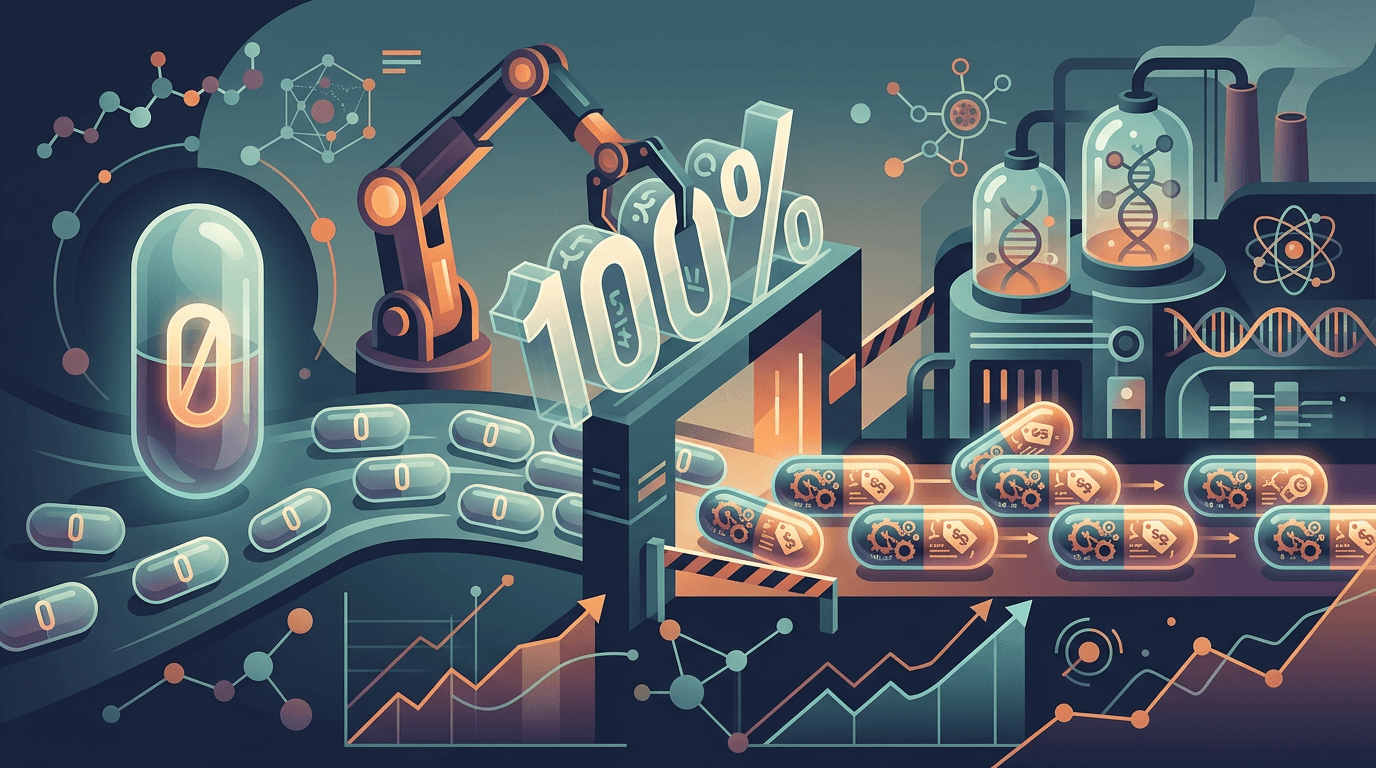
The Trump administration just slapped a 100% tariff on imported brand-name drugs, the steepest Section 232 rate ever applied to a single product category. But the real story is in the escape hatches: cut your prices, build a factory in America, or pay double at the border.
The Biggest Tariff Pharma Has Ever Seen
Imagine ordering a steak at a restaurant and being told the bill just doubled. Not because the steak changed, but because the kitchen is overseas. That's essentially what the Trump administration did when it announced a 100% tariff on imported brand-name pharmaceuticals and their ingredients.
It's the steepest Section 232 tariff among modern applications such as steel and aluminum. Not steel. Not aluminum. Pills.
The logic is straightforward, even if the execution is dizzyingly complex: if you want to sell patented drugs in America, either make them here, slash your prices, or pay double at the border.
A Menu of Pain (With Some Emergency Exits)
Before the industry collectively passes out, there's fine print. Lots of it. The 100% rate is a ceiling, not a blanket. The administration has built a tiered system that looks more like a choose-your-own-adventure book than a trade proclamation.
The tiers work like this. If your company submits an onshoring plan to the Commerce Department (basically a credible commitment to build manufacturing in the U.S.), the tariff drops to 20%. If you go further and sign a Most Favored Nation pricing agreement with HHS, promising to match your lowest international prices in the U.S., the tariff drops to zero. Both of those preferential rates hold through January 20, 2029.
Countries with trade deals got their own lane. Drugs from the EU, Japan, South Korea, and Switzerland face a 15% tariff instead of 100%. The UK negotiated a direct zero-tariff arrangement for pharmaceuticals through January 2029 under a bilateral pharmaceutical trade deal.
And here's the kicker: generics and biosimilars are completely exempt. So are orphan drugs (treatments for rare diseases), cell and gene therapies, plasma-derived therapies, fertility treatments, and nuclear medicines. At least for now. The Commerce Department has to revisit the generic exemption within a year.
Get tomorrow's biotech intelligence before your competitors.
Join thousands of biotech professionals who start their day with our free, daily briefing.
Who's Already Cutting Deals?
The White House says 17 companies have already signed combined onshoring and MFN pricing agreements, pledging roughly $448 billion in U.S. manufacturing investment. That's a staggering number. It suggests the administration was negotiating behind the scenes long before the announcement dropped.
Think of it like a hostage negotiation where some hostages already walked out the front door. The companies that moved fast locked in zero-percent tariffs. Everyone else is staring at a ticking clock.
Large firms listed in Annex III of the proclamation face tariffs starting July 31, 2026, just weeks away. Smaller companies get until September 29. That's a 120-day window for the big players and 180 days for everyone else to cut a deal, restructure their supply chains, or eat the cost.
Wall Street Shrugs (Mostly)
You might expect a policy this aggressive to send biotech stocks into freefall. The reaction has been more nuanced.
Analysts have noted the announcement actually removes a policy overhang that's been hanging over the sector since the Section 232 investigation launched in April 2025. Given high margins in branded pharma and the breadth of exemptions, the overall threat to the sector has been characterized as manageable.
The catch? Smaller companies with big indications are the most vulnerable. They rely more heavily on imported finished products and have far less leverage to negotiate favorable deals. A mid-cap company importing a single blockbuster drug from Ireland doesn't have the same bargaining power as Pfizer.
The Little Guys Are Furious
A new coalition called the Mid-Sized Biotech Alliance of America (MBAA) has already formed to fight the tariffs. Their argument is pointed: this creates an "unjust two-tiered system" that rewards mega-cap companies with the resources to negotiate sweetheart deals while crushing smaller innovators.
They're not wrong. A company with 50 products can spread onshoring costs and absorb margin hits. A company with two products, one of them imported, has no room to maneuver. Analysts expect this pressure to accelerate distressed M&A and strategic partnerships, as smaller firms seek shelter under the tariff umbrellas of larger players.
PhRMA, the main industry lobby, has condemned the policy outright. CEO Stephen Ubl argued that two-thirds of drugs used in the U.S. are already manufactured domestically and that "every dollar spent on tariffs is a dollar that can't be invested in communities across the country."
What This Actually Means for Drug Prices
This is where it gets counterintuitive. A 100% tariff sounds like it should double drug prices. In practice, it probably won't.
Given the breadth of exemptions and deal-making, the real impact on manufacturer costs for tariff-exposed products is expected to be significantly less than 100%, painful but not catastrophic for an industry accustomed to gross margins above 70%.
More importantly, the MFN pricing agreements that unlock tariff exemptions are specifically designed to lower U.S. drug prices. Companies that sign on are committing to match their cheapest international prices for American patients. So the tariff is really a stick forcing companies toward a carrot that benefits consumers.
There's a wrinkle, though. For drugs already subject to Medicare negotiation under the Inflation Reduction Act, manufacturers have no pricing lever to offset higher costs. They can't raise prices in government channels. That means margins get squeezed from both sides: tariffs pushing costs up, IRA negotiations holding prices down.
Generics and Biosimilars: The Quiet Winners
With branded imports suddenly more expensive and complicated, generic drugs and biosimilars just became even more attractive to payers, hospitals, and formulary committees. They fill over 90% of U.S. prescriptions already, and now they have a built-in cost advantage that didn't exist six months ago.
Expect insurers to push harder for biosimilar adoption. Expect pharmacy benefit managers to tighten formularies around branded imports. And expect generic manufacturers to enjoy a policy tailwind unlike anything they've seen in years.
The risk? That one-year review. If Commerce recommends extending tariffs to generics in 2027, the entire calculus flips. For now, though, the exemption is a gift.
The 2029 Cliff
Perhaps the most underappreciated detail in all of this: the zero-tariff deals expire on January 20, 2029. That date isn't random. It's the last day of Trump's current term.
Every company that signed an MFN and onshoring agreement is essentially betting that either Trump gets succeeded by someone who maintains the framework, or that their U.S. manufacturing will be far enough along to be self-sustaining by then. If neither happens, the 100% tariff snaps back.
For the onshoring-only companies paying 20%, the cliff comes in April 2030, when rates are scheduled to jump to 100% unless domestic production targets are met.
This isn't just trade policy. It's industrial policy, price control policy, and election-year policy wrapped into one proclamation. The pharmaceutical industry just got the most complicated homework assignment in its history, and the deadline is already here.
Clinical & Regulatory4 min read
The Best-Selling Drug Just Met Its Copycat
Samsung Bioepis just posted the first-ever Phase 3 data for a Keytruda copycat, and it matched the $32 billion original on every measure. With at least ten companies racing to build biosimilar versions of the world's best-selling drug, the countdown to cheaper cancer immunotherapy has officially begun.