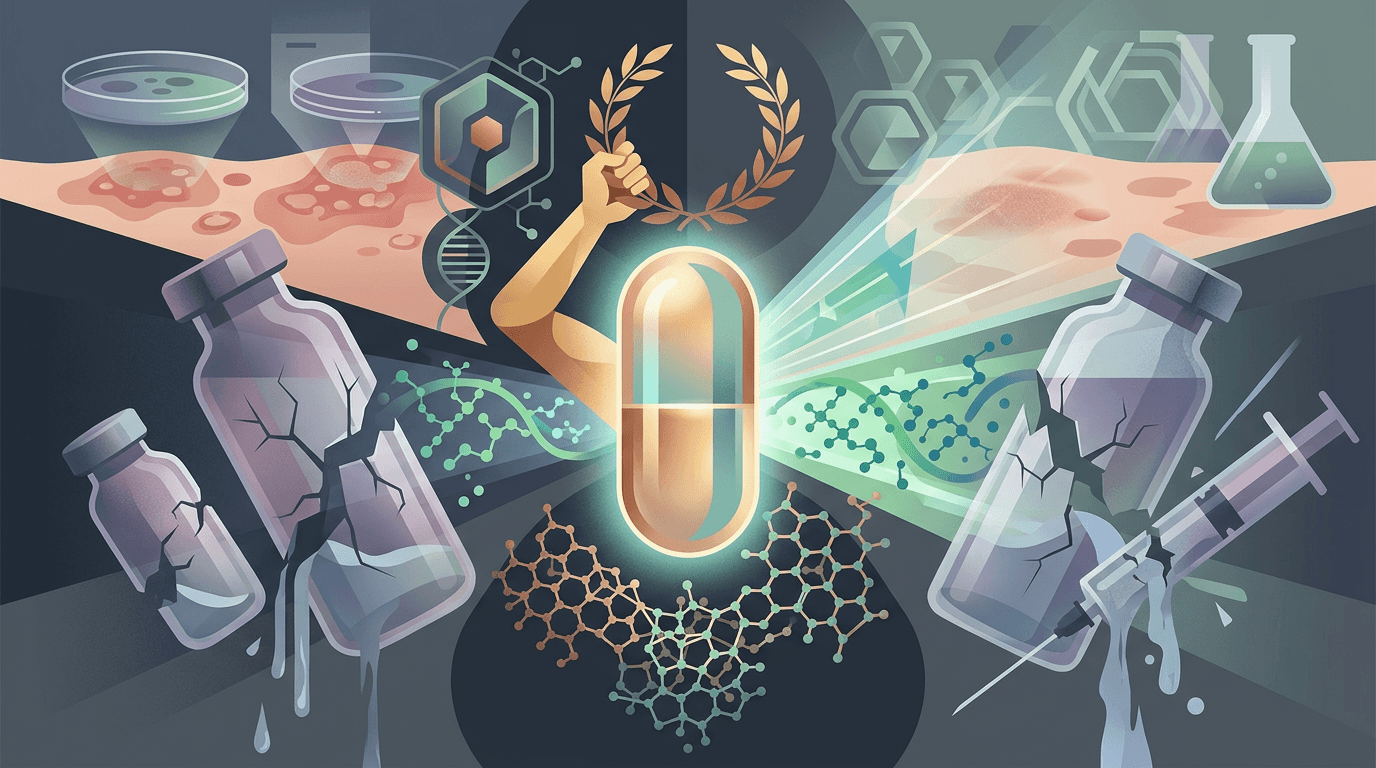

Takeda's oral psoriasis drug zasocitinib just crushed its Phase 3 trials with biologic-level skin clearance rates. With peak sales estimates of up to $6 billion, the $4 billion acquisition that spawned it might be biotech's best bargain.
Imagine telling 10 people with severe psoriasis that a once-daily pill could make their skin almost completely clear. Now imagine more than five of them actually getting there. That's what Takeda just showed with zasocitinib, and it could reshape how doctors treat one of the most common autoimmune diseases on the planet.
Takeda's Phase 3 LATITUDE trials enrolled over 1,800 patients with moderate-to-severe plaque psoriasis. The drug hit every single endpoint. Co-primary measures (75% skin improvement and near-clear skin ratings) were met with flying colors. But the secondary endpoints tell the real story.
More than 50% of patients achieved PASI 90 by week 16, meaning their skin was 90% clearer than when they started. Roughly 30% hit PASI 100, which is doctor-speak for completely clear skin. For an oral medication, those are jaw-dropping numbers. All 44 ranked secondary endpoints were met, including superiority over both placebo and apremilast (sold as Otezla), a popular existing oral treatment.
To understand why analysts are using phrases like "best-in-class," you need to understand the competitive landscape. Today, the most effective psoriasis treatments are biologics: injectable drugs that target specific immune pathways. They work incredibly well, but they come with needles, cold storage requirements, and hefty price tags.
Oral options exist, but they've historically been second-tier performers. Apremilast is convenient but modest in efficacy. BMS's deucravacitinib (branded Sotyktu), the first approved TYK2 inhibitor, was supposed to change that equation. It has, to a degree, but its commercial uptake has been modest.
Zasocitinib targets the same enzyme, TYK2, but with a dramatically different potency profile. Think of TYK2 as a light switch controlling inflammation. Zasocitinib keeps the lights off for a full 24 hours, sustaining over 90% inhibition around the clock.
The selectivity story is equally compelling. Zasocitinib shows more than one-million-fold selectivity for TYK2 over the other three JAK enzymes (JAK1, JAK2, JAK3). In practical terms, it causes of JAK1/3 signaling at clinical doses. Traditional JAK inhibitors like tofacitinib and baricitinib hit those other pathways significantly, which is why they carry black box warnings about blood clots, infections, and cancer risk.

GSK sold its severe itch drug linerixibat to Alfasigma for $300 million, just two weeks before an FDA decision. The deal reveals how Big Pharma is shedding promising niche assets to chase bigger markets.

Join thousands of biotech professionals who start their day with our free, daily briefing.

Takeda didn't develop zasocitinib from scratch. The company acquired it from Nimbus Therapeutics in 2022 for a cool $4 billion, one of the largest deals ever for a single preclinical-stage asset. At the time, skeptics raised eyebrows. A $4 billion check for a drug that hadn't even entered pivotal trials felt like buying a house based solely on the architect's sketches.
The Phase 2b data helped quiet the doubters. In a trial that randomized 287 patients, zasocitinib showed dose-dependent improvements with a clean safety profile. The 30 mg dose delivered what researchers described as "biologic-level efficacy," with up to one-third of patients achieving completely clear skin by week 12. Discontinuations due to side effects were rare and comparable across all dose groups.
Now, with Phase 3 results in hand, that $4 billion looks less like a gamble and more like a bargain.
The global psoriasis treatment market is worth roughly $29 to $34 billion in 2025, depending on whose estimate you trust. It's projected to more than double by the mid-2030s, reaching over $70 billion. The oral therapy segment alone sits at about $4.8 billion and is growing at a 10.2% clip annually.
Patient preferences are the wind at zasocitinib's back. Surveys show that over 50% of patients and nearly half of healthcare providers prefer oral treatments over injectables when efficacy and safety are comparable. Even more telling: 91.2% of patients currently on injectable biologics said they'd switch to an equivalent oral option. That's not a niche preference; that's a migration waiting to happen.
Biologics still dominate severe psoriasis, holding nearly 50% of the overall market. But their reign depends partly on the assumption that pills can't match their performance. Zasocitinib's data challenges that assumption head-on.
Wall Street noticed. Jefferies analysts described zasocitinib as having potential to "redefine the oral psoriasis market," projecting the oral psoriasis segment could exceed $5 billion by 2030.
Takeda plans to file its New Drug Application starting in fiscal year 2026 (which begins April 2026). If approved across its full development program, which spans psoriasis, psoriatic arthritis, Crohn's disease, and ulcerative colitis, Takeda projects peak sales of $3 to $6 billion. That would make the $4 billion Nimbus acquisition look like a steal.
A head-to-head Phase 3 trial against Sotyktu is already underway, with results expected in the second half of 2026. If zasocitinib's preclinical superiority translates to a clinical win there, BMS will have a serious problem on its hands.
Zasocitinib's safety profile has been reassuring so far. The most common side effects were upper respiratory infections, nasopharyngitis, and acne; nothing that would spook a regulator. No new safety signals emerged through 24 weeks of data. But "no new signals" and "long-term safe" are two very different things, especially for a drug class that's been burned by safety concerns before.
The broader JAK inhibitor family carries well-documented risks around cardiovascular events, malignancies, and serious infections. Zasocitinib's extreme selectivity for TYK2 should theoretically avoid those issues, but theory and reality don't always agree. The FDA will want to see longer-term data before giving its blessing, and post-marketing surveillance will be closely watched.
Then there's the crowded competitive landscape. IL-23 and IL-17 biologics keep getting better. New entrants like bimekizumab are raising the efficacy bar. Zasocitinib's convenience advantage only matters if its efficacy holds up in real-world use, not just in tightly controlled clinical trials.
Takeda's zasocitinib just delivered the strongest Phase 3 data ever seen for an oral psoriasis treatment. It blocks inflammation with surgical precision, avoids the safety baggage of older JAK inhibitors, and offers the one thing biologics can't: the simplicity of a daily pill.
For the tens of millions of people worldwide living with psoriasis, that combination could be transformative. For Takeda, it could be the blockbuster that justifies one of biotech's boldest acquisitions. And for BMS, it's a five-alarm fire heading straight for Sotyktu's modest market share.
The next chapter arrives when Takeda files with the FDA. After that, the head-to-head against Sotyktu. Place your bets now; this race is just getting started.
BMS's experimental drug mezigdomide just cleared its first phase 3 hurdle in multiple myeloma, validating an entirely new class of cancer drugs called CELMoDs. But the real showdown against the company's own blockbuster predecessor is still a year away.