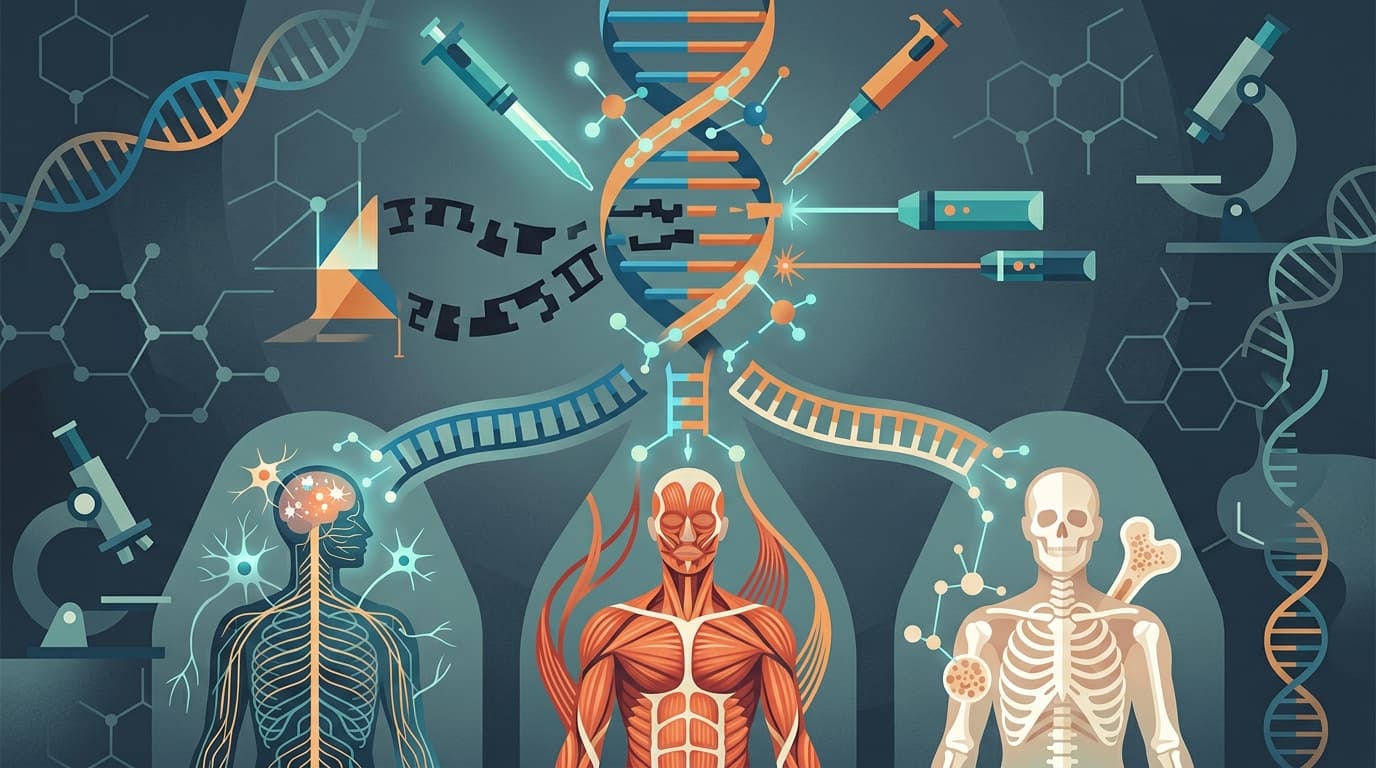
The Genetic Fix That Doesn't Care What Disease You Have
The first-ever tRNA therapy just entered the clinic, and it doesn't care what disease you have. Alltrna's AP003 could become the foundation of a disease-agnostic genetic medicine platform, but the road from first-in-human trial to approved drug is anything but simple.
A Whole New Class of Medicine Just Walked Into the Clinic
Imagine a drug that doesn't treat a specific disease. Instead, it fixes a specific type of typo in your DNA, regardless of which chapter of the book it appears in. That drug just got the green light for its first-ever test in humans.
On March 31, 2026, a biotech company called Alltrna announced that its therapy, AP003, has been approved to begin a Phase 1 clinical trial in Australia. It's the first time a transfer RNA (tRNA) therapy has ever been tested in people. And the implications are enormous: if it works, it could become the first truly disease-agnostic genetic medicine, treating dozens of conditions with a single platform.
This isn't an incremental step. It's the birth of a new modality.
What the Heck Is a tRNA Therapy?
Let's back up. Your cells build proteins by reading instructions from your DNA, kind of like following a recipe. Each ingredient (amino acid) gets delivered to the kitchen (the ribosome) by a tiny molecular courier called transfer RNA, or tRNA. When the recipe says "add arginine," tRNA shows up with arginine. Simple enough.
But roughly 10% of genetic diseases are caused by a specific kind of mutation called a nonsense mutation. Think of it as a typo that inserts a period in the middle of a sentence. The ribosome reads along, hits that premature stop sign, and quits early. You get a half-finished protein that doesn't work. The result can be anything from a rare liver disease to muscular dystrophy, depending on where the typo occurs.
Alltrna's approach is elegant: engineer a custom tRNA that ignores the fake stop sign, inserts the correct amino acid, and lets the ribosome finish the job. Full-length protein, crisis averted.
The beauty is that this fix doesn't care which gene has the typo. It only cares about the type of typo. That's what makes it disease-agnostic.
AP003: The Details
AP003 targets the most common nonsense mutation in human genetics: , which accounts for roughly 21-22% of all nonsense mutations across genetic diseases. That's a huge slice of the pie for a single therapy to address.
Get tomorrow's biotech intelligence before your competitors.
Join thousands of biotech professionals who start their day with our free, daily briefing.
Arg-TGA
The drug itself is a chemically modified tRNA molecule packaged inside a lipid nanoparticle (the same type of fatty delivery bubble that made mRNA COVID vaccines possible). This particular formulation is designed to reach the liver, so the initial focus is on liver-related "Stop Codon Disease," as Alltrna calls it.
The Phase 1 trial, approved under Australia's Therapeutic Goods Administration, will test single ascending doses in healthy volunteers. That means they're starting with the basics: is it safe, and how does the body process it? If the safety data looks clean, future trials would move into patients who actually carry the Arg-TGA mutation.
Why This Matters Beyond One Trial
The traditional approach to genetic medicine is one disease, one drug. You spend years and billions developing a therapy for cystic fibrosis, then you start over for the next condition. It's like building a new car from scratch every time someone needs a different color.
Alltrna is trying to build a paint shop instead. Because nonsense mutations share a common mechanism (premature stop codons), a single tRNA therapy could theoretically treat multiple diseases that happen to share the same type of typo. The company estimates that Arg-TGA alone affects patients across an enormous range of conditions, with roughly 30 million people worldwide carrying some form of nonsense mutation.
If the platform works, you wouldn't need a separate drug for each disease. You'd need a separate tRNA for each codon type. There are only a handful of those, which means a small toolkit could cover a vast number of conditions.
The mRNA Parallels Are Hard to Ignore
mRNA therapy followed a strikingly similar arc. Scientists discovered messenger RNA in 1960, but it took until 2008 for the first mRNA therapy to enter a human trial (a cancer vaccine for melanoma). Then another 12 years passed before the first mRNA product received Emergency Use Authorization, in the form of COVID vaccines in December 2020, with full FDA approval following in August 2021.
tRNA was discovered around the same era as mRNA. Now, decades later, it's finally getting its first clinical shot. The parallel isn't perfect; tRNA faces its own unique challenges. But the trajectory is familiar: long scientific runway, breakthrough moment, and a platform that could reshape medicine if the early data holds up.
The Catch (There's Always a Catch)
Let's be honest about what could go wrong, because the road from "first-in-human" to "approved drug" is littered with wreckage.
Delivery is the biggest question mark. Lipid nanoparticles work well for the liver, which is great for liver diseases. But many nonsense mutations cause problems in muscle, the brain, or the lungs. Getting tRNA therapies to those tissues is a completely different engineering challenge, one that even established gene therapies haven't fully cracked.
Safety in patients is unproven. The Phase 1 trial tests healthy volunteers. That tells you whether the drug is tolerable, but it doesn't tell you what happens when it starts suppressing premature stop codons in someone whose biology depends on that broken protein being absent. There's always a risk that restoring a protein could trigger unintended consequences: immune reactions, off-target effects, or changes to proteins that were never supposed to be affected.
And then there's the competition with natural biology. Inside your cells, real stop codons are supposed to halt protein production at the right time. Convincing an engineered tRNA to override only the fake stop signs, without occasionally messing with the real ones, is a precision problem that will need rigorous clinical evidence to resolve.
The Competitive Landscape
Alltrna isn't alone in the tRNA space. Tevard Biosciences has been developing suppressor tRNA therapies using viral vectors (AAV delivery), with preclinical data showing 70% restoration of dystrophin in Duchenne muscular dystrophy models. But Alltrna is the first to get a tRNA drug into a human trial, which gives it a significant first-mover advantage in generating real clinical data.
Other companies are circling the space, though most remain in early preclinical stages. The field lost at least one player in 2025, a reminder that novel modalities are high-risk bets even when the science is promising.
The Bottom Line
This trial won't cure anything tomorrow. It's a safety study in healthy people, the most preliminary step in drug development. But what it represents is genuinely historic: the first time an entirely new class of genetic medicine has entered the clinic, with a mechanism that could, in theory, address thousands of diseases from a single platform.
The last time something like this happened, it was mRNA. And we all know how that turned out.
Alltrna's AP003 is a small molecule with a very big idea. Now it just has to prove that the idea works in the most complicated lab of all: the human body.
Clinical & Regulatory4 min read
From $100M IPO to Liquidation in Five Years
IO Biotech went from a $100M IPO and "most innovative biotech" honors to total Chapter 7 liquidation in five years, all because its cancer vaccine trial missed statistical significance by the thinnest of margins. It's the most brutal cautionary tale in immuno-oncology right now.