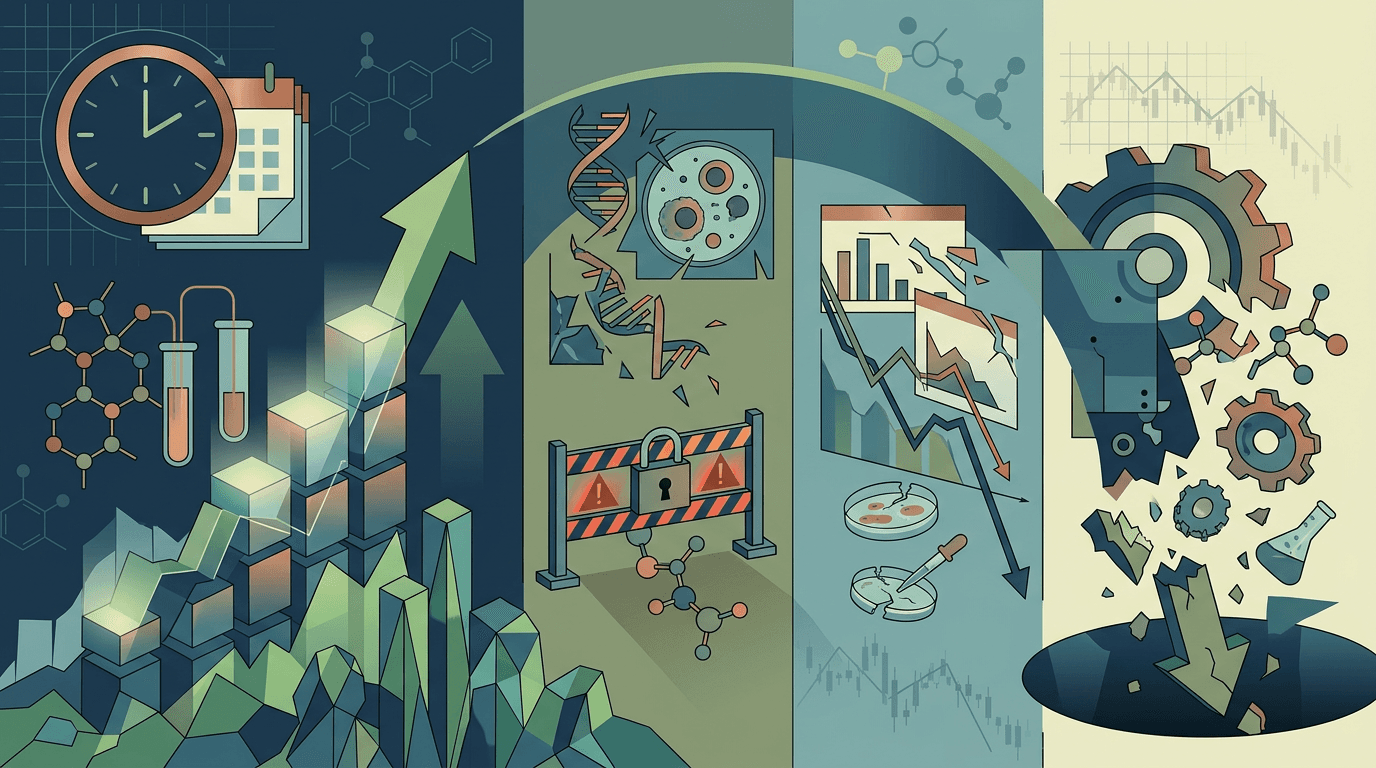

IO Biotech went from a $100M IPO and "most innovative biotech" honors to total Chapter 7 liquidation in five years, all because its cancer vaccine trial missed statistical significance by the thinnest of margins. It's the most brutal cautionary tale in immuno-oncology right now.
In March 2025, IO Biotech was named one of the most innovative biotechs in the world by Fast Company. By March 31, 2026, it was dead.
Every employee: terminated. Every board member: resigned. A court-appointed trustee now controls what's left of the company, tasked with selling off the scraps to pay creditors. Common shareholders? The company says they'll almost certainly get nothing.
This is the story of how a cancer vaccine startup went from a $100 million Nasdaq IPO to Chapter 7 liquidation in roughly five years. And it's a story every investor in the red-hot immuno-oncology space should read carefully.
IO Biotech's entire future rested on a single Phase 3 trial. The company had bet everything on Cylembio, a cancer vaccine designed to work alongside Merck's blockbuster immunotherapy Keytruda (pembrolizumab) in patients with advanced melanoma.
The concept was elegant. Cylembio would train the immune system to attack not just the tumor itself, but also the bodyguard cells that protect it. Think of it like a heist movie: instead of just going after the vault, you also take out the security guards. The company's proprietary T-win platform was built on this dual-attack strategy, and early data from Phase 1/2 looked genuinely promising.
So they ran the big trial. 407 patients with untreated, inoperable, or metastatic melanoma.
The results landed in August 2025. Patients on Cylembio plus Keytruda went a median of 19.4 months without their cancer progressing, compared to 11 months for Keytruda alone. That's a meaningful difference in clinical terms. Consistent benefits showed up across patient subgroups, and the combo didn't add any extra toxicity.
Sounds great, right? There was just one problem.
In clinical trials, you don't just need results that look good. You need results that are statistically significant, meaning there's strong enough evidence that the benefit wasn't due to random chance. IO Biotech's trial needed a p-value of 0.045 or lower to hit its mark.

Biogen is paying a 140% premium to acquire Apellis Pharmaceuticals in a $5.6 billion all-cash deal, its biggest acquisition in years. The move completes a three-year strategy to build a complement disease powerhouse, and it tells you everything about where big pharma thinks the future of immunology is headed.


Join thousands of biotech professionals who start their day with our free, daily briefing.

It landed at 0.0558.
To put that in sports terms: IO Biotech's shot hit the rim, bounced twice, and rolled out. The difference between success and failure was razor-thin, but in drug development, close doesn't count. The trial technically missed its primary endpoint for progression-free survival, and that changed everything.
IO Biotech had been planning to file for FDA approval by the end of 2025. But at a pre-submission meeting on September 29, 2025, the agency recommended the company not bother submitting. The data, the FDA said, wasn't strong enough.
No application was ever filed. No formal rejection letter was ever issued. The FDA simply told IO Biotech: don't even try. That's arguably worse than a rejection, because it meant the agency saw no path forward with the existing data.
The company publicly said it would design a new study and keep talking to the FDA. Behind the scenes, the math was brutal. Running another large Phase 3 trial would cost hundreds of millions of dollars, and IO Biotech's cash was draining fast.
What followed was a textbook biotech death spiral, compressed into just a few months.
The stock cratered. Shares plunged 46.5% in a single session after the company announced it was exploring "strategic alternatives" (the corporate euphemism for "we're running out of options"). Another day brought a 59.7% drop, shrinking the market cap to roughly $41 million. By the end, shares were trading at about six cents.
On January 21, 2026, IO Biotech formally announced it was looking at a merger, asset sale, or outright liquidation. On January 30, the company hired Raymond James as an advisor and implemented additional workforce reductions. But no buyer materialized. No white knight showed up.
On March 31, the company filed for Chapter 7 bankruptcy in Delaware. Not Chapter 11, which allows companies to reorganize and try again. Chapter 7 is the end of the road: total liquidation. The filing triggered automatic termination of every remaining employee, resignation of the entire board, and default on a €22.5 million loan from the European Investment Bank.
IO Biotech's collapse is painful on its own. But it also carries a warning for one of biotech's hottest sectors.
Cancer vaccines are having a moment. Moderna's personalized mRNA vaccine (mRNA-4157) showed a 49% reduction in cancer recurrence risk in a Phase 2b melanoma trial and is now in Phase 3. BioNTech is running its own cancer vaccine program with Roche. Investor excitement is palpable.
But the IO Biotech story exposes the brutal math underneath that excitement. Even when a cancer vaccine shows a real clinical benefit (remember, 19.4 months vs. 11 months is no small thing), a narrow miss on statistical significance can turn a promising therapy into a bankrupt company overnight.
The broader field faces its own headwinds, too. Personalized cancer vaccines can take three months or more to manufacture for each patient, and there are no clear regulatory standards for testing their potency. The FDA is clearly willing to hold a hard line: just ask ImmunityBio, which received a refuse-to-file letter in May 2025 for its cancer immunotherapy, sending its stock to a 52-week low.
IO Biotech raised roughly $100 million in its 2021 IPO. It pulled in another €127 million in Series B. All of that capital, plus the years of scientific work that began in 2014, is now being parceled out by a bankruptcy trustee.
The T-win platform, whatever its merits, will likely be sold to the highest bidder for pennies on the dollar (if anyone bids at all). The science behind Cylembio isn't necessarily dead; it just needs a new home and, more importantly, a new trial with tighter statistics.
For the cancer vaccine sector, the lesson is uncomfortable but important: biology can be right even when the statistics say no. And in biotech, the statistics are all that matter. IO Biotech's vaccine may have genuinely helped patients live longer without their cancer worsening. But at p=0.0558, it doesn't matter. The company is gone, and the patients who might have benefited from a second, larger trial will never get the chance.
That 0.0108 difference between success and failure is the cruelest number in drug development.
A nine-patient trial from an AI-driven startup just produced eczema data that rivals Sanofi's $15 billion blockbuster Dupixent. The catch? It's a once-daily pill, not an injection, and the real tests are just beginning.