$250M in Four Months: The Beijing Startup Big Pharma Can't Stop Funding
A Beijing biotech founded in 2022 just raised $250 million in four months, with AstraZeneca, sovereign wealth funds, and top-tier VCs all piling in. The bet: an AI platform that could crack the code on a "Goldilocks" class of drugs most pharma companies can't figure out.
A Quarter-Billion Before Most Startups Find Office Space
Most biotech startups spend years begging VCs for a meeting. Syneron Bio just raised $250 million in four months, and the investor list reads like a who's-who of global capital.
The Beijing-based company closed a $150 million Series B on March 31, just four months after pulling in nearly $100 million in Series A/A+ rounds. The backers include sovereign wealth money, Big Pharma, and some of the most prominent life sciences funds on the planet. For a company founded in 2022, that's not just fast. It's almost absurd.
So what's everybody so excited about?
The Goldilocks Drug
Syneron Bio makes macrocyclic peptides, which is a fancy name for a type of drug that sits in the sweet spot between two major categories. Small molecule drugs (think: pills you swallow) are convenient but often can't grab onto tricky biological targets. Large biologics (think: injectable antibodies) are powerful but expensive and hard to deliver. Macrocyclic peptides aim to be the Goldilocks option: potent enough to hit tough targets, small enough to potentially be taken as a pill.
Picture it like dating. Small molecules are the person who's easy to hang out with but can't commit to anything serious. Biologics are deeply committed but incredibly high-maintenance. Macrocyclic peptides? They're the rare catch who can actually do both.
The problem has always been finding the right macrocyclic peptides for any given disease. That's where Syneron's secret weapon comes in.
Teaching AI to Play Molecular Matchmaker
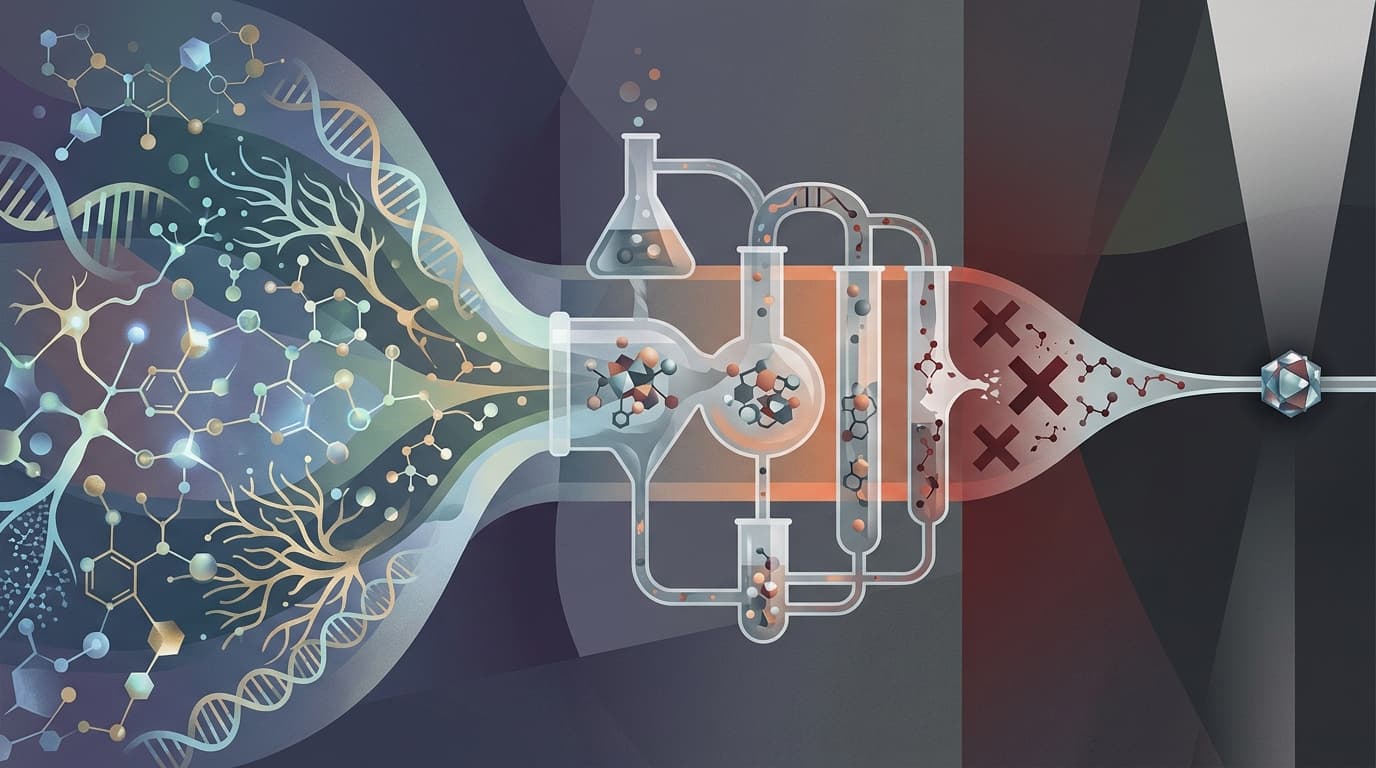
Syneron's proprietary platform, called Synova, uses artificial intelligence to design, screen, and optimize macrocyclic peptides at massive scale. Instead of the traditional approach (synthesize a bunch of molecules, test them one by one, hope something sticks), Synova generates enormous libraries of peptide candidates and uses machine learning to predict which ones will actually work.
Think of it as the difference between wandering through a city looking for a restaurant versus having an algorithm sort every menu in town by exactly what you're craving. The AI doesn't eliminate the need for lab work, but it dramatically narrows the search.
Get tomorrow's biotech intelligence before your competitors.
Join thousands of biotech professionals who start their day with our free, daily briefing.
The platform targets diseases across oncology, autoimmune conditions, metabolic disorders, and rare diseases. That breadth is part of what makes investors salivate; this isn't a one-trick pony betting everything on a single drug.
Follow the Money (It Tells a Story)
The Series B was led by an unnamed international life sciences fund, with co-leads Decheng Capital and CDH VGC. But the supporting cast is where things get really interesting.
A wholly owned subsidiary of the Abu Dhabi Investment Authority (one of the world's largest sovereign wealth funds) participated. So did True Light Capital, an independent subsidiary of Singapore's Temasek. Throw in Qiming Venture Partners, BioTrack Capital, and a slate of returning investors including AstraZeneca, LAV, Sinovation Capital, 5Y Capital, GL Ventures, and Lenovo Capital, and you've got a cap table that looks like it was assembled at Davos.
When sovereign wealth funds start showing up alongside pharma giants, it signals something beyond typical venture enthusiasm. These are institutions that measure investment horizons in decades, not quarters.
AstraZeneca's Double Down
Perhaps the most telling detail: AstraZeneca came back for seconds. The pharma giant first invested in Syneron's Series A round in December 2025, but their relationship goes deeper than equity checks. Back in March 2025, AstraZeneca signed a collaboration deal with Syneron worth $75 million in upfront and near-term payments, with potential milestone payouts reaching up to $3.4 billion.
That's a pharma company putting real money behind Syneron's platform and buying shares in the company. It's like a restaurant critic not only giving you five stars but also investing in your franchise. AstraZeneca clearly believes the Synova platform can deliver clinical candidates worth billions.
The pharma giant has been on a signing spree with Chinese biotechs, inking 16 licensing deals since 2023 as part of a broader $15 billion China investment commitment through 2030. Syneron is one of the crown jewels in that portfolio.
The Bigger Picture: AI Biotech's Funding Frenzy
Syneron isn't raising in a vacuum. Early 2026 has been a banner period for AI-enabled biotech platforms pulling in Series B rounds north of $75 million. Ambrosia Biosciences grabbed $100 million for oral GLP-1 drugs in March. ILiAD Biotechnologies raised $115 million in February. QuantX Biosciences brought in $85 million with Sanofi Ventures on board.
Investors are clearly placing big bets that AI can compress drug discovery timelines and improve success rates. The question, as always, is whether the technology translates from impressive demos to actual drugs in actual patients.
One analyst from AInvest noted that while the sovereign wealth participation adds long-term credibility, the rapid fundraising pace also introduces risks: dilution for early investors and execution uncertainty, given that no specific clinical timelines have been disclosed. It's a lot of capital deployed before any clinical data arrives.
What Could Go Wrong (Because Something Always Can)
For all the hype, Syneron still faces real challenges. The macrocyclic peptide space is getting crowded. PeptiDream, the Japanese pioneer in the field, has inked deals with Novartis worth up to $2.71 billion and collaborations with Ono Pharmaceutical. AbbVie acquired Nimble Therapeutics in December 2024 specifically to boost its oral peptide discovery capabilities. Eli Lilly partnered with Peptron in October 2024.
Syneron's AI-first approach is a differentiator, but it needs to prove the platform can produce clinical candidates that survive the brutal gauntlet of human trials. The real payday comes from owning drugs that work, not just the platform that finds them.
CEO Dr. Xiao Zhang has emphasized that the new financing strengthens the company's cash position for "global patient impact." That's the right aspiration. Now comes the hard part: turning a quarter-billion dollars in investor confidence into medicines that change lives.
The Bottom Line
Syneron Bio has accomplished something remarkable for a three-year-old company. Raising $250 million across two rounds in four months, with backing from AstraZeneca, sovereign wealth funds, and top-tier VCs, puts it in rare company. The Synova platform's AI-driven approach to macrocyclic peptides is genuinely compelling, and the AstraZeneca partnership (with its $3.4 billion ceiling) provides both validation and a clear commercial pathway.
But biotech has a long history of well-funded platforms that never delivered a drug. The next chapter of Syneron's story won't be written by investors; it'll be written in the clinic. That's where we'll find out if this Goldilocks molecule is truly just right.
Clinical & Regulatory
4 min read
The $15 Billion Question Hanging Over Biotech's Future
The White House wants to cut $15.8 billion from HHS, including a $5 billion hit to NIH. Congress has killed proposals like this before, but the uncertainty alone is already doing damage to America's biotech pipeline.