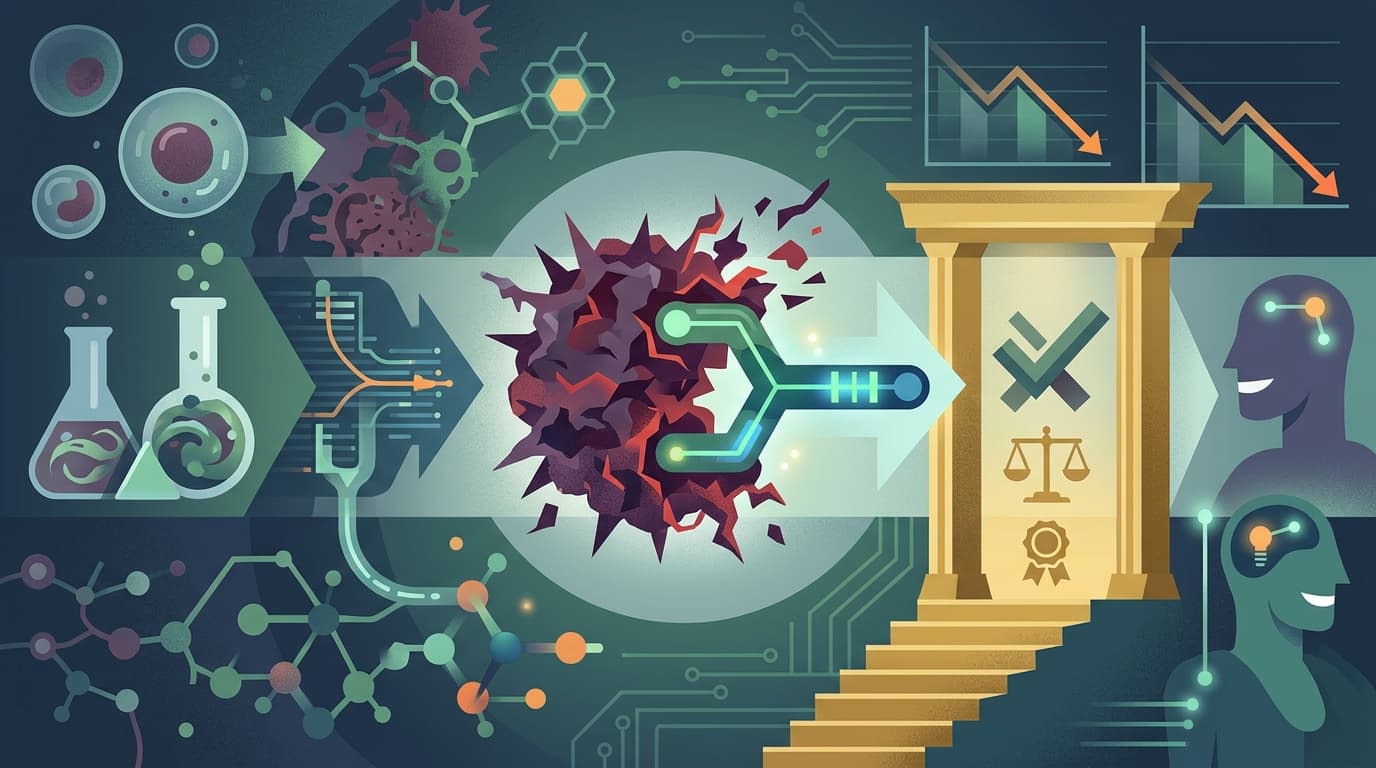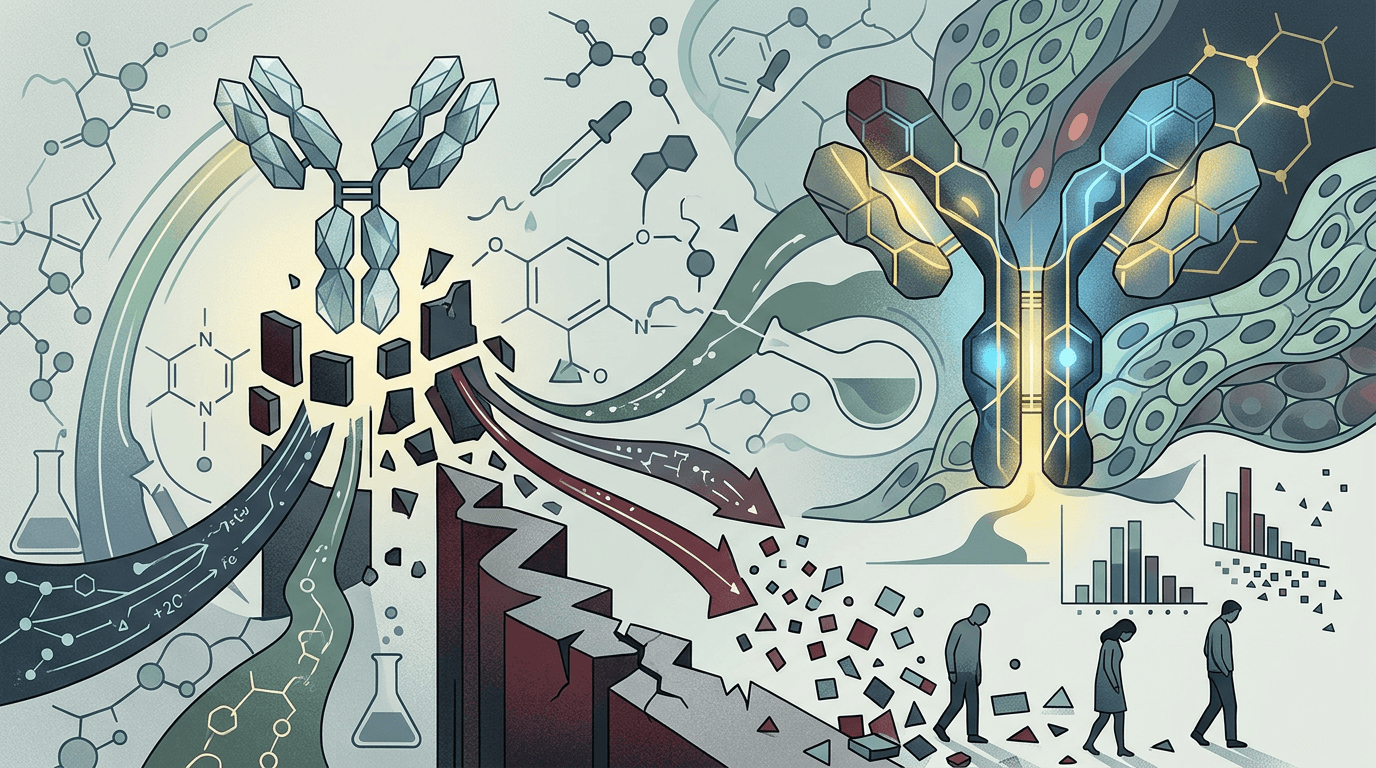

Summit Therapeutics' stock cratered up to 28% after its ivonescimab trial missed a key interim endpoint in squamous lung cancer. For a company that bet $5 billion on dethroning Keytruda, the timing couldn't be worse.
Summit Therapeutics spent three years telling investors it had the drug that could take down Keytruda, the best-selling cancer medicine on the planet. On May 1st, the market delivered its verdict: shares cratered as much as 25% in a single day, falling from roughly $20.83 to around $15.62.
The reason? Interim data from its HARMONi-3 trial missed expectations. The squamous lung cancer cohort failed to hit its progression-free survival benchmark (basically, how long patients go before their tumors start growing again). For a company that had positioned itself as the next king of immuno-oncology, this was the biotech equivalent of a frontrunner tripping on the final lap.
To understand why this stings so badly, you need to know what ivonescimab is and why Wall Street was so excited about it.
Ivonescimab is a bispecific antibody, which is a fancy way of saying it's a single molecule that hits two targets at once: PD-1 and VEGF. Think of it like a Swiss Army knife instead of carrying two separate tools. PD-1 blockade helps your immune system see cancer cells. VEGF blockade cuts off the blood supply tumors need to grow. Combine both in one drug, and (in theory) you get something better than either approach alone.
Summit licensed ivonescimab from Chinese biotech Akeso back in December 2022, paying $500 million upfront with up to $5 billion in milestones. The deal gave Summit exclusive rights in the U.S., Canada, Europe, and Japan. It was one of the largest licensing deals in the PD-1/VEGF space, and it came with serious expectations attached.
Before this week's stumble, the story looked compelling. Ivonescimab already had multiple positive Phase III studies under its belt and a BLA (the formal application for FDA approval) accepted for EGFR-mutant lung cancer, with a decision date set for November 14, 2026. Summit wasn't some scrappy startup swinging for the fences; it had real clinical data and a regulatory path.
The HARMONi-3 trial tests ivonescimab plus chemotherapy against Keytruda plus chemotherapy in first-line non-small cell lung cancer. It's the kind of head-to-head showdown investors love, because beating the standard of care is how you steal market share.

Two Oxford companies are teaming up to decode the genetic roots of autoimmune disease, and their bet could reshape how drug targets are chosen. Genomics Ltd. brings the world's largest gene dataset; Greywolf Therapeutics brings the clinical candidates. The result might just fix your immune system's friendly-fire problem.


Join thousands of biotech professionals who start their day with our free, daily briefing.
But lung cancer isn't one disease. The squamous subtype (named for the flat cells where the cancer originates) tends to be trickier. Squamous tumors are more commonly found in smokers, respond differently to treatment, and have historically been harder to crack with VEGF-targeting drugs. The interim analysis in this particular cohort is where the wheels came off.
Full trial data from HARMONi-3 is still expected in the second half of 2026. So it's possible the non-squamous cohort tells a different story. But "just wait for the rest of the data" is a tough sell when your stock just lost a quarter of its value.
The clinical miss would have been painful on its own. Pair it with Summit's first-quarter financials, and you've got a one-two punch that rattled even the bulls.
Summit reported a net loss of $189.4 million for Q1 2026, more than triple the $62.9 million loss from the same quarter a year ago. Operating expenses ballooned to $195.2 million, up from $66.8 million. The GAAP loss per share came in at $0.24, missing the consensus estimate of $0.27. Running five global Phase III trials simultaneously is expensive, and when the data disappoints, that burn rate goes from "aggressive" to "alarming" in a hurry.
Piper Sandler responded by trimming its price target to $16 from $17 while keeping a Neutral rating. At least one analyst maintained a Buy with a $40 target, arguing the November FDA decision could still unlock major value. That's a wide spread, which tells you how divided the Street is right now.
Summit isn't the only company chasing the PD-1/VEGF dream. This drug class has attracted significant licensing deal activity since 2024, as Big Pharma scrambles to defend against (or join) the bispecific revolution.
Pfizer licensed SSGJ-707 from 3SBio. BioNTech grabbed PM8002 from Biotheus in a deal worth $55 million upfront plus over $1 billion in milestones. Merck KGaA struck a deal with Hengrui worth €1.4 billion covering HRS-1167 and SHR-A1904. And Merck (the U.S. one, Keytruda's maker) is running its own candidate, MK-2010, which showed a 55% response rate in early NSCLC data.
The core question now is whether all PD-1/VEGF bispecifics are created equal, or whether ivonescimab's squamous miss reveals something specific about this drug. If it's a class-wide issue with squamous tumors, the entire sector takes a hit. If it's ivonescimab-specific, competitors might actually benefit from Summit's stumble.
Summit's bad week fits into a broader pattern. The immuno-oncology combination space has been humbling investors lately.
IO Biotech's Keynote-D18 trial failed in melanoma in August 2025. The TIGIT pathway, once considered a promising checkpoint target, has racked up serial failures from Roche, Merck, BMS, and iTeos/GSK. The common thread? Early-stage excitement that didn't survive the rigor of large, randomized trials. iTeos/GSK's belrestotug showed promising response rates in mid-stage testing, then delivered no meaningful benefit in the pivotal study. It's like acing every practice exam and bombing the final.
Investors are getting pickier as a result. "Rational combinations" (checkpoint inhibitors paired with chemo or antibody-drug conjugates) still get funding. But novel dual-target experiments face a higher bar, both from regulators and from the market.
Summit's story isn't over. The FDA decision on ivonescimab for EGFR-mutant lung cancer arrives in November. And full HARMONi-3 data later this year could redeem (or further damage) the narrative.
But May 1st was a reminder that in biotech, positioning and promise only take you so far. At some point, the data has to deliver. Summit bet billions that one molecule could do the work of two. The molecule just blinked.
The FDA just approved the first-ever PROTAC, a drug that doesn't just block cancer proteins but destroys them entirely. Vepdegestrant's approval for ESR1-mutated breast cancer validates an entirely new class of medicine, and the implications stretch far beyond one tumor type.