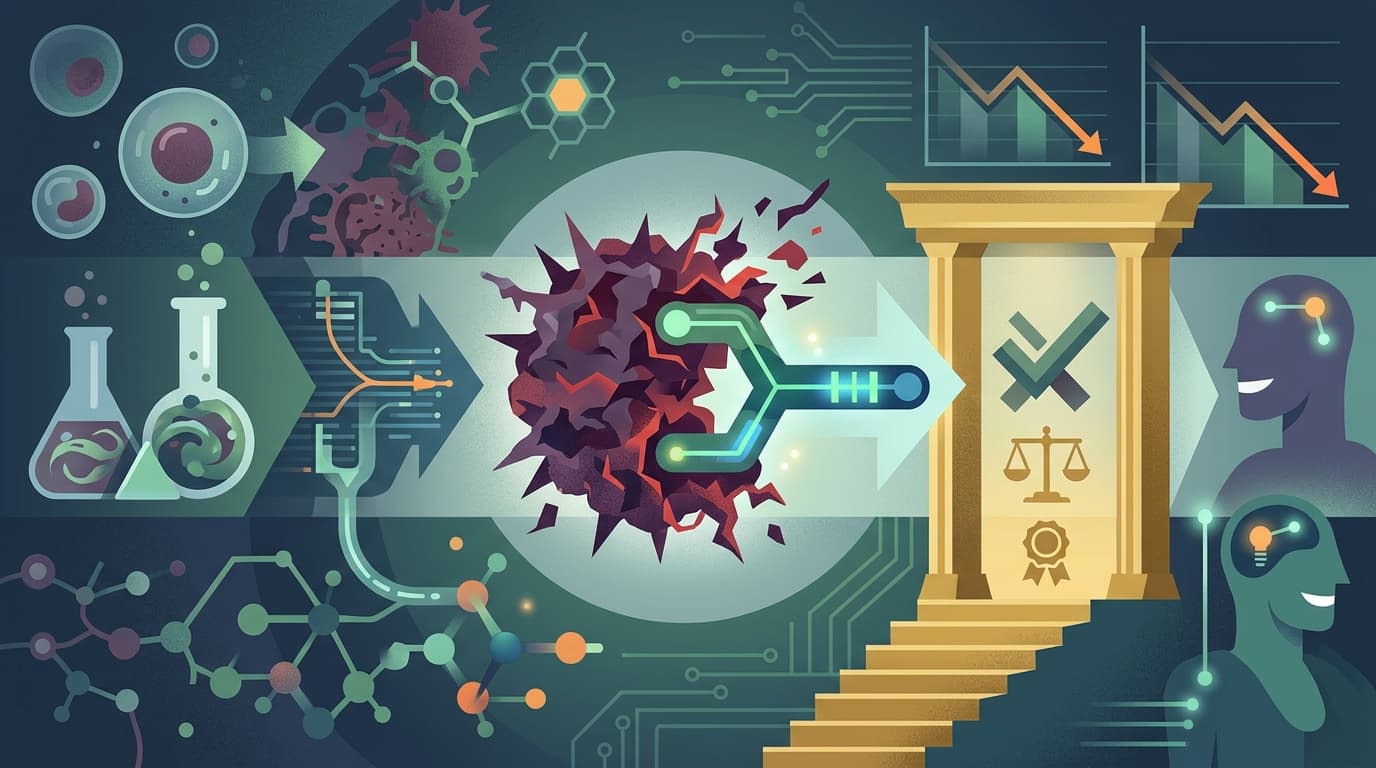

Two Oxford companies are teaming up to decode the genetic roots of autoimmune disease, and their bet could reshape how drug targets are chosen. Genomics Ltd. brings the world's largest gene dataset; Greywolf Therapeutics brings the clinical candidates. The result might just fix your immune system's friendly-fire problem.
Imagine a nightclub bouncer who starts turning away the regulars. Instead of kicking out troublemakers, he's roughing up the loyal customers. That's basically what happens in autoimmune disease: your immune system, built to attack invaders, starts targeting your own healthy tissue instead.
About one in ten people worldwide deal with some form of autoimmune condition. And despite decades of research, most treatments still work by suppressing the whole immune system, which is a bit like fixing the bouncer problem by firing all the security guards.
Two Oxford-based companies think they've found a better approach. And it starts with reading the genetic playbook that tells the bouncer who to let in.
On April 29, Genomics Ltd. and Greywolf Therapeutics announced a strategic partnership to dig through massive gene datasets looking for clues about autoimmune disease. Specifically, they're hunting for variants in two genes called ERAP1 and ERAP2 (Endoplasmic Reticulum Aminopeptidases, which are enzymes that help cells chop up proteins and display them on their surface so the immune system can decide: friend or foe).
When these enzymes malfunction, cells display the wrong protein fragments. The immune system sees unfamiliar faces and panics. T cells, the body's soldiers, start attacking healthy tissue. That's the molecular root of conditions like axial spondyloarthritis (a painful inflammatory spine disease), psoriatic arthritis, and potentially type 1 diabetes.
Genomic studies have linked ERAP variants to autoimmune risk for years. What's been missing is a way to systematically figure out which patients, with which variants, in which diseases would benefit most from targeting these enzymes. That's exactly the gap this partnership aims to fill.
Genomics Ltd. operates what it calls the world's largest harmonized genotype-phenotype dataset, essentially millions of genetic profiles matched with real health outcomes. The company was co-founded by Professor Sir Peter Donnelly, former Director of the Wellcome Centre for Human Genetics at Oxford. Think of Genomics as a massive genetic library with an AI-powered search engine that can cross-reference variants across independent studies at scale.

The FDA just approved the first-ever PROTAC, a drug that doesn't just block cancer proteins but destroys them entirely. Vepdegestrant's approval for ESR1-mutated breast cancer validates an entirely new class of medicine, and the implications stretch far beyond one tumor type.


Join thousands of biotech professionals who start their day with our free, daily briefing.
Their client list backs up the credibility. Genomics has maintained a partnership with Vertex Pharmaceuticals since 2018, extending it multiple times (most recently a three-year renewal in July 2024). They've also collaborated with Biogen since 2015. In February 2026, they opened a flagship London office and unveiled new AI capabilities.
Greywolf Therapeutics is the clinical-stage partner bringing the drug candidates. Founded in 2017, the company has raised nearly $100 million in Series B funding, with backers including Pfizer Ventures, ICG Life Sciences, Andera Partners, and Canaan. Their technology modulates antigen presentation (the process by which cells show protein fragments to the immune system) by inhibiting ERAP1.
Greywolf already has two programs in the clinic. GRWD5769 is in a Phase 1/2 trial for solid tumors, and GRWD0715 is in a Phase 1/2 trial for axial spondyloarthritis. The Genomics partnership is designed to expand that autoimmune footprint beyond spine disease.
Drug development is brutally expensive, and most candidates fail. One of the best ways to improve your odds? Start with a target that human genetics already points to.
Genomic evidence suggests that drug targets backed by genetic data are more than twice as likely to succeed in clinical trials compared to those without such backing. That statistic, cited by Genomics, explains why pharma companies are racing to partner with genomic data platforms.
This partnership essentially functions as a de-risking exercise. Before Greywolf commits the resources to run expensive late-stage trials in multiple autoimmune diseases, Genomics can help them figure out where the genetic signal is strongest. Which patient populations? Which indications? Where is ERAP dysfunction most clearly driving disease?
As Greywolf CEO Peter Joyce put it: "Understanding the genetic drivers... is crucial to assessing which patient populations to initially focus on... to further strengthen and de-risk our pipeline."
This deal didn't happen in a vacuum. The entire pharma industry is shifting toward genomics-driven target discovery, and the pace of dealmaking in 2026 has been staggering.
Eli Lilly inked a $1.1 billion partnership with Seamless Therapeutics in January 2026 for gene editing in genetic hearing loss. Takeda partnered with Iambic AI for small-molecule design. Illumina unveiled its Billion Cell Atlas at the J.P. Morgan Healthcare Conference, with AstraZeneca, Eli Lilly, and Merck signed on as first partners to validate genetic targets using AI at massive scale.
The common thread? Companies are no longer treating genomic data as a nice-to-have side project. It's becoming the foundation of how drugs get discovered, validated, and aimed at the right patients.
Financial terms of the Genomics/Greywolf deal were not disclosed. No IP licensing, option rights, or commercialization agreements were announced; this is purely an R&D collaboration.
That's worth noting. This isn't a blockbuster M&A deal or a billion-dollar licensing agreement. It's two companies pooling their strengths (data on one side, drug candidates on the other) to figure out where to swing next. The real payoff, if it comes, will show up years from now when Greywolf either expands into new autoimmune indications with confidence or avoids wasting resources on the wrong ones.
The Genomics/Greywolf partnership is a quiet deal with a loud thesis: the era of guessing at drug targets is ending. Genetic data, combined with AI-powered analysis, is becoming the compass that guides where clinical dollars go.
For patients with autoimmune diseases, that matters enormously. Instead of broad immune suppression (the equivalent of carpet-bombing your own body), the next generation of treatments could be precisely targeted based on your specific genetic profile.
Greywolf's bouncer won't just be fired. He'll be retrained to do his job properly. And Genomics is handing over the employee manual.
The FDA's biologics center just lost its fifth director in a little over a year. Vinay Prasad's exit leaves CBER in limbo at a moment when gene therapies, cell therapies, and vaccines hang in the balance, and analysts are warning of months of regulatory volatility ahead.