Big Pharma Got a Hall Pass on Drug Tariffs. Small Biotechs Got the Bill.
Trump's 100% drug tariffs came with plenty of escape hatches for Big Pharma. Small biotechs got a maze of unclear exemptions and no map. The innovation gap is about to get a lot wider.
Imagine you're a 15-person biotech company in Cambridge, Massachusetts. You've spent years developing a promising drug. Your active ingredients come from a contract manufacturer overseas. And then one morning, the government slaps a 100% tariff on your imported patented pharmaceuticals.
You scramble to figure out if you qualify for an exemption. You call your lawyers. You call your trade group. Nobody has a clear answer. Meanwhile, Pfizer and Johnson & Johnson already cut deals with the White House months ago.
Welcome to the fall of 2026, where the U.S. drug tariff regime has become the most lopsided playing field in biotech.
The Rules Only Make Sense If You're Already Rich
The Trump administration's Section 232 tariffs on pharmaceuticals rolled out in two waves: one on July 31 and a broader expansion on September 29. The headline rate on imported patented drugs and their active ingredients? A staggering 100%.
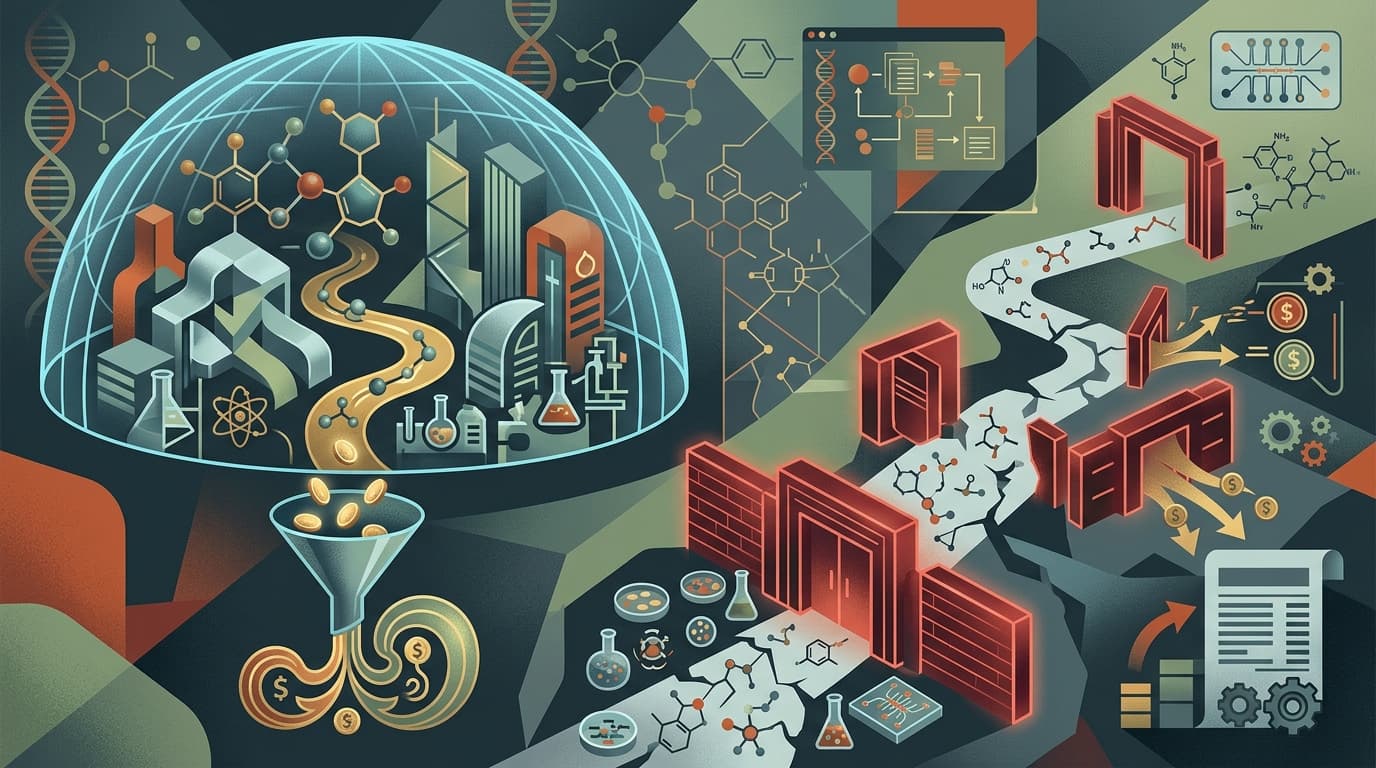
But the system is riddled with carve-outs, and that's where the trouble starts. Large drugmakers that signed Most Favored Nation (MFN) pricing agreements with the administration won't have to pay tariff costs until early 2029. Companies that committed to building U.S. manufacturing facilities got their rate knocked down to 20%. Products from allied countries like the EU, Japan, and South Korea generally face just 15%.
Sounds like plenty of escape hatches, right? Sure, if you're a Fortune 500 pharma giant with a government affairs team and billions in capital to pledge toward a shiny new American factory. If you're a small biotech burning cash to keep clinical trials alive, these relief paths might as well be written in ancient Greek.
A Factory Isn't Exactly a Weekend Project
One of the main routes to tariff relief is committing to domestic manufacturing. The problem: building a new pharmaceutical plant can take 5 to 10 years and cost up to $2 billion. For a pre-revenue biotech with 50 employees and a single drug candidate, that's not a strategy. That's a fantasy.
Get tomorrow's biotech intelligence before your competitors.
Join thousands of biotech professionals who start their day with our free, daily briefing.
Most smaller biotech companies rely on overseas contract manufacturers to produce their drugs and raw ingredients. They don't own factories. They don't have the leverage to renegotiate supply contracts overnight. And they certainly can't absorb a 100% cost increase on imported inputs while simultaneously funding R&D, regulatory filings, and (if they're lucky) early commercialization.
Think of it like a neighborhood restaurant competing against a fast-food chain. McDonald's can negotiate bulk deals on beef, build its own distribution network, and absorb a price spike on imports. The family-owned bistro? It just watches its margins evaporate.
The Exemption Maze Nobody Can Navigate
In theory, the tariff framework includes a decent list of exemptions. Generics are safe at a 0% rate for two years starting August 2026. Biosimilars are specifically exempt. Orphan drugs (treatments for rare diseases) qualify if all approved uses carry orphan designation. Cell and gene therapies, plasma-derived products, nuclear medicines, and several other specialty categories also got carve-outs.
There's even a research exemption: products imported solely for clinical trials and R&D face a 0% additional tariff. That's a meaningful lifeline for early-stage companies.
But knowing exemptions exist and actually qualifying for them are two very different things. STAT News reported on October 8 that smaller biotech companies are still waiting for clear guidance on how to determine eligibility and complete the required paperwork. Trade group BIO has been vocal about the confusion, arguing that companies are left uncertain about how to even apply for relief.
The practical question for many biotechs boils down to classification: is your product a patented pharmaceutical, a biologic, a biosimilar, or one of the exempt specialty categories? The answer determines whether you owe nothing or owe double.
The Gap Is Getting Wider
The White House has touted roughly $400 billion in new U.S. pharmaceutical investment commitments as evidence the tariff policy is working. And for big pharma, that narrative holds up. Large companies have the capital to pledge domestic facilities, the legal teams to negotiate MFN pricing deals, and the organizational depth to run dedicated tariff compliance units.
Small biotechs have none of that. They're running lean teams where the same person might handle regulatory submissions, investor relations, and now, apparently, international trade law. The tariff compliance burden isn't just financial; it's organizational. When your company has 20 employees, there's no "tariff team." There's just more work piled on people who were already stretched thin.
PhRMA president Stephen Ubl has warned that tariffs could jeopardize billions in U.S. manufacturing investments and undermine the goal of keeping America the best place to discover and manufacture medicines. BIO has gone further, calling for a longer-term strategy built around incentives, tax credits, and workforce investment rather than punitive tariffs.
What This Means for the Pipeline
Analysts are flagging a worrying downstream effect: less money for research. When operating costs spike, something has to give. For cash-constrained biotechs, that something is often R&D spending. Early-stage programs get shelved. Hiring freezes kick in. Partnerships become harder to negotiate because investors now view tariff exposure as an added risk factor.
Some analysts warn the tariffs could push weaker companies toward mergers, asset sales, or outright shutdown. The net effect isn't a total freeze on innovation, but a likely reallocation of investment toward larger firms, domestic manufacturing, and lower-risk programs. The bold, swing-for-the-fences science that small biotechs are famous for? That's the stuff most at risk.
It's worth remembering that small biotechs punch well above their weight in drug discovery. They originate a disproportionate share of new medicines that eventually reach patients. Squeezing them financially doesn't just hurt their balance sheets; it narrows the entire pipeline of future treatments.
The Bottom Line
The tariff system, as it stands, rewards scale. Companies big enough to negotiate pricing deals, commit to billion-dollar factories, or staff up compliance teams can navigate it. Companies that can't are left guessing, paying, or both.
If the administration wants tariffs to strengthen American drug manufacturing without kneecapping the innovators who discover most new medicines, it needs to offer smaller biotechs a realistic path to relief. Clear guidance on exemptions would be a start. Broader carve-outs for pre-revenue companies would help more. But right now, the system feels like it was designed by people who forgot that the biotech ecosystem doesn't begin and end with the ten biggest drugmakers.
The best drugs of the next decade are probably being developed right now in small labs with tight budgets. Whether those drugs survive the tariff era is an open question, and it's one worth taking seriously.
4 min read
Roche Is Hiring a Chinese Startup to Invent Its Next Cancer Drug
Roche signed a deal worth up to $1 billion with Defand Therapeutics, a two-year-old Chinese startup with zero clinical trials, to discover molecular glue cancer drugs. It's Roche's fourth China partnership since August, and it signals a radical shift in how big pharma thinks about drug discovery.