
Huntington's disease has wrecked every RNA-targeting drug that's tried to crack it. Skyhawk Therapeutics just dropped 15-month data for an oral pill that shows patients actually improving, not just declining slower. The catch? The real test hasn't started yet.
Huntington's disease has broken more drug programs than almost any other disease in neuroscience. In 2021, Roche pulled the plug on tominersen, its most advanced antisense therapy, after a Phase 3 trial showed an unfavorable overall benefit/risk profile. That same year, Wave Life Sciences struck out with its own huntingtin-lowering programs. In 2022, Novartis shelved branaplam after patients developed nerve damage. By 2024, Roche's follow-up trial with tominersen also failed.
The lesson was brutal and clear: just because you can lower the toxic protein doesn't mean patients get better.
So when Skyhawk Therapeutics reported 15-month data for its Huntington's drug SKY-0515 on September 15, 2026, the whole field leaned in. And the numbers are worth leaning in for.
The headline finding is striking. Patients on SKY-0515 didn't just decline more slowly than expected. They actually improved by 0.94 points on a composite score called cUHDRS, which bundles together measures of movement, thinking, and everyday function. Meanwhile, a matched group of untreated patients from a large natural-history database declined by 0.65 points over the same period.
That's a 1.59-point gap between the two groups, and it was statistically significant (p<0.001).
To put that in context: Huntington's is a disease where patients only go in one direction. Stopping the slide would be remarkable. Reversing it, even modestly, would be unprecedented. Skyhawk says the advantage showed up at every prespecified timepoint. All four components of the score favored the drug, including motor function, cognitive speed, and the ability to handle daily tasks.
This isn't a story about one lucky measurement on one lucky day.
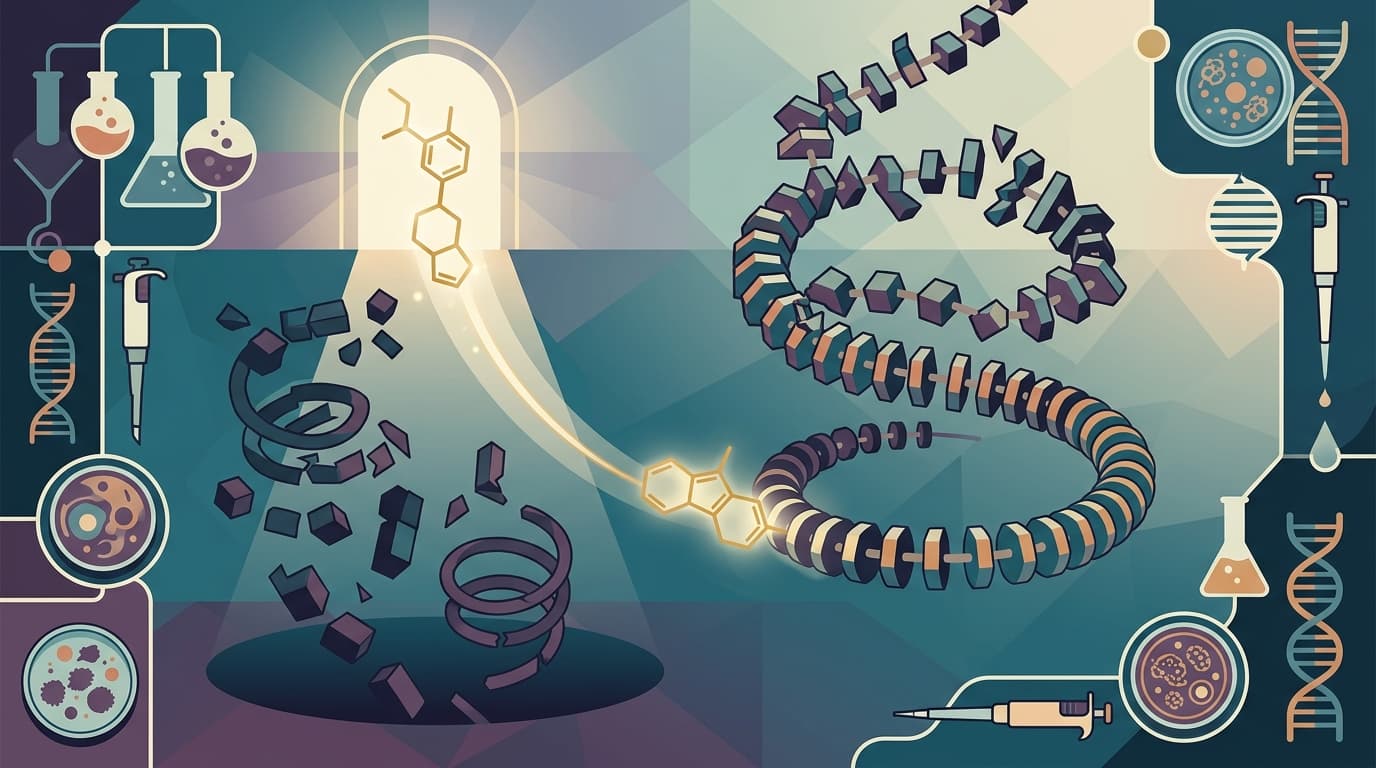
Most of the previous Huntington's failures relied on antisense oligonucleotides (ASOs), which are essentially synthetic DNA fragments injected into the spinal fluid to block production of the toxic huntingtin protein. Think of them as molecular scissors that cut a specific genetic message before it can do damage.

Novo Nordisk partnered with Anthropic to deploy Claude AI across its drug development pipeline, adding to deals with OpenAI and NVIDIA. The world's most valuable pharma company wants to become 'the most AI-driven healthcare company,' and the broader industry is sprinting to keep up.


Join thousands of biotech professionals who start their day with our free, daily briefing.
SKY-0515 takes a different route. It's an oral RNA splicing modifier: a pill that changes how cells read the genetic instructions for huntingtin. Instead of cutting the message after it's made, splicing modifiers rearrange how the message gets assembled in the first place. If an ASO is like intercepting a letter at the post office, a splicing modifier rewrites the letter at the source.
The practical upside? Patients swallow a pill instead of getting a spinal tap. That alone could change who's willing to enroll in trials and, eventually, who's willing to stay on treatment for years.
Biologically, SKY-0515 also appears to be hitting its targets. At the 9 mg dose, the drug reduced mutant huntingtin protein by more than 60% and lowered PMS1 mRNA (a genetic modifier linked to disease onset) by more than 25%. Safety looked clean: no treatment-related serious adverse events were reported in the dataset.
Before you start printing "Huntington's: Solved" t-shirts, some important caveats.
This was a small Phase 1/2 study. The comparison group wasn't randomized; it was drawn from an external database called Enroll-HD. External controls are like comparing your marathon time to your neighbor's Strava data. Useful, sure, but not the same as running side by side.
The Huntington's field has been burned specifically by the gap between encouraging biomarker results and actual clinical benefit. Tominersen lowered huntingtin protein beautifully. It still failed. Branaplam had a plausible mechanism. It still caused nerve damage. The pattern has taught everyone a painful lesson: biology isn't destiny until a placebo-controlled trial says so.
Skyhawk knows this. The company is already running FALCON-HD, a randomized, double-blind, placebo-controlled Phase 2/3 trial that enrolled 144 patients with Stage 2 and early Stage 3 Huntington's across Australia and New Zealand. That's the real test.
Right now, Huntington's patients can get drugs that manage symptoms like involuntary movements and mood changes. That's it. There is no approved therapy that slows or stops the underlying brain degeneration. The disease affects an estimated 41,000–43,000 people in the U.S. alone, with many more carrying the gene mutation and waiting to find out when symptoms will start.
Every approved treatment is essentially rearranging deck chairs. What patients need is someone to steer the ship.
Skyhawk isn't the only company still trying. PTC Therapeutics is running its own oral splicing modifier, PTC518, through Phase 2 trials for Huntington's. Roche and Novartis remain active in the broader RNA therapeutics space, though both carry the scars of their earlier Huntington's setbacks. The competitive landscape is small but real, and the first company to prove disease modification in a controlled trial could define the market.
SKY-0515's 15-month data is genuinely encouraging. A 1.59-point functional advantage, consistent results across every measured domain, solid target engagement, clean safety, and an oral route of administration: that's a compelling package for a disease that has humbled everyone who's tried.
But compelling packages have fallen apart before in Huntington's. The FALCON-HD trial will be the moment of truth. If the drug holds up against a real placebo group in a properly powered study, Skyhawk won't just have validated SKY-0515. It will have validated an entirely new way of attacking neurodegeneration.
For now, the data earns something rare in Huntington's research: cautious optimism that isn't foolish.
Roche just signed a deal worth up to $1 billion with a three-year-old startup that can screen 300,000+ bispecific antibody combinations at once. The real story isn't the price tag; it's what it says about the future of drug discovery.