Roche Just Paid $36.5M for a Machine That Tests 300,000 Antibody Combos
Roche just signed a deal worth up to $1 billion with a three-year-old startup that can screen 300,000+ bispecific antibody combinations at once. The real story isn't the price tag; it's what it says about the future of drug discovery.
The Needle-in-a-Haystack Problem
Imagine you're trying to find the perfect pair of dance partners in a room of thousands. Not just two people who can dance individually, but two who move better together than either could alone. Now multiply that room by a hundred.
That's roughly the challenge facing bispecific antibody discovery. Bispecific antibodies are engineered proteins designed to grab two different targets at once, like a molecular bouncer with both hands full. They're one of the hottest drug formats in biotech right now. But figuring out which pair of targets actually produces a useful drug? That's still painfully slow.
Roche just bet big that a three-year-old startup can fix it.
What Roche Actually Bought
On September 17, 2026, Roche signed a deal with Dualitas Therapeutics, a South San Francisco biotech founded in 2023. The headline number: up to $1 billion in total deal value. The actual check Roche is writing today: $36.5 million upfront.
The rest comes in milestones and royalties, meaning Dualitas only collects if the science works and drugs eventually reach patients. Think of it like buying a house with a small down payment and a mortgage that only kicks in if the house appreciates. Roche gets to explore; Dualitas gets validated.
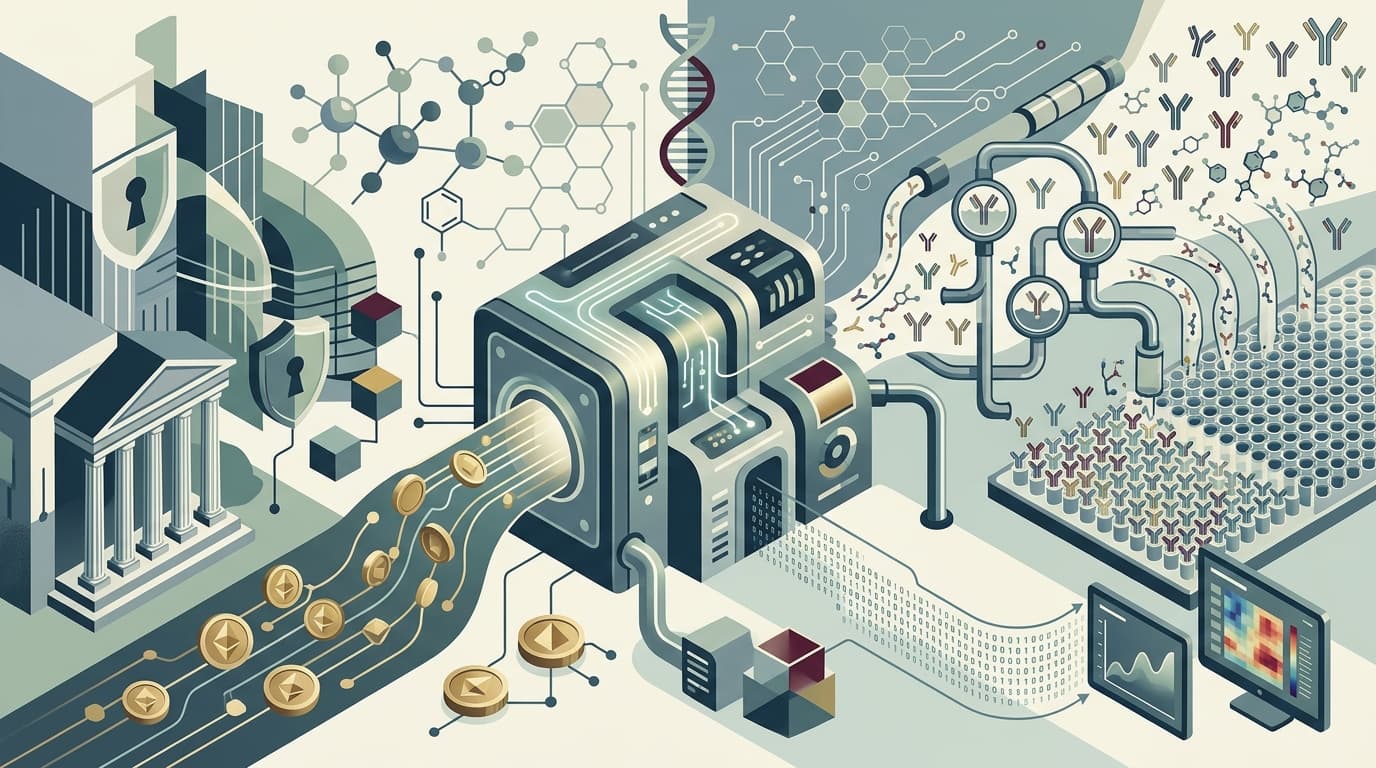
What makes Dualitas interesting isn't a single drug candidate. It's a platform called DualScreen, a discovery engine that can functionally test more than 300,000 bispecific combinations across the cell surface. Most traditional approaches start by picking two targets they think will work well together, then building a bispecific to test the hypothesis. DualScreen flips the script: screen everything first, then figure out what works.
It's the difference between trying on three outfits you think might look good and having a personal stylist who's already tested every combination in your closet.
Why Roche Needs This
Roche isn't a bispecific rookie. The Swiss pharma giant already has on the market: Hemlibra for hemophilia A, Lunsumio and Columvi for blood cancers, and PiaSky. It also has NXT007, a next-generation hemophilia drug planned to enter Phase III trials in 2026.
Get tomorrow's biotech intelligence before your competitors.
Join thousands of biotech professionals who start their day with our free, daily briefing.
four approved bispecific antibodies
So why go shopping for external technology?
Because Roche's bispecific strength has been concentrated in oncology and hematology. This Dualitas deal is aimed squarely at immunology and inflammation, a therapeutic area where bispecifics remain relatively underexplored. Roche is essentially opening a new front, and it needs better reconnaissance tools to do it.
The deal also reflects a broader strategic pattern. Roche has been consolidating around its strongest bispecific programs while pruning weaker early-stage assets. Rather than building a sprawling pipeline of mediocre candidates, the company appears to be investing in platforms that can generate smarter picks from the start. Dualitas offers exactly that: a way to let biology, not guesswork, dictate which target combinations deserve development resources.
The Bispecific Gold Rush
Roche is far from the only pharma giant writing big checks for bispecifics. In fact, the deal looks almost modest compared to some of its competitors' recent moves.
Bristol Myers Squibb paid $1.5 billion upfront (in a deal worth up to $11.1 billion total) to partner with BioNTech on a PD-L1/VEGF-A bispecific. Pfizer struck a deal with 3SBio worth up to $6.35 billion. AbbVie and RemeGen agreed to terms reaching $5.6 billion.
Bispecific antibodies were involved in six of the top 20 R&D licensing deals from January to October 2025 alone. The pace isn't slowing.
What's driving all this activity? Two things. First, pharma companies want differentiated drugs that can do more than a standard antibody. Bispecifics that hit two targets simultaneously can, in theory, be more effective with fewer side effects. Second, and this is the less obvious point: companies are competing for platform access, not just individual molecules. The firms that control the best discovery technology will generate the best candidates year after year. It's the classic "teach a man to fish" play.
The Part Nobody's Talking About
The biggest challenge in bispecific antibody development isn't building them. It's knowing what to build.
Traditional bispecific screening has several frustrating bottlenecks. Getting two different antibody chains to pair correctly (called "chain mispairing") is a persistent headache. Throughput is limited because each combination requires separate construction, expression, and testing. And here's the real kicker: just because two antibodies bind their respective targets doesn't mean they'll do anything useful together.
Binding is not function. That's the critical distinction. A bispecific might latch onto two cell-surface proteins perfectly well in a test tube and then do absolutely nothing meaningful in a living system. Many discovery programs waste years chasing combinations that look great on paper but flop in functional experiments.
Dualitas's DualScreen platform is designed to solve this by running function-first screens. Instead of asking "Do these two arms bind?", it asks "Does this combination actually do something biologically?" Across 300,000-plus combinations, that approach could surface mechanisms that conventional methods would never find, particularly proximity-dependent effects where two targets need to be physically close on a cell surface to trigger a therapeutic response.
What the Street Thinks
Analyst reaction has been measured, which is probably the right read. For a company Roche's size, a $36.5 million upfront payment barely registers on the income statement. The billion-dollar headline is real, but contingent on years of successful research, development, and commercialization.
The consensus: this deal is strategically smart but not a stock mover. It validates Dualitas's technology (a huge win for a startup barely three years old, led by co-founders Greg Lazar and Forbes Huang). And it fills a genuine gap in Roche's pipeline strategy by extending bispecific capabilities into immune and inflammatory diseases.
For Roche, the risk is low and the optionality is high. If DualScreen uncovers even one or two genuinely novel bispecific candidates in immunology, the deal will have paid for itself many times over.
The Bigger Picture
The bispecific antibody field is entering a new phase. The first wave was about proving the format could work at all. The second wave (where we are now) is about industrializing discovery: screening faster, smarter, and at a scale that would have been unthinkable five years ago.
Roche's bet on Dualitas is a signal that the competitive advantage in bispecifics is shifting. It's no longer enough to know how to build a bispecific antibody. Everyone can do that now. The winners will be the companies that know which ones to build. And knowing which ones to build requires the ability to test hundreds of thousands of possibilities and let biology, not intuition, pick the winners.
That's what $36.5 million buys you today. Whether it turns into a billion depends on what those 300,000 combinations reveal.
Funding & Financings4 min read
The Pill That Wants to Kill a $2 Billion Needle
Sling Therapeutics just raised $123 million to develop an oral pill that could replace IV infusions for thyroid eye disease. With Phase 2 data already in hand and a $2 billion market in its sights, this small company is picking a fight with Amgen and Viridian.