The First-in-Class Drug Attacking Liver Disease at Its Rusty Roots
Calliditas just proved a brand-new class of drugs can fight liver disease by targeting oxidative stress at its enzymatic source. The Phase 2b data are in, the mechanism is validated, and the competitive landscape is wide open.
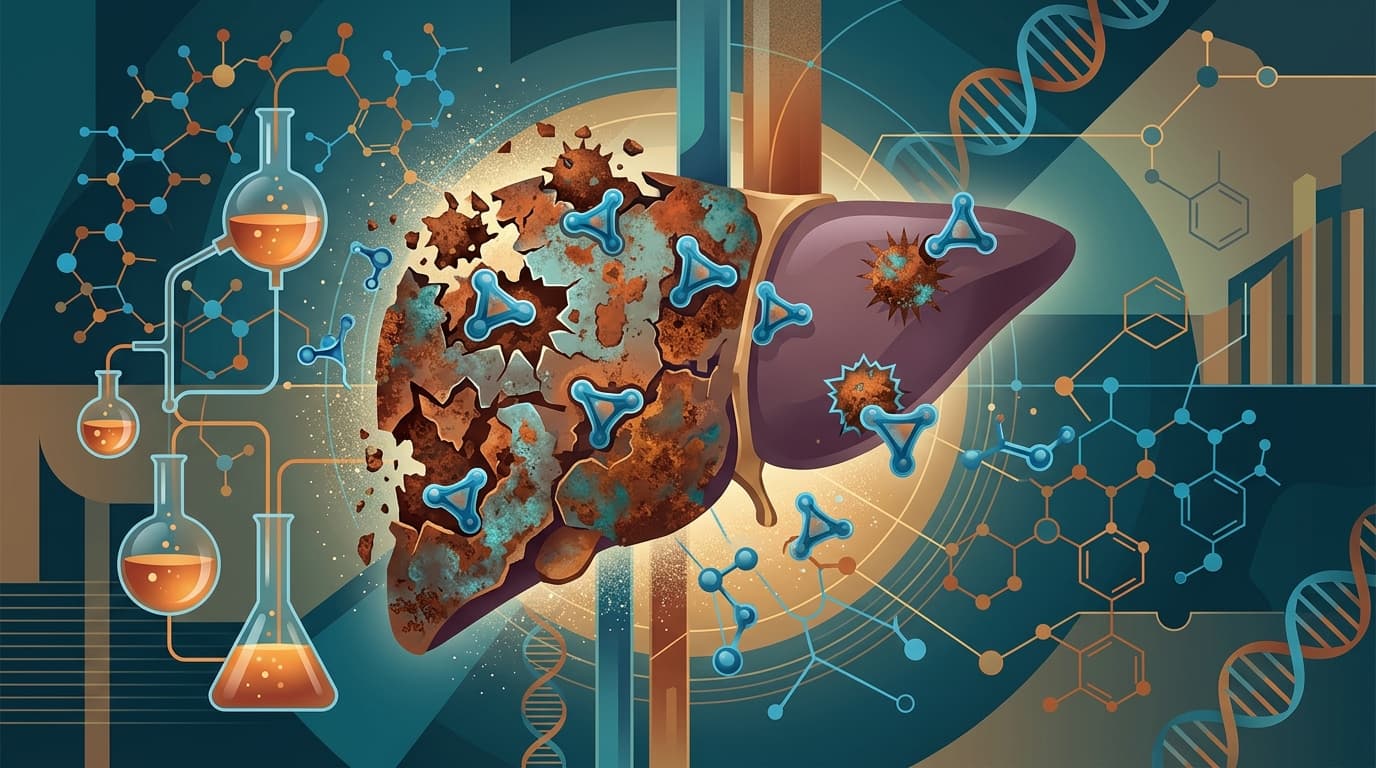
Your liver cells are basically rusting from the inside out. That's the core problem in primary biliary cholangitis (PBC), a chronic autoimmune liver disease where toxic bile acids slowly destroy the bile ducts, trigger runaway oxidative stress, and scar the organ into dysfunction. For decades, doctors have tried to slow the destruction. Now Calliditas Therapeutics says it can attack the rust itself.
The Swedish biotech just reported that its Phase 2b TRANSFORM trial of setanaxib hit its primary endpoint in PBC patients. Both doses of the drug significantly reduced alkaline phosphatase (ALP), a key marker of liver damage, compared to placebo over 24 weeks. It's the first clinical proof that a brand-new class of drugs called "naxibs" can move the needle in cholestatic liver disease.
And that matters a lot more than it sounds.
Why Your Liver Rusts (and Why Nobody's Fixed It)
Let's back up. PBC is a rare disease, but it's a nasty one. The immune system attacks the small bile ducts inside the liver. Bile builds up. That bile triggers a cascade of oxidative stress: essentially, certain enzymes called NADPH oxidases (NOX for short) start pumping out reactive oxygen species (ROS). Think of ROS as molecular rust. They damage cells, activate scar-forming cells called hepatic stellate cells, and drive fibrosis. Left unchecked, fibrosis can progress to cirrhosis. Cirrhosis can progress to a transplant list.
The standard first-line treatment, ursodeoxycholic acid (UDCA), has been around for decades. It works for a lot of patients, but roughly 30 to 40 percent don't respond adequately. For those people, the options have been frustrating.
Obeticholic acid (OCA) was once the go-to second-line therapy. It improved lab numbers, sure. But it also made patients itch like crazy, carried serious safety concerns in patients with advanced liver disease, and ultimately had its European marketing authorization revoked. Two newer PPAR agonists, seladelpar and elafibranor, were approved recently and represent a genuine step forward. They lower ALP, they're well-tolerated, and they even help with the itch.
Get tomorrow's biotech intelligence before your competitors.
Join thousands of biotech professionals who start their day with our free, daily briefing.
But none of them directly target the oxidative stress engine that drives fibrosis. They manage downstream consequences. Setanaxib is going after the factory floor.
What Setanaxib Actually Does
Imagine your liver's fibrosis process as a fire. Most current drugs are essentially hosing down the smoke. Setanaxib is trying to cut the gas line.
The drug is a first-in-class dual inhibitor of NOX1 and NOX4, two specific enzymes in the NADPH oxidase family. These enzymes are the primary producers of the ROS that drive oxidative stress in liver tissue. By blocking NOX1 and NOX4, setanaxib reduces ROS production at its source. Less ROS means less activation of the profibrotic pathways (particularly TGF-beta signaling) that tell stellate cells to start laying down scar tissue.
In preclinical models, the drug reduced stellate cell activation, cut collagen deposition, and dialed down inflammatory markers. The question was always whether that would translate to humans.
The TRANSFORM Trial: Small But Significant
TRANSFORM enrolled 76 adults with PBC who had elevated liver stiffness and either couldn't tolerate UDCA or weren't responding to it. They were randomized to one of two setanaxib doses (1,200 mg/day or 1,600 mg/day) or placebo for 24 weeks.
The primary endpoint was simple: did ALP go down?
It did. The 1,600 mg group saw roughly a 19% reduction in ALP from baseline. The 1,200 mg group dropped about 14%. Both were statistically significant versus placebo, and the effects showed up early; significant changes appeared from week 8 onward, and as early as week 4 when the dose groups were combined.
For context, ALP reduction is the accepted biochemical surrogate in PBC. It's how seladelpar and elafibranor got approved. A 19% drop at 24 weeks puts setanaxib in the conversation, though direct cross-trial comparisons are tricky.
The Fibrosis Signal: Promising, Not Proven
This is where things get more nuanced. Calliditas also measured liver stiffness using FibroScan, a non-invasive imaging tool that estimates how scarred the liver is. The results showed "positive trends" toward reduced stiffness in the setanaxib arms versus placebo.
But trends aren't statistical significance. And that distinction matters.
To be fair, detecting meaningful changes in liver stiffness typically requires a year or more of treatment. TRANSFORM only ran for six months. Earlier Phase 2a data from sicker patients (those with baseline stiffness above 9.6 kPa) had shown a roughly 3 kPa median reduction, consistent with about one stage of fibrosis improvement. So the biological plausibility is there. The 24-week window just may not have been long enough to capture it convincingly.
Notably absent from the topline results: fatigue data. Fatigue was a prespecified secondary endpoint and one of the most debilitating symptoms PBC patients face. When a company doesn't mention a secondary endpoint in its press release, experienced biotech watchers know what that usually means. It probably didn't look great.
The Safety Question Mark
Overall, the drug looked reasonably safe. Rates of adverse events and serious adverse events were similar between setanaxib and placebo. That's encouraging for a drug you'd need to take chronically.
But there's a wrinkle: more patients on setanaxib stopped treatment due to side effects than on placebo. The company hasn't fully detailed what those side effects were, and this is the kind of thing that makes analysts pause. A drug can have a great efficacy signal, but if patients keep dropping out, the real-world commercial story gets complicated.
Calliditas' Bigger Bet
Setanaxib in PBC isn't a one-off experiment. It's the centerpiece of a deliberate strategic pivot.
Calliditas built its reputation on Nefecon, a targeted-release oral budesonide for IgA nephropathy (a rare kidney disease). That drug gave the company commercial credibility and a revenue base. But one product does not a diversified pipeline make.
Enter Genkyotex. Calliditas acquired the French biotech in late 2020 and fully absorbed it by October 2021, gaining global rights to setanaxib and the entire NOX inhibition platform. The idea was elegant: one drug mechanism, multiple diseases.
Calliditas now describes setanaxib as a "pipeline in a product," and the breadth of its clinical program backs that up. Beyond PBC, the company is running a Phase 2 proof-of-concept trial in Alport syndrome (a rare genetic kidney disease), with topline data expected soon. There's an investigator-led Phase 2 in idiopathic pulmonary fibrosis. And perhaps most intriguingly, a Phase 2 trial in head and neck cancer (combining setanaxib with Merck's pembrolizumab) showed early signals of improved progression-free survival and overall survival in approximately 55 evaluable patients.
The oncology program is now listed as available for out-licensing, which tells you exactly how Calliditas is thinking: keep the rare diseases, monetize the oncology option through a partner.
A New Drug Class With Very Few Members
Setanaxib's significance extends beyond Calliditas' pipeline. The World Health Organization has formally recognized "naxibs" as a new drug class (NADPH oxidase inhibitors), and setanaxib is the most advanced member by a wide margin.
The competitive landscape is remarkably empty. A few NOX4-selective compounds are in early development for pulmonary fibrosis. Some older pan-NOX inhibitors like apocynin exist as research tools but lack the selectivity and drug-like properties needed for clinical development. That's basically it.
For liver fibrosis specifically, there is no other clinical-stage NOX inhibitor. Setanaxib doesn't just have a first-mover advantage; it has a "basically the only mover" advantage. Whether that translates into commercial opportunity depends entirely on Phase 3 execution.
What Comes Next
The TRANSFORM data are encouraging but clearly not the final word. A 14 to 19 percent ALP reduction is meaningful, and the mechanism of action is genuinely novel. But several questions remain open.
First, Calliditas needs to prove that setanaxib actually reduces fibrosis over a longer treatment period. The 24-week trends are suggestive, not definitive. Second, the discontinuation signal needs explaining. Third, the fatigue miss (or non-report) is a gap that hepatologists will notice.
The original TRANSFORM design was far more ambitious: a combined Phase 2b/3 trial with over 300 patients and 52 weeks of treatment. Calliditas scaled it down to 76 patients and 24 weeks, a pragmatic move to conserve capital and get a clean proof-of-concept. But it means a full pivotal trial is still ahead.
For investors, the readout is what analysts would call "incrementally positive": it de-risks the mechanism, adds value to the NOX platform, and justifies further investment. But it's not the kind of data that transforms (no pun intended) a stock overnight. The bigger catalysts are still coming: a Phase 3 design in PBC, the Alport syndrome readout, and any partnerships that validate the oncology angle.
For patients with PBC who are running out of options, though, the story is simpler. For the first time, someone is trying to stop the rust at its source. And the early evidence suggests it might actually work.
Clinical & Regulatory4 min read
The Cell Therapy That Couldn't Convince 9 Out of 12 Experts
An FDA advisory panel voted 9–3 against Capricor's deramiocel for Duchenne heart disease, citing "fragile" data and suspicious statistical changes. With the PDUFA decision three weeks away, the odds of approval just got a lot worse.