SCOTUS Killed the President's Tariff Power. Pharma's Not Off the Hook.
The Supreme Court killed IEEPA tariffs in a landmark 6-3 ruling, but pharma's supply chain headaches are just getting started. Section 232 duties on APIs and finished drugs survived, and with the U.S. importing 88% of its active ingredients from abroad, the real cost reckoning hasn't even begun.
The Supreme Court just told the President he can't use emergency powers to slap tariffs on imports. You'd think pharma would be popping champagne. Not so fast.
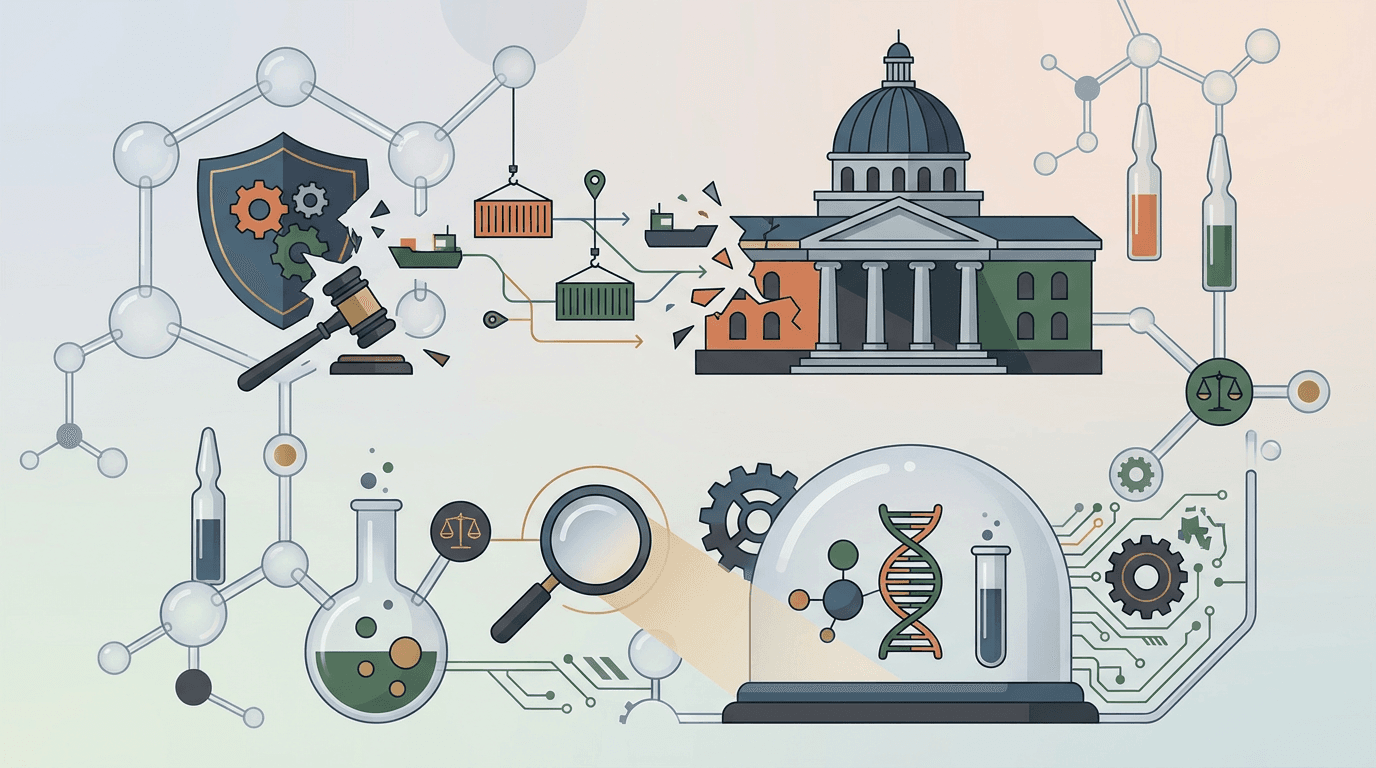
In a 6-3 ruling on February 20, the Court struck down all tariffs imposed under the International Emergency Economic Powers Act (IEEPA), a Cold War-era law the Trump administration had been using like a Swiss Army knife to tax imports from China, Canada, Mexico, and dozens of other countries. The decision in Learning Resources, Inc. v. Trump is the biggest check on presidential trade authority in decades. It killed roughly $175 billion worth of tariff collections in one swing.
But for biotech and pharma companies watching their supply chain costs like a hawk? The story is more complicated than the headline suggests.
The Ruling That Rewrote Trade Law
Chief Justice Roberts delivered the opinion, joined by an unusual coalition: Sotomayor, Kagan, Gorsuch, Barrett, and Jackson. That's about as bipartisan as the Supreme Court gets these days.
The core logic was almost elegant in its simplicity. IEEPA lets the President "regulate importation" during national emergencies. The government argued that tariffs are just a form of regulation. The Court said: nice try, but tariffs are taxes. And only Congress gets to levy taxes. It's right there in Article I of the Constitution.
Think of it like this: your landlord can set rules about noise and pets. But they can't suddenly decide you owe property taxes. Different power. Different authority. The Court applied the same principle to IEEPA. Regulating imports, like banning or restricting certain goods, is one thing. Taxing them is another entirely.
The ruling wiped out the "fentanyl crisis" tariffs on Canadian, Mexican, and Chinese goods, the "reciprocal" tariffs on imports from nearly every trading partner, and all other IEEPA-based duties. U.S. Customs and Border Protection stopped collecting them as of February 24.
Why Pharma Shouldn't Celebrate Yet
If you run a biotech that imports active pharmaceutical ingredients (the actual chemical compounds that make your drugs work) you might have breathed a sigh of relief. IEEPA tariffs were hitting APIs and finished drugs from major suppliers.
Get tomorrow's biotech intelligence before your competitors.
Join thousands of biotech professionals who start their day with our free, daily briefing.
But the Court's ruling was surgical. It took down IEEPA tariffs specifically. It left everything else standing. And "everything else" includes Section 232, a separate law that lets the President impose tariffs on national security grounds after a formal investigation.
The Department of Commerce launched a Section 232 investigation into pharmaceutical imports back in April 2025. That investigation covers the full stack: finished drugs, APIs, key starting materials, and medical countermeasures. Its findings are expected any day now.
President Trump threatened 100% tariffs on branded pharmaceutical imports in September 2025 unless companies started building manufacturing plants in the U.S. That threat hasn't gone away. It's just living under a different legal roof now.
The API Problem Nobody Talks About
The real vulnerability isn't about tariff rates. It's about where America's drugs actually come from.
The U.S. sources 88% of its APIs from abroad. India supplies about a third, the EU provides a fifth, and China accounts for 8%. That alone makes the industry a sitting duck for any tariff action. But it gets worse.
About 70% of India's APIs actually originate from China. So even when your drug's label says "API sourced from India," there's a good chance the supply chain traces back to Chinese manufacturers. It's like ordering a "locally roasted" coffee only to learn the beans were shipped from the other side of the world. The label tells one story. The supply chain tells another.
This means tariffs on Chinese pharmaceutical inputs ripple through Indian suppliers and ultimately hit American biotechs, even if India itself gets favorable treatment.
The Patchwork of Protection (and Pain)
Several countries have already cut deals to soften the blow of potential Section 232 pharmaceutical tariffs. The EU and Japan face a maximum 15% rate. The UK secured a full exemption for pharmaceuticals, pharmaceutical ingredients, and medical devices. Countries like Argentina, Cambodia, and South Korea got exemptions for generic drugs specifically.
Even individual companies have gotten in on the action. AstraZeneca, Eli Lilly, Merck, Novo Nordisk, and Pfizer all secured tariff reprieves, in exchange for agreeing to lower certain drug prices. That's the government essentially using tariff threats as a negotiating lever.
But small and mid-cap biotechs? They don't have the leverage to cut bilateral deals with the White House. If your company relies on imported APIs from a non-exempted country, you're eating whatever duty gets imposed. And with the product exclusion process under Section 232 eliminated, there's no easy way to get individual relief.
A New Layer: Section 122 Enters the Chat
As if the tariff landscape weren't messy enough, the administration rolled out a new tool the same day IEEPA tariffs ended. On February 24, a 10% temporary surcharge went into effect on most imports under Section 122 of the Trade Act of 1974. It lasts 150 days.
Section 122 is designed to address balance-of-payments problems; think of it as an emergency brake for trade deficits. It's narrower and time-limited, which is probably why it survived where IEEPA didn't. But for importers, it's another cost stacked on top of whatever Section 232 ultimately delivers.
For biotechs doing the math on their cost of goods, the equation keeps getting more variables and fewer solutions.
What This Actually Means Going Forward
The SCOTUS ruling is a genuinely historic rebalancing of trade power between the President and Congress. It means the executive branch can't unilaterally weaponize emergency declarations to reshape trade policy. That matters enormously for the long game.
But in the short term, Section 232 is the sword still hanging over pharma's head. The investigation covers the full pharmaceutical supply chain. The threatened tariff rates are eye-watering. And the U.S. produces only about 10% of APIs by volume domestically, which means reshoring isn't a quick fix; it's a decade-long project.
The Court reminded everyone that Congress holds the power of the purse. Now the question is whether Congress will actually use it, or whether the White House will keep finding alternative statutory tools to get what it wants.
For biotech CFOs running scenarios on their 2026 budgets, the takeaway is uncomfortable but clear: one tariff threat died, but the next one is already in the room. The supply chain math hasn't changed. And the political incentive to bring drug manufacturing back to the U.S., through carrots or sticks, isn't going anywhere.
Keep your import spreadsheets updated. This story is far from over.
Clinical and Regulatory
4 min read
Roche's New Breast Cancer Pill Has a Secret Weapon
Roche's oral breast cancer drug giredestrant just got its FDA date, and its secret weapon isn't the drug itself. It's the combination strategy that cut disease progression by 62% in the patients who need it most.