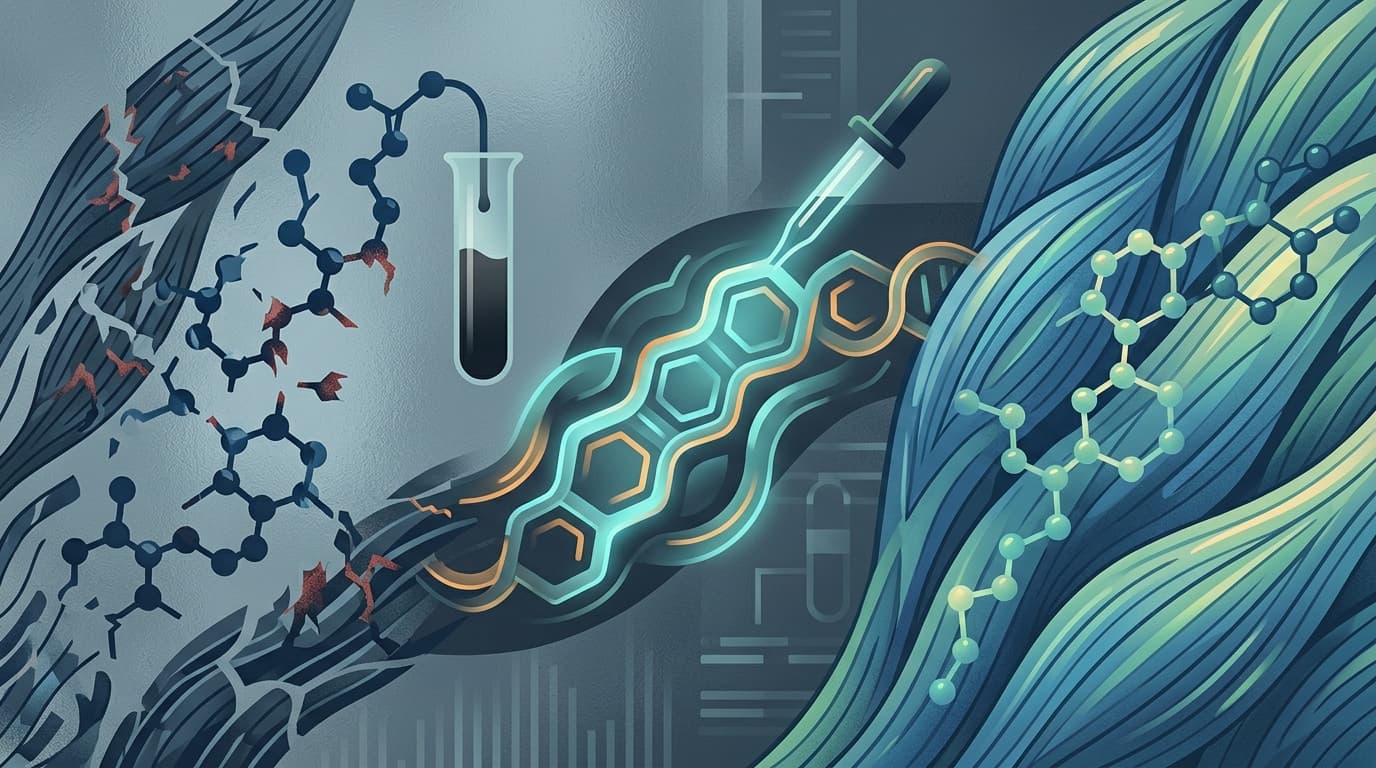

Four adult Duchenne patients showed less fat in their muscles after six months on Satellos' experimental drug, reversing a trajectory that was supposed to be a one-way street. The data are tiny but the implications are massive.
In Duchenne muscular dystrophy, muscles don't just weaken. They get replaced by fat, slowly and relentlessly, like a house being reclaimed by weeds. By adulthood, most patients are wheelchair-bound, their limb muscles more fat than fiber. The trajectory only goes one direction: down.
Or at least, that's what everyone assumed.
Satellos Bioscience has been running its Phase 2 TRAILHEAD trial of SAT-3247 in adult Duchenne muscular dystrophy patients, and the emerging data, on paper, shouldn't exist. Four adult Duchenne patients treated with the company's oral drug SAT-3247 showed less fat in their muscles, not more. Their strength held steady. Their muscle damage markers dropped. In a disease defined by relentless decline, the arrow pointed the other way.
Forget the jargon for a moment. The single most important measurement in this dataset is something called muscle fat fraction: the percentage of a patient's muscle tissue that has been replaced by fat, measured by MRI.
In healthy muscle, that number is low. In adult Duchenne patients, it's often above 60% or even 80% in the legs. The number only goes up over time. It's one of the clearest indicators that the disease is winning.
In TRAILHEAD, the average fat fraction across all four patients dropped from 49.7% to 46.0% over six months. That's a 3.7 percentage-point improvement. In absolute terms, it sounds modest. In context, it's like watching a melting glacier start to grow back. It's not supposed to happen.
To understand why these results are surprising, you need a quick detour into what actually goes wrong in Duchenne.
The disease is caused by a missing protein called dystrophin. Most people know dystrophin as the thing that holds muscle fibers together. But it also plays a quieter, equally important role: it tells muscle stem cells (called satellite cells) how to divide properly.
In healthy muscle, a satellite cell divides into two different daughters. One stays a stem cell; the other becomes a "progenitor" that repairs damaged muscle. Think of it like a bakery where one person takes orders and the other bakes bread. Without dystrophin, that system breaks. You get a bakery full of people taking orders, but nobody's actually baking.

Prime Medicine just won a binding patent arbitration against Beam Therapeutics over a key gene-editing therapy, and the fallout could reshape who controls what across the entire CRISPR landscape. The ruling clears Prime's path to the clinic while exposing just how tangled gene-editing IP has become.


Join thousands of biotech professionals who start their day with our free, daily briefing.

SAT-3247 is a small molecule that inhibits a protein called AAK1, which sits in a signaling pathway (Notch) that controls this division process. By blocking AAK1, the drug essentially restores the missing instruction manual. It doesn't replace dystrophin. Instead, it uses a workaround to get satellite cells dividing properly again, pumping out progenitors that can actually repair muscle.
It's dystrophin-independent, which matters because it means the drug could theoretically work regardless of the patient's specific genetic mutation. That's a big deal in a disease where existing therapies like exon-skipping drugs only work for narrow genetic subsets.
Muscle fat fraction was the headline, but the rest of the data told a consistent story.
Creatine kinase (CK), a blood marker that rises when muscles are actively breaking down, fell by about 38%. It dropped from 2,130 U/L at the start of the earlier Phase 1b study to 1,315 U/L at the six-month TRAILHEAD mark. Lower CK suggests the muscles aren't taking as much damage anymore.
Strength held steady, too. Upper limb function, measured by the PUL 2.0 scale (a standard test for non-ambulatory Duchenne patients), improved by 1 point in two patients and stayed flat in the other two. In a disease where these scores typically erode over time, stability counts as good news.
Patients also reported feeling less fatigued. Their scores on a fatigue-related quality of life scale improved by nearly 7 points on average over the study period. And SAT-3247's safety profile stayed clean: no serious side effects, no dropouts, 100% compliance across roughly 186 days of treatment.
Let's be clear about the elephant in the room: this is four patients. No placebo group. No blinding. Open-label design.
These four adults had already participated in Satellos' earlier Phase 1b trial, where they showed grip-strength improvements. They then had a roughly 7 to 11 month break before re-enrolling in TRAILHEAD. That means they're essentially hand-picked, previously responding patients. Calling them "enriched" would be generous; calling them "the best possible scenario for a press release" might be more accurate.
Regression to the mean, motivated patient behavior, and simple measurement variability could all be at play. Analysts know this, which is why the consensus reaction falls into the "scientifically encouraging, but show me more" category. MarketBeat pegs the analyst consensus at Moderate Buy with a price target of $18, roughly double the recent share price near $9.
The market's reaction was positive but measured. Satellos' stock (NASDAQ: MSLE) rallied on elevated volume, reversing a prior 20% drawdown. The company's market cap sits around $190 million, a number that prices in hope more than proof.
Most Duchenne drug development focuses on kids, and for good reason. Younger patients have more muscle left to save. But adults with Duchenne have been largely left behind by the clinical pipeline. Gene therapies like Sarepta's Elevidys carry age and eligibility restrictions. Exon-skipping drugs only target specific mutations and were studied primarily in younger populations.
Satellos' approach flips the script by asking: what if muscle remodeling is possible even after years of decline? The company itself noted that patients with higher baseline muscle mass showed greater strength improvements, which logically supports testing SAT-3247 in younger patients who retain more muscle. The BASECAMP pediatric trial is already actively enrolling.
But the adult data carry their own weight. If SAT-3247 can move the needle in patients aged 21 to 28 whose muscles are already half fat, it suggests the regenerative machinery isn't dead in advanced disease. It's just waiting for the right signal.
Satellos plans to run TRAILHEAD through its full 12 months and expand enrollment to around 30 patients, potentially lowering the entry age to 16 pending FDA feedback. The BASECAMP pediatric study, already actively enrolling globally with top-line data expected in late 2026, will be the real test of whether this mechanism can produce clinically meaningful improvements in patients with more muscle to work with.
For now, the data are a proof of concept in the truest sense: proof that the concept of reversing muscle fat in adult Duchenne isn't crazy. Four patients is a whisper, not a shout. But in a disease where the loudest sound is usually decline, even a whisper in the other direction gets people's attention.
GSK just terminated its $2.2 billion Alzheimer's partnership with Alector after both drugs flopped in clinical trials. The $700 million upfront payment is gone forever, and the wreckage tells us a lot about why the brain remains drug development's toughest frontier.