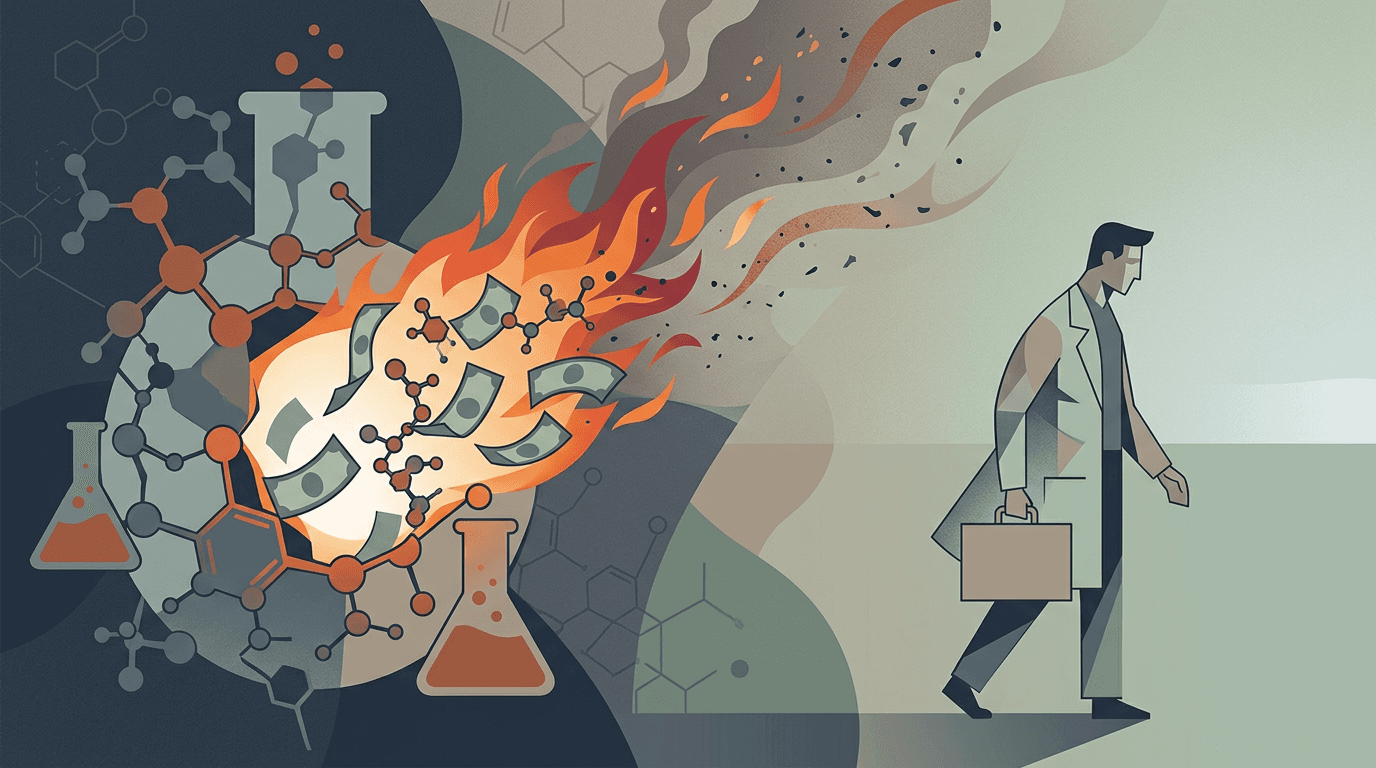
GSK Just Lit $700 Million on Fire (and Walked Away)
GSK just terminated its $2.2 billion Alzheimer's partnership with Alector after both drugs flopped in clinical trials. The $700 million upfront payment is gone forever, and the wreckage tells us a lot about why the brain remains drug development's toughest frontier.
In 2021, GSK wrote Alector a $700 million check. It was the opening act of what was supposed to be a $2.2 billion blockbuster partnership in neurodegeneration. Five years later, both drugs have flopped, the collaboration is dead, and GSK is moving on.
The official termination notice went out on July 6, 2026. After a 180-day wind-down period, the partnership will formally end on January 2, 2027. That $700 million upfront? Non-refundable. The remaining $1.5 billion in milestone payments? They'll never be triggered.
It's one of the most expensive breakups in recent biotech history. And it tells us something important about why Alzheimer's remains the graveyard of good intentions.
Two Drugs, Two Strikeouts
The GSK-Alector deal covered two antibodies designed to raise levels of a protein called progranulin in the brain. Think of progranulin as a kind of neural bodyguard; it helps protect brain cells from degeneration. The theory was elegant: boost the bodyguard, slow the disease.
Latozinemab (AL001) went first. It was tested in a Phase 3 trial called INFRONT-3 for a rare, aggressive form of dementia called FTD-GRN (frontotemporal dementia caused by a specific gene mutation). The drug did exactly what it was designed to do on a biological level: it raised progranulin significantly. But on the measure that actually matters, whether patients' dementia slowed down, it failed. No benefit on cognitive decline. No effect on brain imaging. Secondary endpoints came up empty too.
Alector cut roughly 49% of its workforce after those results.
Then came nivisnebart (AL101), the antibody GSK was steering toward Alzheimer's and Parkinson's. It entered a Phase 2 trial called PROGRESS-AD in early Alzheimer's patients. An independent data monitoring committee conducted a pre-specified futility analysis in April 2026. Their conclusion: the study was unlikely to hit its primary goal of slowing cognitive decline. The trial was halted for futility.
Get tomorrow's biotech intelligence before your competitors.
Join thousands of biotech professionals who start their day with our free, daily briefing.
Both drugs successfully hit their biological target. Progranulin levels went up. The antibodies did their job in the bloodstream. So why didn't patients get better?
This is the cruelest puzzle in Alzheimer's research. You can change the biomarker and still lose the patient. It's like fixing the oil light on your dashboard while the engine is already seized.
Analysts at William Blair interpreted the latozinemab data as evidence that "restoring [progranulin] does not translate to clinical benefit in this trial/patient population." That's a polite way of saying the entire biological hypothesis may be wrong, or at least insufficient, for patients who already have symptoms.
The timing problem looms large. By the time someone shows up in a doctor's office with dementia symptoms, decades of neurodegeneration have already occurred. Raising progranulin at that point might be like watering a plant that's already dead at the roots.
And for nivisnebart in sporadic Alzheimer's (the common kind, not driven by a single gene mutation), the rationale was even more speculative. Alzheimer's disease involves a tangled web of amyloid plaques, tau proteins, inflammation, and vascular damage. Boosting one protective protein was always going to be a long shot against that kind of complexity.
Alzheimer's: The Graveyard with a Waiting List
If you're keeping score at home, the numbers are brutal. Historically, roughly 99% of Alzheimer's drug trials fail. One analysis found that between 2003 and recent years, only 2 out of 100 compounds that reached Phase 2 or Phase 3 made it through. Phase 3 alone has a 98% failure rate.
And yet the pipeline keeps growing. As of early 2025, there were 182 clinical trials testing 138 different Alzheimer's drug candidates, up from 164 trials the year before. Phase 1 activity nearly doubled, jumping from 26 trials to 48.
The field isn't giving up. It's just learning, painfully and expensively, what doesn't work.
Alector's story is especially instructive because it wasn't just one approach that failed. The company also had AL002, a separate Alzheimer's drug targeting a different mechanism (microglial cells via a protein called TREM2). That one flopped in its Phase 2 trial too: no effect on cognition, no effect on amyloid plaques, nothing on brain biomarkers. Three different drugs, three different angles, three failures. The common thread? The brain refused to cooperate.
What Happens to Alector Now?
Alector's stock tells the story. Analyst consensus sits at "Hold" with price targets clustered in the low single digits. Multiple firms downgraded after the latozinemab failure; Mizuho slashed its target from $3.50 to $1.50. The most optimistic targets reach $10, while the bearish end sits below a dollar.
The company still has earlier-stage programs in tau-targeting therapies and blood-brain barrier delivery technology. Some analysts see long-term optionality there, but those programs are years away from meaningful data. For now, Alector is a "show me" story with a thin catalyst calendar and real questions about cash burn.
GSK Isn't Done with the Brain
Here's the twist: GSK walking away from Alector doesn't mean they're walking away from neuroscience. They've been quietly assembling a new playbook, one built on platforms and tools rather than single big bets.
Since 2025, GSK has inked deals with ABL Bio for blood-brain barrier delivery technology (£38.5 million upfront, over £2 billion in potential milestones), Vesalius Therapeutics for a genetics-guided Parkinson's disease program ($80 million upfront), and Muna Therapeutics for Alzheimer's target discovery using spatial brain mapping (€33.5 million upfront). They're also working with Rgenta on RNA-targeting small molecules that include neuro applications.
The pattern is clear: smaller checks, more partners, platform-first thinking. Instead of betting $700 million on one partner's two drugs, GSK is spreading risk across multiple collaborations, each anchored to cutting-edge technology rather than a single molecule.
It's the difference between putting your entire bankroll on one horse and buying a stake in the whole stable.
The Uncomfortable Truth
The GSK-Alector story isn't unique. It's a particularly expensive example of something that happens over and over in neurodegeneration: smart science, solid target engagement, and total failure to help patients. The brain remains the hardest organ in medicine to treat, protected by a blood-brain barrier that blocks most drugs and governed by biology we still don't fully understand.
But 182 active Alzheimer's trials say the industry hasn't given up. The next generation of attempts will be armed with better biomarkers, more precise patient selection, and earlier intervention strategies. Whether that's enough to crack the code remains the biggest open question in drug development.
GSK lost $700 million learning that lesson. The rest of the industry is watching, and taking notes.
Clinical & Regulatory5 min read
The Billion-Dollar Drug Built on a Paper That No Longer Exists
The NEJM just retracted the pivotal trial paper for Tavneos, a vasculitis drug with nearly half a billion in annual sales. The reason: patient data was secretly changed after the trial was unblinded, and nobody disclosed it.