Sarepta's $900M Drug Just Got the FDA's Scariest Label
Sarepta's Duchenne gene therapy Elevidys just earned the FDA's most severe warning after two boys died from liver failure. Now the company is slashing 36% of its workforce and fighting for survival. The gene therapy revolution's darkest chapter is still being written.
Two boys received a gene therapy that was supposed to save their lives. Both were hospitalized within two months. Neither survived.
Now the drug that generated nearly $900 million in revenue last year carries the most severe warning the FDA can slap on a medicine. And the company behind it is gutting more than a third of its workforce.
The Warning No Company Wants
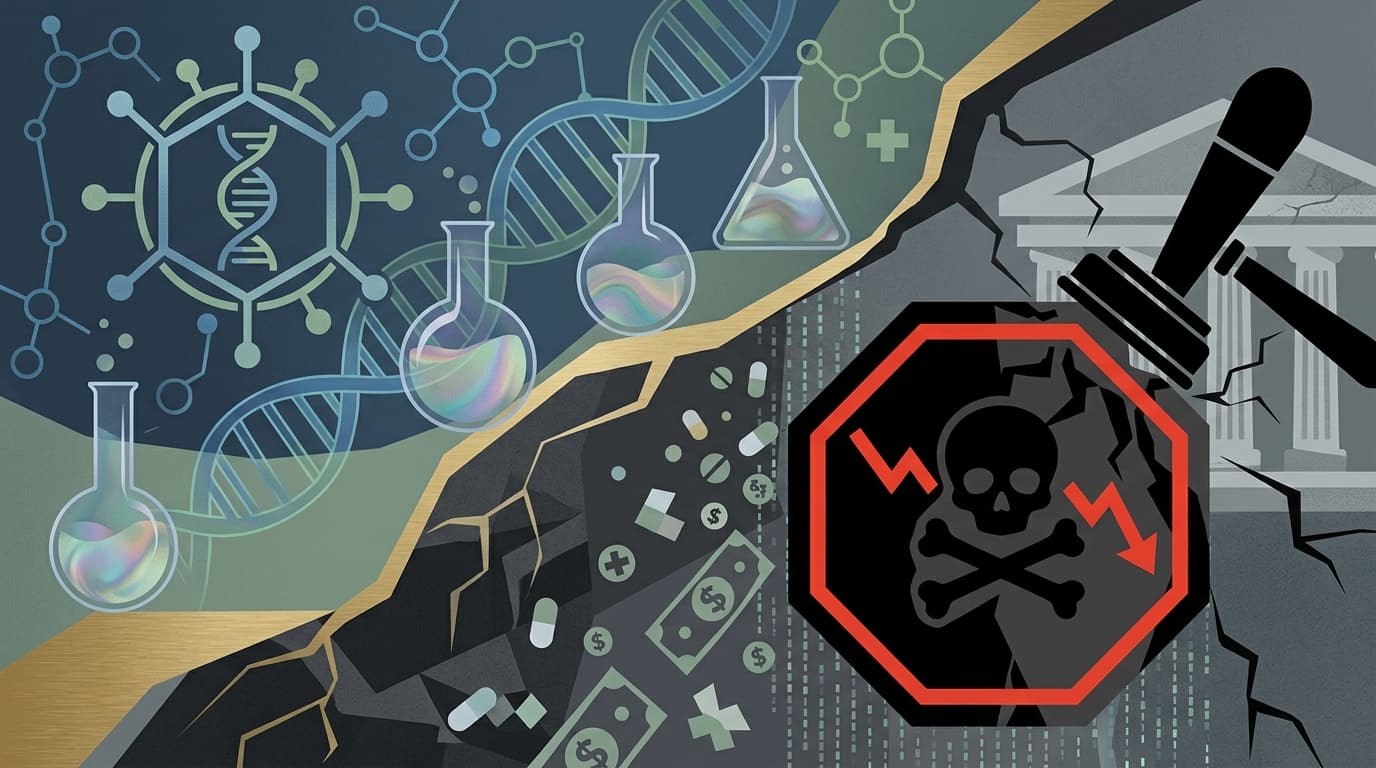
Sarepta Therapeutics' flagship gene therapy, Elevidys (try saying "delandistrogene moxeparvovec" three times fast), just received an FDA boxed warning for acute serious liver injury and acute liver failure. In regulatory parlance, a boxed warning is the black box: it's the pharmaceutical equivalent of a skull and crossbones on a bottle of poison. The FDA doesn't hand these out casually.
The trigger was devastating. Two non-ambulatory boys with Duchenne muscular dystrophy (DMD), a genetic disease that progressively destroys muscle tissue, developed dangerously elevated liver enzymes after receiving Elevidys. Both were hospitalized within roughly two months of their infusions. Both died from acute liver failure.
And those weren't the only cases. A third death occurred in an adult male with limb-girdle muscular dystrophy who received a related investigational therapy from Sarepta's same viral-vector platform. He died 80 days after dosing. The FDA also flagged at least one serious non-fatal case involving blood clots, bowel damage, and portal hypertension.
A Billion-Dollar Drug With a Shrinking Address Book
Elevidys wasn't some obscure lab experiment. It was a commercial juggernaut. In 2025, the therapy pulled in $898.7 million in net revenue, making it one of the most successful gene therapy launches in history. The idea was elegant: deliver a functional gene to produce a shortened version of dystrophin, the protein that DMD patients can't make, using a one-time infusion. One shot, potentially life-changing benefit.
But that revenue figure came with a big asterisk. Sarepta had already suspended shipments to non-ambulatory U.S. patients back in June 2025 after the first death. Now the FDA has gone further, and restricting Elevidys to ambulatory patients aged four and older.
Get tomorrow's biotech intelligence before your competitors.
Join thousands of biotech professionals who start their day with our free, daily briefing.
removing the non-ambulatory indication entirely
Think of it like a restaurant that used to serve lunch and dinner suddenly losing its dinner license. The addressable market just shrank significantly. You can see it in the numbers: quarterly U.S. revenue dropped from a peak run rate to about $100 million per quarter in the first half of 2026 ($102 million in Q1, $98.1 million in Q2). That's still real money, but the trajectory is pointing the wrong direction.
The updated label now requires weekly liver function monitoring for three months after infusion, and it warns that patients with preexisting liver problems face higher risk. Liver injury typically begins within eight weeks of treatment.
500 Pink Slips and a Survival Plan
When your flagship product gets a black box warning and an FDA investigation, the financial dominoes start falling fast. Sarepta announced it's cutting approximately 500 jobs, roughly 36% of its entire workforce.
This isn't a trim. It's a chainsaw.
The restructuring is expected to save about $400 million annually once fully implemented. The workforce reduction alone should generate around $120 million in cash savings this year, while pausing and cutting pipeline programs (including several limb-girdle muscular dystrophy gene therapies) adds another $300 million in non-personnel savings. The company has been blunt about why: it needs to meet its 2027 financial obligations and maintain access to financing.
Sarepta is pivoting toward a leaner operation focused on higher-priority programs and its siRNA (small interfering RNA) platform. Translation: the company is placing fewer, more concentrated bets instead of spreading resources across a sprawling pipeline. Some deprioritized programs may get partnered out or shelved entirely.
Wall Street Is Squinting, Not Panicking
The stock tells a messy story. For context, this is a company that once traded well above $100.
Analyst sentiment is cautious but not apocalyptic. Average price targets range from $22 to $25, which implies some upside from current levels, but the spread between the most bullish target ($38) and the most bearish ($5) tells you everything about the uncertainty here. Piper Sandler recently cut its target to $20, while Barclays reaffirmed its Hold rating. Morningstar pegged fair value at $19.13, basically where the stock sits today, and flagged "high uncertainty."
In other words, nobody is pounding the table in either direction. The market is waiting.
A Familiar, Frightening Pattern
Sarepta's crisis isn't happening in a vacuum. Gene therapy's liver problem is becoming a recurring theme, like a horror movie franchise that keeps getting sequels nobody asked for.
Zolgensma, Novartis's gene therapy for spinal muscular atrophy, reported two pediatric deaths from acute liver failure in Russia and Kazakhstan. Those deaths occurred about five to six weeks after infusion, eerily similar to the Elevidys timeline. Zolgensma already carried its own boxed warning for liver injury before those fatalities.
The underlying technology in both cases relies on adeno-associated virus (AAV) vectors: essentially hollowed-out viruses used as delivery trucks to carry therapeutic genes into cells. The liver, which filters blood and processes foreign particles, takes the brunt of the viral load. It's a known class-wide concern, and it raises uncomfortable questions about whether AAV-based gene therapies can ever fully escape this risk.
For the rare disease community, the calculus is agonizing. DMD is a brutal, progressive disease. Most patients lose the ability to walk in childhood, and life expectancy is severely shortened. A therapy that can deliver even partial dystrophin production represents genuine hope. But when that therapy carries a risk of fatal liver failure, every treatment decision becomes a high-stakes gamble.
What Comes Next
Sarepta isn't dead. It still has a product generating north of $200 million in the first half of 2026, international expansion underway (including a $40 million milestone from the first commercial sale in Japan through Roche's partner Chugai), and a restructured cost base designed to extend its runway.
But the company is operating under a cloud that won't lift quickly. The FDA investigation continues. The boxed warning will hang over every physician conversation about Elevidys. And the gene therapy field, which has spent years promising a revolution in medicine, is learning that revolutions sometimes come with casualties.
The question isn't whether gene therapy works. It does, sometimes spectacularly. The question is whether the industry can make it safe enough, consistently enough, to justify the extraordinary trust that patients and families place in a single infusion. Right now, that answer is still being written in real time, and the ink is uncomfortably red.
Clinical & Regulatory5 min read
Capricor's Duchenne Drug Just Hit a Wall. Then the Activist Investors Showed Up.
Capricor's cell therapy for Duchenne muscular dystrophy faces a likely FDA rejection after advisors voted 9-to-3 against it, and activist investor Kaos Capital is simultaneously demanding a full boardroom overhaul. It's a two-front war that could determine the company's survival.