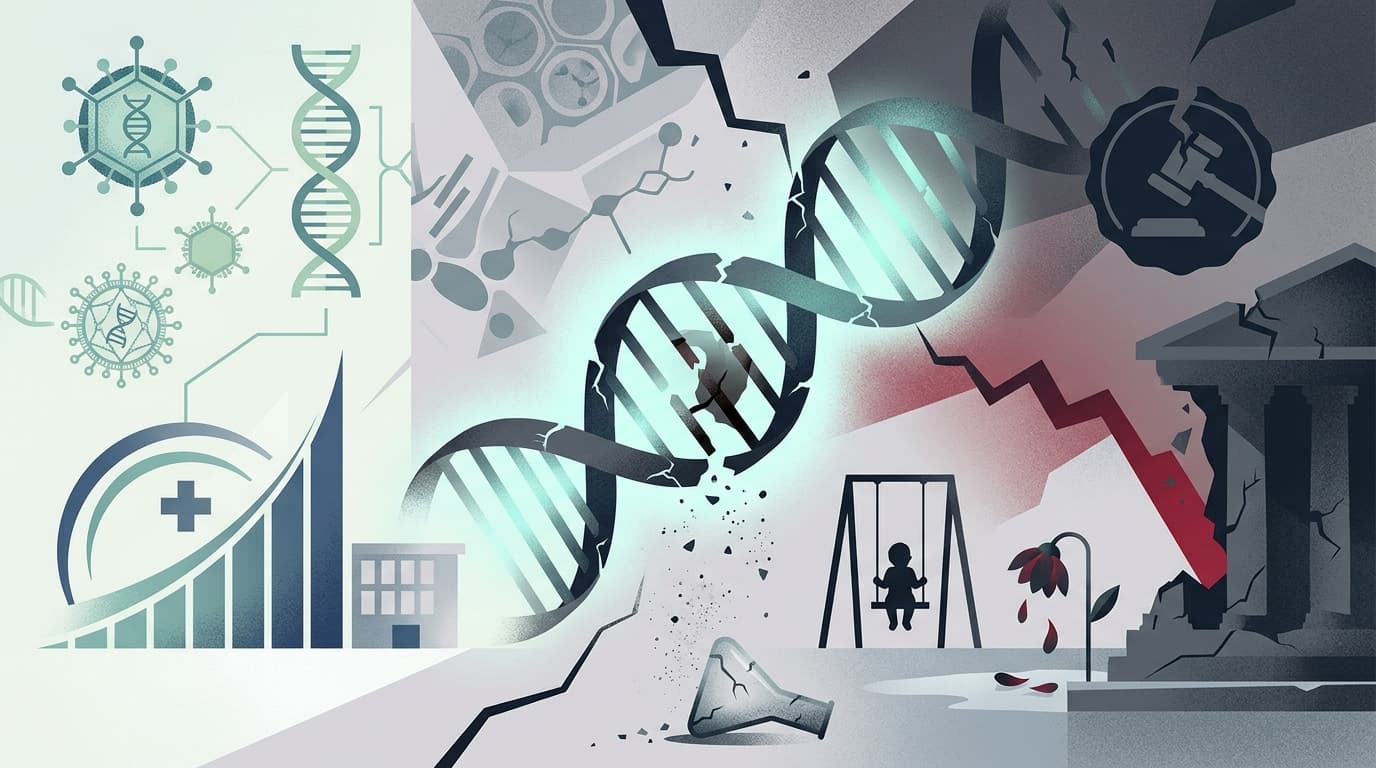
Sarepta's Gene Therapy Was Supposed to Change Everything. Then Kids Started Dying.
Sarepta's Duchenne gene therapy Elevidys just received the FDA's most severe safety warning after pediatric patient deaths from liver failure. With 500 jobs cut and a failed confirmatory trial in the rearview, the company that once symbolized gene therapy's future is fighting to survive.
The Promise That Turned Dark
Imagine telling a parent their child has a treatment that could rewrite the genetic code causing their muscles to waste away. That was the pitch for Elevidys, Sarepta Therapeutics' gene therapy for Duchenne muscular dystrophy (DMD), a brutal disease that steals mobility from young boys and typically kills them by their 20s or 30s.
Now imagine telling those same parents that the treatment has killed children like theirs.
The FDA has slapped Elevidys with a black box warning, the most severe safety label the agency can attach to a drug without pulling it from the market entirely. The reason: life-threatening and fatal acute liver failure in patients who received the therapy. On top of that, Sarepta just announced it's cutting 36% of its workforce, roughly 500 people. The company that once symbolized gene therapy's brightest future is now fighting for survival.
What Actually Happened
At least two non-ambulatory pediatric patients (teenagers who had lost the ability to walk) died from acute liver failure after receiving Elevidys. Both deaths occurred within about two months of treatment. A third death surfaced in a related Sarepta gene therapy program using a similar viral vector, which only intensified the scrutiny.
The FDA didn't just add a warning label. It narrowed who can receive Elevidys to ambulatory patients (those who can still walk) aged four and older with a confirmed DMD gene mutation. Non-ambulatory patients, the ones who arguably need help the most, are now effectively locked out. The agency also requested that Sarepta suspend distribution at one point and placed clinical trials on hold.
Sarepta says it's working on a new approach to immune suppression, including a drug called sirolimus, to try to prevent the liver toxicity before restarting treatment in broader populations. But "we're working on it" doesn't bring anyone back.
Get tomorrow's biotech intelligence before your competitors.
Join thousands of biotech professionals who start their day with our free, daily briefing.
Elevidys was never on rock-solid footing to begin with. The FDA granted it accelerated approval, which is essentially a conditional green light. The deal: you can sell the drug now, but you need to prove it actually works in a confirmatory trial.
That confirmatory trial, called EMBARK (Study 301), missed its primary endpoint. Translation: the study failed to prove what it was specifically designed to prove. For a drug already under accelerated approval, that's like borrowing money from the bank and then failing the audit.
Commercially, Elevidys was generating real revenue. One quarter showed $181 million in sales; another reported $132 million. But the trajectory was bumpy. Safety concerns, distribution pauses, and weaker-than-expected demand from international partner Roche had already been chipping away at momentum before the black box warning landed.
500 People Just Lost Their Jobs
The workforce reduction tells you everything about where Sarepta's head is at. Cutting 500 employees (36% of the company) is not a trim. It's a restructuring born out of necessity.
Sarepta expects the move to save about $400 million annually, with roughly $120 million in cash savings hitting in 2026 alone. The company says it will bring non-GAAP R&D and administrative expenses down to a range of $800 million to $900 million per year. That's the language of a company shifting from "grow at all costs" to "survive and stabilize."
The company's own guidance suggests that Elevidys usage in the second half of 2026 will be modestly below the first half but should stabilize over time. "Modestly below" and "stabilize" are doing a lot of heavy lifting in that sentence. When your flagship product just got a black box warning after killing patients, optimism is a tough sell.
Wall Street's Whiplash
The market reaction has been, to put it mildly, chaotic. When the FDA first signaled it would add a warning rather than yank the drug entirely, Sarepta shares surged more than 30% in after-hours trading. Investors were relieved the worst-case scenario (full withdrawal) hadn't materialized.
That relief didn't last. When reports emerged that the FDA was pushing for a broader suspension of shipments, the stock plummeted more than 35%. If you're keeping score, that's a round trip to nowhere with maximum nausea along the way.
Analyst sentiment has settled into cautious territory. Evercore ISI noted the warning removed the doomsday scenario of a full market withdrawal for ambulatory patients. William Blair agreed withdrawal looked unlikely but warned of "near-term headwinds" from doctors and patients losing confidence. The consensus? A lukewarm Hold with some Sell ratings sprinkled in. Nobody's pounding the table.
The Bigger Problem: Gene Therapy's Reputation
This isn't just a Sarepta story. Elevidys is the only gene therapy on the market for DMD, and its struggles send a signal to every company, investor, and regulator watching the space.
The core issue is one of dosing. AAV gene therapies (the technology behind Elevidys) work by using a harmless virus to deliver corrected genetic instructions into a patient's cells. Think of it like a biological FedEx truck carrying the right blueprint to the right address. The problem is that systemic, high-dose delivery of these viral vectors can overwhelm the liver and trigger fatal immune responses.
Recent reviews of AAV safety have connected the dots: the most serious adverse events, including deaths, cluster around very high doses delivered intravenously. The old assumption that AAV was uniformly safe has been thoroughly revised. The current scientific consensus is more nuanced: AAV can still be transformative, but the margin for error at high systemic doses is razor-thin.
For the field, expect tighter trial designs, stricter patient screening (especially for kids), better immune monitoring, and a growing push toward lower-dose engineering and improved viral capsids that can target specific tissues without flooding the whole body. Regulators aren't abandoning gene therapy, but they're demanding stronger justification for high-dose programs and clearer stopping rules when things go wrong.
What Comes Next
Sarepta is betting that its modified immune suppression strategy can solve the liver toxicity problem and eventually reopen the door to non-ambulatory patients. That's a big bet, and the data to support it doesn't exist yet.
Meanwhile, the company has to hold its commercial position with a product carrying the FDA's scariest warning label, a failed confirmatory trial, and a workforce that just shrank by more than a third. The next few quarters will tell us whether Sarepta can stabilize or whether this is the beginning of a longer unraveling.
For the families navigating DMD, the stakes are infinitely higher than any stock chart. They need better, safer options. The question now is whether gene therapy can deliver on that promise without the cost being measured in children's lives.
Deals & M&A4 min read
Novo Nordisk Really Wants You to Swallow a $1.4B Pill
Novo Nordisk just dropped $1.4 billion on a macrocycle startup days after another billion-dollar delivery deal. The injection giant is betting its future on pills, and the reason has everything to do with Eli Lilly.