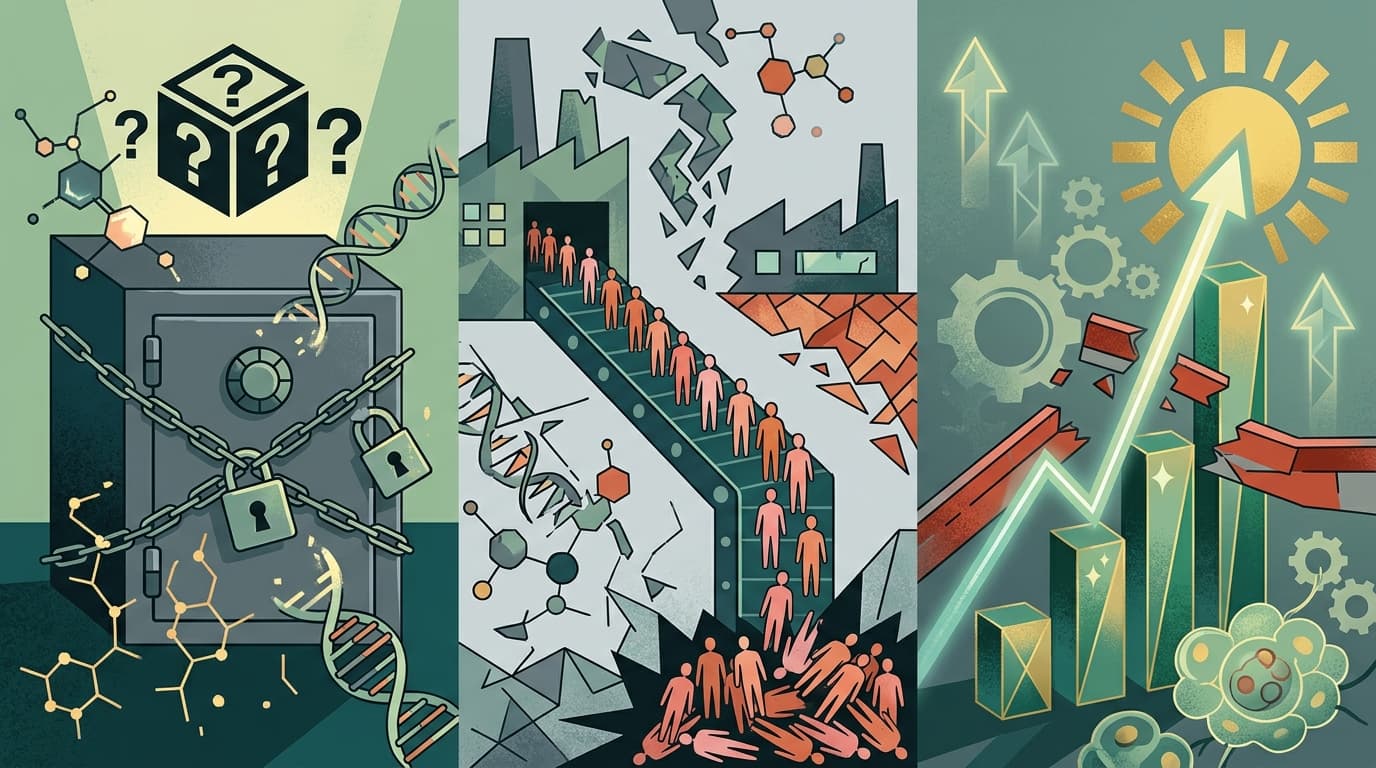
Sarepta's Worst Week: A Black Box, 500 Pink Slips, and a 33% Stock Rally
Sarepta added a black box warning to its only-in-class Duchenne gene therapy and laid off 36% of its workforce on the same day. The stock rallied 33%. Welcome to biotech logic.
The Most Confusing Day in Biotech
Imagine your doctor gives you terrible news and great news in the same sentence. That's basically what Sarepta Therapeutics did last week. The company slapped a black box warning (the FDA's scariest safety label) on its flagship gene therapy, announced it was firing roughly 500 people, and then watched its stock jump 33% after hours.
Welcome to biotech, where nothing makes sense until it does.
What Happened to Elevidys
Sarepta's Elevidys (delandistrogene moxeparvovec, if you enjoy tongue twisters) is the only approved gene therapy for Duchenne muscular dystrophy, a devastating disease that progressively destroys muscle tissue in young boys. When the FDA approved it in 2023, it was a landmark moment. A one-time infusion that could deliver a functional version of the dystrophin gene directly into muscle cells. Think of it like patching a critical software bug, except the software is a child's body.
Now that patch has a serious warning label attached. The FDA added a boxed warning for acute serious liver injury and acute liver failure, including fatal outcomes. Reports of fatal liver failure in non-ambulatory pediatric patients (kids who can no longer walk) triggered the change. Liver injury typically shows up within eight weeks of treatment, and patients with preexisting liver problems face higher risk.
The updated label now restricts Elevidys to ambulatory patients age 4 and older, effectively shrinking the eligible population. Doctors must run weekly liver function tests for at least three months after infusion, plus weekly cardiac monitoring for a full month. That's a lot of follow-up for a therapy that was supposed to be a one-and-done miracle.
Beyond liver toxicity, the safety picture has gotten messier over time. Post-marketing reports have flagged myocarditis (heart inflammation), immune-mediated myositis (the body attacking its own muscles), and even cases of thrombotic microangiopathy, a dangerous blood-clotting disorder. One reported case involved a 17-year-old. The constellation of safety signals paints a picture of a therapy whose risk profile keeps expanding.
Get tomorrow's biotech intelligence before your competitors.
Join thousands of biotech professionals who start their day with our free, daily briefing.
The Revenue Slide That Got Worse
Safety concerns don't just hurt patients; they crush sales. Elevidys posted $375 million in revenue during Q1 2025. Impressive. But the trajectory from there resembles a ski slope. Q2 dropped to $282 million. Q3 fell to $131.5 million. By Q4, Elevidys brought in just $110.4 million, missing analyst consensus of $120.5 million.
The full-year 2025 tally: $898.7 million. Not bad in a vacuum, but the downward trajectory told a clear story. Sarepta suspended shipments to non-ambulatory U.S. patients back in June 2025, which cut into volume. Management also blamed a severe year-end flu season and rescheduled December infusions, which feels a bit like blaming rain for a sinking boat.
In 2026, things haven't improved. Q1 brought in just $102 million from Elevidys, a fraction of the year-ago quarter. Q2 total revenue was $401.3 million, down from $611.1 million the prior year. Sarepta guided for $1.2 to $1.3 billion in total revenue. Analysts had been expecting $1.84 billion. That gap between guidance and expectations? It's the size of a small biotech company.
500 Jobs, $400 Million in Savings
So Sarepta did what companies do when the math stops working: it reached for the layoff button. About 500 employees, roughly 36% of the workforce, are being let go. The company expects approximately $400 million in annual savings, with around $120 million coming from personnel costs in 2026 and about $300 million from non-personnel reductions kicking in next year.
But this isn't just cost-cutting. It's a strategic pivot. Sarepta is pausing or killing several gene therapy programs, particularly in limb-girdle muscular dystrophy, and redirecting resources toward its siRNA (small interfering RNA) pipeline. Translation: they're moving away from the expensive, one-shot gene therapy model and toward a different technology platform that could be easier to manufacture and commercialize.
It's the biotech equivalent of a restaurant realizing their signature dish keeps sending people to the hospital, so they redesign the entire menu.
Wait, the Stock Went UP?
This is the part that makes casual observers question whether Wall Street has lost its mind. Sarepta's stock rallied 33% after hours on the news. How?
The logic, twisted as it may seem, boils down to two things. First, investors were relieved the FDA didn't pull Elevidys from the market entirely. A black box warning is bad, but it's not a death sentence for a drug. Second, the $400 million in cost savings gave investors confidence that Sarepta could survive even if Elevidys revenue keeps shrinking. When a company facing existential questions suddenly finds a way to stay alive, the stock can bounce hard.
Analysts were split on the outlook. Jefferies called the label changes "no surprises" and argued they could actually reassure investors that Elevidys would remain available. Goldman Sachs stayed neutral, pointing to demand uncertainty and caregiver hesitancy. H.C. Wainwright kept its Sell rating with a $5 price target, citing declining revenue and weak confidence in future projections. William Blair warned that safety concerns and disclosure issues could deepen distrust among both patients and investors.
The Bigger Picture for Gene Therapy
Elevidys was supposed to be the proof of concept: a gene therapy that could work commercially at scale. Instead, it's become a cautionary tale about what happens when post-marketing safety data tells a different story than clinical trials.
The Duchenne landscape still has players. Four approved exon-skipping therapies (eteplirsen, golodirsen, viltolarsen, casimersen) address specific mutations. Vamorolone, deflazacort, and givinostat offer supportive treatment. On the horizon, Avidity's delpacibart zotadirsen and Dyne's DYNE-251 represent next-generation exon-skipping approaches that could gain approval soon. Solid Biosciences has also completed enrollment of its SGT-001 micro-dystrophin gene therapy Phase 1/2 IGNITE DMD trial, which is now in long-term follow-up.
But for now, Elevidys stands alone as the only approved gene therapy for Duchenne. That monopoly position used to look like a strength. Now it looks like a spotlight nobody at Sarepta wants to be standing under.
What to Watch
Sarepta's next few quarters will answer a critical question: can a gene therapy survive commercially with a black box warning, a shrinking eligible population, and growing caregiver fear? The restructuring will need to deliver meaningful savings if Elevidys revenue keeps declining.
For the broader gene therapy field, Sarepta's struggles carry a lesson that extends well beyond Duchenne. Post-marketing safety surveillance can reshape a drug's commercial destiny overnight. The therapy that looked like the future of medicine two years ago now comes with the FDA's most serious warning. The families choosing Elevidys for their sons deserve clarity on the risk, and so far, clarity has been in short supply.
Clinical & Regulatory6 min read
A Blood Test Just Changed How We Treat Breast Cancer
The FDA just approved a breast cancer drug with a twist: treatment decisions are driven by a blood test, not a scan. AstraZeneca's camizestrant could rewrite the rules of precision oncology, but it almost didn't survive a brutal advisory committee vote.