
Sangamo Therapeutics, once a gene therapy pioneer, is being carved up in bankruptcy court. PTC Therapeutics is paying $111 million for its nearly FDA-ready Fabry disease gene therapy while Eli Lilly grabbed the gene-editing toolbox for $50 million. It's a cautionary tale about what happens when great science meets terrible economics.
Sangamo Therapeutics once dreamed of rewriting human DNA. Now it's being carved up in bankruptcy court like a Thanksgiving turkey.
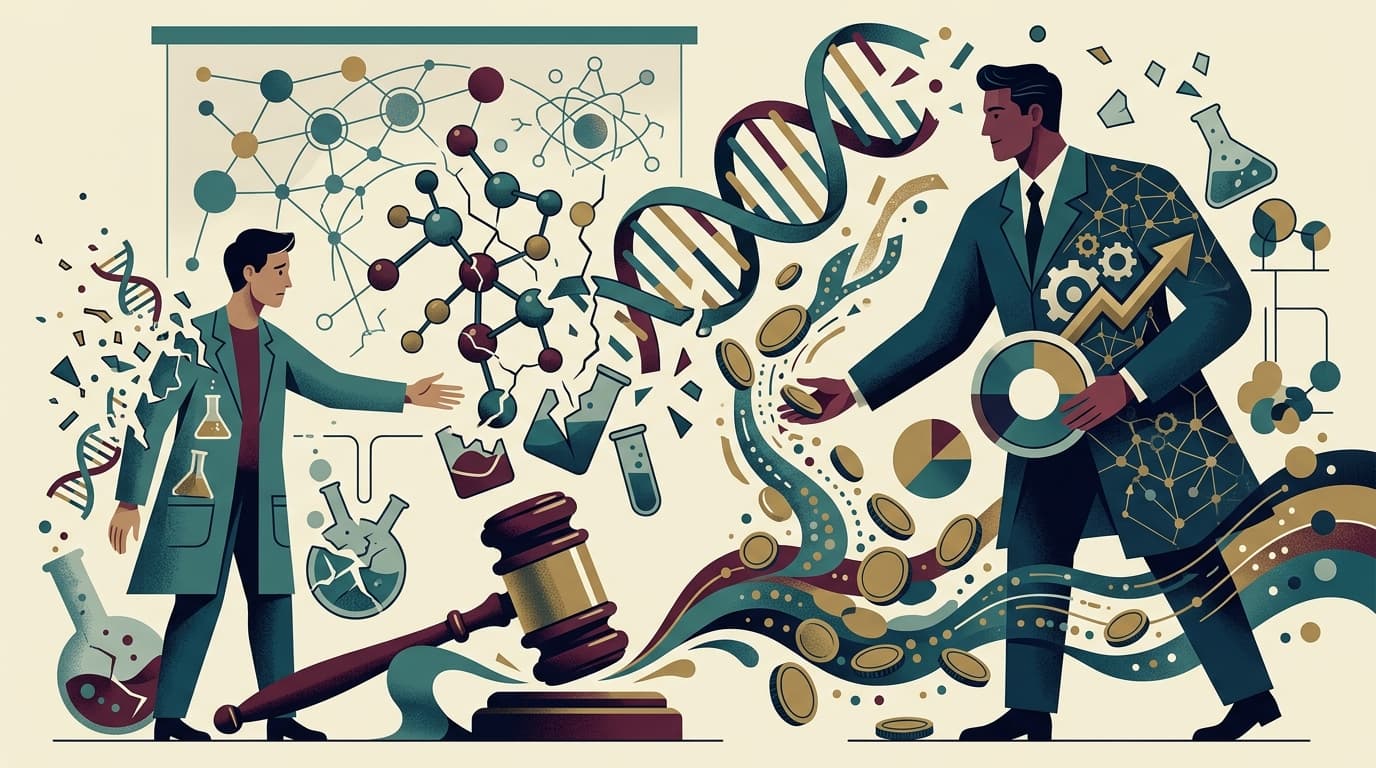
PTC Therapeutics just agreed to buy Sangamo's most advanced asset, a Fabry disease gene therapy called ST-920, for $111 million upfront. That comes with up to $100 million more if the FDA gives it the green light. Separately, Eli Lilly scooped up Sangamo's gene-editing platforms and delivery technology for just $50 million. Combined, the two deals total roughly $161 million in guaranteed cash for a company that was once valued at billions.
This isn't a merger. It's an estate sale. And it tells you everything about the brutal economics of gene therapy.
ST-920 (known formally as isaralgagene civaparvovec, a name only a regulatory filing could love) is a gene therapy for Fabry disease. Fabry is a rare genetic condition where patients can't produce enough of an enzyme called alpha-galactosidase A. Without it, fatty substances build up in cells throughout the body, gradually damaging the heart, kidneys, and nervous system.
Current treatments mostly involve enzyme replacement therapy (ERT): regular infusions that deliver the missing enzyme from the outside. Think of it like filling a leaky bucket. You have to keep pouring because the bucket never stops draining. Patients stay on ERT for life, and the global Fabry treatment market is already worth an estimated $2.83 billion.
Gene therapy promises something different: fix the underlying genetic defect once and let the body produce its own enzyme. One treatment instead of a lifetime of infusions. That's the pitch, anyway.
And ST-920's clinical data looks surprisingly solid for a program coming out of a bankrupt company. In a Phase 1/2 trial of 32 patients, the therapy showed a positive mean annualized eGFR slope (basically, kidney function was stable or improving rather than declining) at both 52 and 104 weeks. One patient has shown sustained enzyme production for up to . Safety was clean: mostly mild side effects, no deaths, no one dropped out because of safety concerns.

The FDA just approved a breast cancer drug with a twist: treatment decisions are driven by a blood test, not a scan. AstraZeneca's camizestrant could rewrite the rules of precision oncology, but it almost didn't survive a brutal advisory committee vote.


Join thousands of biotech professionals who start their day with our free, daily briefing.
More importantly, Sangamo had already started a rolling BLA submission to the FDA under the accelerated approval pathway. PTC expects to complete that filing in Q4 2026. Translation: this isn't some early-stage moonshot. It's a drug that could be on the market within a year or two.
PTC Therapeutics has been reinventing itself. The company built its reputation on Translarna, a treatment for Duchenne muscular dystrophy, and Emflaza, another DMD drug. But revenue from the DMD franchise has been shifting, and PTC has been aggressively diversifying.
The playbook has been ambitious. PTC monetized its Evrysdi royalties for up to $1.5 billion and licensed its Huntington's disease candidate to Novartis for $1.0 billion upfront. It launched Sephience for PKU (phenylketonuria) and is guiding 2026 product revenue toward $700 million to $800 million.
But here's the thing about rare disease companies: the pipeline has to keep producing. One drug's patent cliff or commercial stumble can crater the whole business. Adding a BLA-stage gene therapy in a $2.8 billion market is like a baseball team picking up a proven starter at the trade deadline. The price is manageable, the risk is lower than developing from scratch, and the timeline to impact is short.
The milestone structure also tells you PTC is being disciplined. That $80 million accelerated approval milestone and $20 million traditional approval milestone mean a significant chunk of the total price only gets paid if the FDA says yes. It's pay-for-performance, which makes sense when you're buying out of bankruptcy.
While PTC grabbed the nearly finished product, Eli Lilly went shopping for something different: the tools that built it.
For $50 million, Lilly acquired Sangamo's capsid delivery platform (the technology for engineering viral shells that carry gene therapies into cells), its zinc finger genome-editing platform, and a smaller prion disease program called ST-506. This builds on a relationship that started in April 2025, when Lilly licensed one of Sangamo's brain-targeting capsids for $18 million upfront.
The logic is straightforward. Lilly doesn't need one specific gene therapy; it needs the underlying technology to build many. Sangamo spent decades refining zinc finger proteins, one of the original gene-editing approaches (predating CRISPR by years). For Lilly, this is like buying a well-equipped workshop rather than a single piece of furniture.
Sangamo's collapse wasn't sudden. It was a slow bleed that accelerated into a hemorrhage.
The company depended heavily on partnerships for funding. When those partners started walking away, the math stopped working. Biogen and Novartis terminated collaborations in 2023. Kite's deal lapsed in 2024. Then Pfizer killed its hemophilia A gene therapy partnership in late 2024, wiping out a major expected milestone stream.
Revenue tells the story in brutal shorthand: $176.2 million in 2023, then $57.8 million in 2024, then $39.6 million in 2025. Meanwhile, cumulative net losses over those three years exceeded $478 million. The company slashed its workforce by 40%, shut its Brisbane headquarters, and tried to cut annual operating expenses in half. It wasn't enough.
By the time bankruptcy arrived, Sangamo had roughly $20.9 million in cash. Barely enough to keep the lights on, let alone fund a BLA submission. The piecemeal sale to PTC and Lilly became the only realistic path to preserving any value for creditors.
Sangamo's story is a cautionary tale that keeps repeating in gene therapy. The science works (ST-920's data is genuinely promising), but the economics of getting there can be lethal. Gene therapies are expensive to develop, slow to commercialize, and dependent on a small patient population to recoup massive investments. When your funding partners bail, there's no safety net.
For PTC, this acquisition is a calculated bet that the hardest, most expensive part of ST-920's journey is already done. For Lilly, it's a bargain-bin purchase of technology that took decades to build. And for Sangamo, a company that helped pioneer the entire field of gene editing, it's the final chapter.
The tools survive. The programs continue. The company does not.
Sometimes in biotech, the best science doesn't win. The best balance sheet does.
Sarepta added a black box warning to its only-in-class Duchenne gene therapy and laid off 36% of its workforce on the same day. The stock rallied 33%. Welcome to biotech logic.