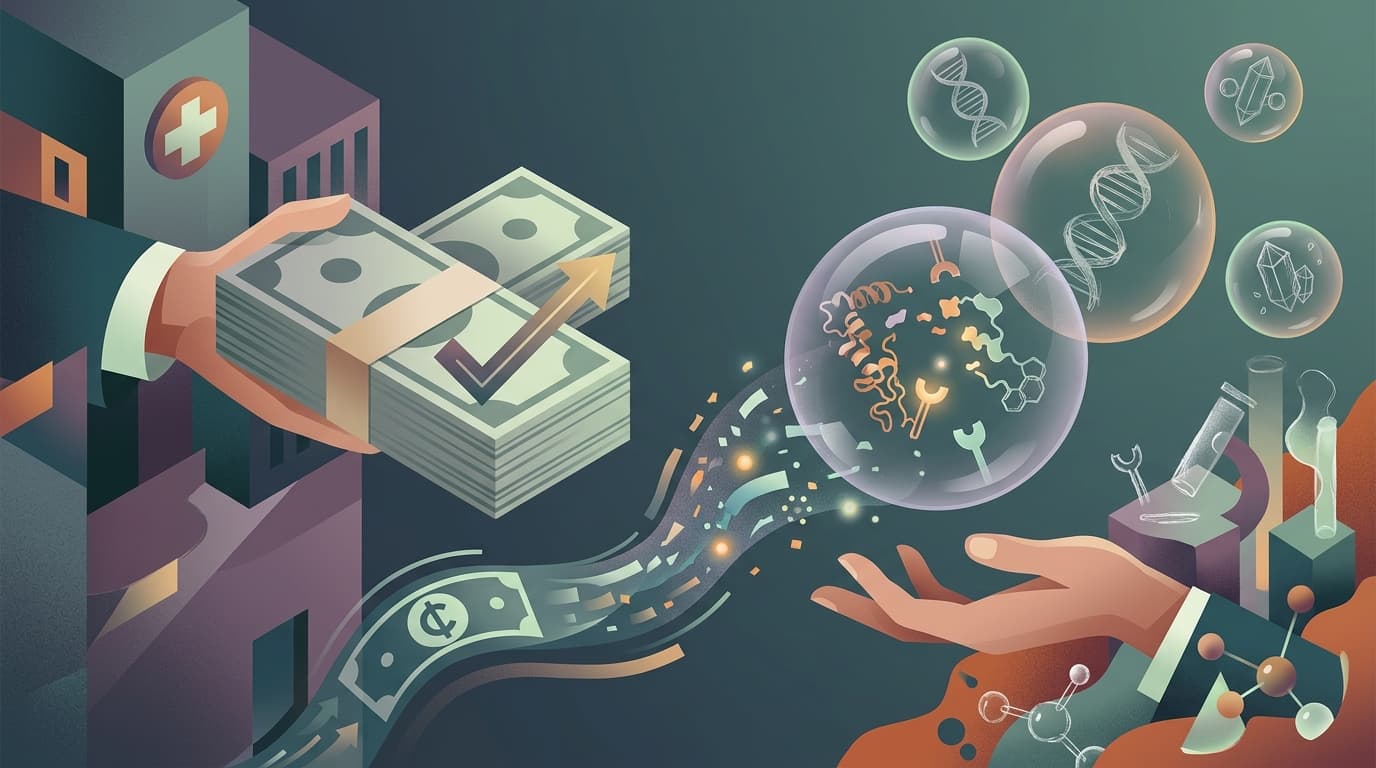

Sanofi just paid Regeneron $1 billion upfront for four antibody programs, three of which haven't entered human testing yet. The total deal could reach $8 billion, making it one of the most aggressive early-stage bets in recent pharma history.
Imagine paying a billion dollars for four items that haven't been built yet. Not prototypes. Not beta versions. Closer to napkin sketches with really good science behind them.
That's essentially what Sanofi just did. The French pharma giant agreed to pay Regeneron $1 billion upfront for four early-stage antibody programs, three of which haven't even entered human testing. And the total price tag? It could climb to $8 billion once milestones are included.
For context, you could buy an NFL franchise for less than that upfront payment. Sanofi bought the biological equivalent of four lottery tickets, and Wall Street is actually applauding.
The deal adds four new long-acting antibodies to the companies' existing collaboration. All four target the same neighborhood of biology: type 2 inflammation, the immune pathway behind conditions like atopic dermatitis (severe eczema), asthma, and other allergic diseases.
Only one of the four programs, an IL-13 antibody called REGN20423, is currently in a Phase 1 trial for atopic dermatitis. The other three (an IL-4xIL-13 bispecific, an IL-4 antibody, and an IL-4Rα antibody) aren't expected to enter clinical studies until 2027.
If that sounds familiar, it should. These targets are all cousins of the biology behind Dupixent, the blockbuster drug that Sanofi and Regeneron already sell together. Think of it like this: Dupixent is the original iPhone, and these four programs are Sanofi's attempt to lock down the next four models before anyone else can.
This isn't a simple acquisition. Sanofi didn't buy these assets outright. Instead, the companies expanded their existing 20-year collaboration under a co-development and co-commercialization model.
The terms break down like this: Sanofi pays $1 billion upfront, then up to $7 billion more in development, regulatory, and commercial milestones. Both companies share the costs of development and commercialization. If any of these drugs make it to market, profits get split . Regeneron leads the science; Sanofi handles the commercial machine.

HHS just unveiled its biggest clinical trial overhaul in decades, betting on AI and "phaseless" trial designs to slash drug development timelines. The vision is bold, but critics warn that faster doesn't always mean better.

Join thousands of biotech professionals who start their day with our free, daily briefing.

Oh, and one more detail that flew under the radar: the agreement also settles earlier litigation between the two companies. Nothing says "let's move on" like a billion-dollar handshake.
Billion-dollar early-stage deals happen. But the structure here is worth noting.
Most pharma companies buying into preclinical programs keep their upfront payments relatively small, loading the real money into milestones that only pay out if the science works. When AbbVie licensed a preclinical antibody from FutureGen in 2024, the headline value was $1.71 billion, but the upfront was just $150 million. Eli Lilly's platform deal with Haya Therapeutics topped $1 billion in total value, but the upfront was undisclosed (and almost certainly modest).
Sanofi, by contrast, wrote a $1 billion check on day one for programs that are overwhelmingly preclinical. That's not standard operating procedure. It signals either extreme confidence in the science, extreme urgency to fill the pipeline, or both.
To understand why Sanofi would pay this much for this little, you have to zoom out.
Sanofi has been on a multi-year mission to rebuild its R&D engine. The company ramped its research spending to roughly €7.4 billion in 2024 and promised a 50% increase in Phase 3 trials between 2023 and 2025. By the end of 2024, it had 83 pipeline projects across immunology, rare diseases, neurology, oncology, and vaccines.
But internal R&D alone wasn't going to be enough. Sanofi has increasingly leaned on acquisitions, licenses, and partnerships to fill gaps. It bought Inhibrx in May 2024 for a rare disease asset. It signed a co-commercialization deal with Novavax for vaccines. And now it's doubling down on its longest-standing partnership to secure what could be the next generation of its biggest franchise.
Dupixent is the engine that powers a huge chunk of Sanofi's revenue. These four programs represent insurance: if competitors develop better alternatives, or if Dupixent's patent protection eventually erodes, Sanofi wants the next-generation weapons already in the chamber.
Analysts are broadly positive, though with the usual caveats about early-stage risk.
J.P. Morgan called the deal a positive for Sanofi, noting that it strengthens the company's early-stage pipeline through access to four new drug candidates. Jefferies analyst Michael Leuchten went further, saying the deal should be viewed positively because it shows the new CEO's proactive focus on investor concerns and the speed of execution. Barclays pointed out that Sanofi's previous CEO had tried and failed to expand this partnership, making the current agreement a meaningful strategic win.
On the Regeneron side, the reception is constructive but more cautious. The company gets a billion dollars in cash today, plus the potential for $7 billion more, while sharing costs with a deep-pocketed partner. But some analysts, including RBC, remain restrained on how much additional stock upside the deal creates.
The real test won't come for years. Three of these four programs are still preclinical, and the history of drug development is littered with promising molecules that failed in human trials. The odds of any single preclinical drug reaching the market hover around 10-15%, depending on the therapeutic area.
But Sanofi isn't betting blindly. Type 2 inflammation is one of the best-validated areas in all of medicine, and Regeneron's track record in antibody engineering is among the best in the industry. These aren't random shots in the dark; they're calculated bets in a neighborhood where both companies have already proven they can win.
The question is whether $1 billion upfront was the right price for that confidence. Sanofi clearly thinks so. Now we wait to see if the science agrees.
For Regeneron, the deal is almost pure upside: cash in hand, shared risk going forward, and continued control of the research. For Sanofi, it's a statement of intent. The company isn't just trying to protect Dupixent's legacy. It's trying to build the sequel.
Genentech's oral pill giredestrant just posted Phase 3 results in the NEJM that could shake up breast cancer treatment. In patients whose cancers outsmarted standard therapy, it cut the risk of progression by up to 62%, and Roche already has an FDA application under review.