The Government Wants to Blow Up How Clinical Trials Work
HHS just unveiled its biggest clinical trial overhaul in decades, betting on AI and "phaseless" trial designs to slash drug development timelines. The vision is bold, but critics warn that faster doesn't always mean better.
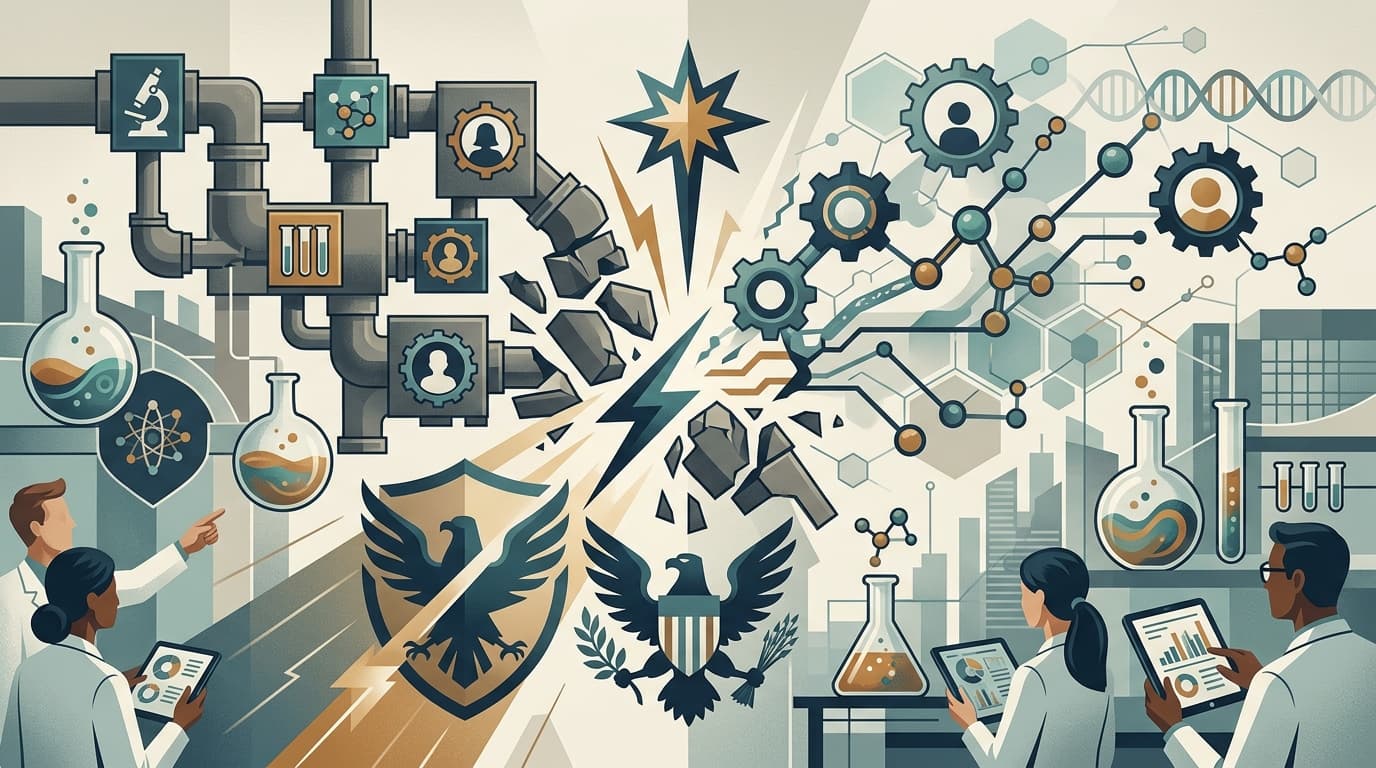
Picture drug development as a relay race. A pharma company finishes Phase 1, hands the baton to Phase 2, then waits around before Phase 3 can even start warming up. Each handoff burns months (sometimes years) and millions of dollars. Patients waiting for life-saving treatments? They just watch the batons drop.
Now HHS wants to rip up the relay format entirely and replace it with something closer to a continuous sprint.
The Biggest Shake-Up in Decades
On September 30, HHS unveiled a sweeping plan to overhaul how clinical trials are designed, run, and analyzed in the United States. The centerpiece is a new five-year program called SURPASS, launched through ARPA-H (the government's moonshot health research agency). The acronym stands for something unwieldy: simulation-augmented, real-time platform adaptive seamless trials. But the ambition behind it is simple: use AI and computational models to make drug testing dramatically faster.
The plan doesn't stop there. HHS also rolled out Operation TrialBlazer, a parallel initiative targeting the earliest stages of drug development. Together, these programs signal a fundamental rethinking of the traditional Phase 1 → Phase 2 → Phase 3 pipeline that has governed drug testing for decades.
If this works, it could cut development timelines significantly. If it doesn't, it raises serious questions about patient safety and scientific rigor.
What "Phaseless" Actually Means
Traditionally, clinical trials run in three distinct stages. Phase 1 tests whether a drug is safe in a small group. Phase 2 checks if it actually works. Phase 3 confirms the results in a much larger population. Each phase is a separate study with its own protocol, its own enrollment, and its own timeline. Think of it like writing three separate books when you could be writing one long novel.
HHS wants to move toward what Axios described as "phaseless trials": flexible, seamless designs where phases blur together. Instead of stopping everything between Phase 2 and Phase 3, a seamless design lets researchers carry data and patients from one stage right into the next.
Get tomorrow's biotech intelligence before your competitors.
Join thousands of biotech professionals who start their day with our free, daily briefing.
The evidence backs up the time savings. Reviews of adaptive seamless designs consistently show they can eliminate the dead time between phases, especially the costly gap between Phase 2 and Phase 3. They can also require fewer total patients, since data from earlier stages feeds directly into the final analysis.
The trade-off? These designs are statistically complex. They demand pre-specified rules for how the trial adapts at each stage. Get the planning wrong, and you can compromise the integrity of your results.
The AI Layer: More Than Just Buzzwords
The SURPASS program isn't just slapping "AI" on a PowerPoint and calling it innovation. It outlines specific, concrete ways artificial intelligence will reshape trial operations:
Predictive computational models will help researchers design better trials upfront. Think of it like running thousands of simulations before you ever enroll a single patient, helping you pick the right dose, the right population, and the right endpoints.
Real-time data analysis means researchers won't have to wait until a trial ends to learn what's happening. They can analyze results as they come in and adapt accordingly. This is the difference between checking your GPS every five minutes versus only looking at the map after you've arrived (possibly at the wrong destination).
An "agentic operations layer" (yes, that's what they called it) will automate the tedious startup tasks that slow trials down: onboarding new treatment arms, cleaning data, constructing datasets. The boring stuff that eats months of calendar time.
AI-enabled site expansion aims to turn hospitals and clinics that have never run a clinical trial into research-capable sites. This could be huge for access and diversity, since trials have historically clustered at a handful of elite academic medical centers.
And it all sits on top of shared infrastructure with common control groups, so multiple treatments can be tested simultaneously on the same platform. Instead of every drug sponsor building their own trial from scratch, they share the plumbing.
The FDA Is Moving Too (Carefully)
HHS isn't acting alone. The FDA has been quietly building its own framework for this moment.
The agency's 2026 agenda includes updated guidance on basket, umbrella, and platform master protocols, which are the trial architectures that make seamless designs possible. It's also issued draft guidance shifting away from the traditional requirement of two adequate and well-controlled trials to prove a drug works, signaling comfort with a single strong pivotal trial plus confirmatory evidence in some cases.
That's a meaningful shift. For decades, the two-trial standard was the gold standard for drug approval. Relaxing it could shave years off development for certain therapies.
FDA has also been working on a seven-step credibility framework for AI models used in drug development. The approach is risk-based: it doesn't automatically greenlight or ban AI. Instead, it asks whether a specific model is credible for a specific purpose, and whether the sponsor can prove reliable performance under real conditions. The key elements include defining the question the model answers, assessing risk, validating performance, and planning for ongoing monitoring after deployment.
On the nonclinical side, the agency issued a rule in September 2026 updating its terminology to recognize new approach methodologies (NAMs), alternatives to traditional animal testing like organoids, tissue models, and computational simulations. HHS says these changes could spare hundreds of non-human primates and more than one million horseshoe crabs annually.
The Political Subplot You Can't Ignore
None of this exists in a vacuum. Robert F. Kennedy Jr.'s HHS has been aggressive about using AI as a policy tool, launching more than 20 initiatives since he took office to expand computational modeling and reduce animal testing. ARPA-H's separate CATALYST program is investing in AI to predict drug safety and optimize dosing.
Kennedy has also framed AI in notably political terms, suggesting it could serve as a "second opinion" better informed than doctors and help free patients from what he called "medical tyranny." That rhetoric has raised eyebrows in the medical community, reflecting a broader concern that Silicon Valley influence is growing faster than the evidence base.
The tension is real. The policy substance (faster trials, better designs, less animal testing) has broad support. The political framing, tied to Kennedy's MAHA movement and criticism of conventional public health expertise, makes some scientists deeply uncomfortable.
The Skeptics Have a Point
For all the ambition, serious questions remain unanswered.
Some experts have warned that regulatory speed doesn't automatically produce scientific success. The real bottlenecks in clinical trials aren't just structural; they're about enrollment, endpoint adjudication, and having enough trained reviewers at FDA to handle the workload. A fancier trial design doesn't fix a staffing shortage.
Critics have also raised concerns about patient safety, weakened evidence standards, FDA capacity, conflicts of interest, and bias in AI-driven eligibility decisions. If an algorithm decides who gets into a trial and who doesn't, the stakes for getting that algorithm right are enormous. Health equity advocates worry that AI could entrench existing disparities rather than fix them.
And there's a practical reality check from the research community: AI works best when it's integrated with human behavior and workflow, not treated as a standalone fix. The fanciest computational model in the world is useless if the clinical sites running the trial can't actually implement it.
Why This Matters Right Now
The U.S. is in a global race to attract clinical trials. Other countries are streamlining their processes, and sponsors are increasingly running pivotal studies overseas where timelines are shorter and costs are lower. HHS's push is partly about competitiveness: if American trial infrastructure stays slow and expensive, the studies (and the innovation that comes with them) will go elsewhere.
SURPASS is a five-year bet. The initial call is going out for cross-disciplinary teams spanning statistics, AI, clinical trial design, operations, and regulation. Whether this transforms drug development or becomes another overpromised government initiative depends entirely on execution.
The vision is compelling: a world where trials run faster, cost less, enroll more diverse patients, and still produce rigorous evidence. The history of ambitious government health tech programs, though, is littered with projects that sounded great in press releases and died quietly in implementation.
This time, millions of patients are watching the relay. HHS says it's time to stop passing batons and start sprinting. The question is whether they can run that fast without tripping.
Clinical & Regulatory
4 min read
The Obesity Shot That Wants You to Forget About It
Viking Therapeutics says patients kept up to 97% of their weight loss after switching to less frequent shots. In a market dominated by weekly injections, monthly dosing could be the convenience edge that reshapes the entire obesity drug race.