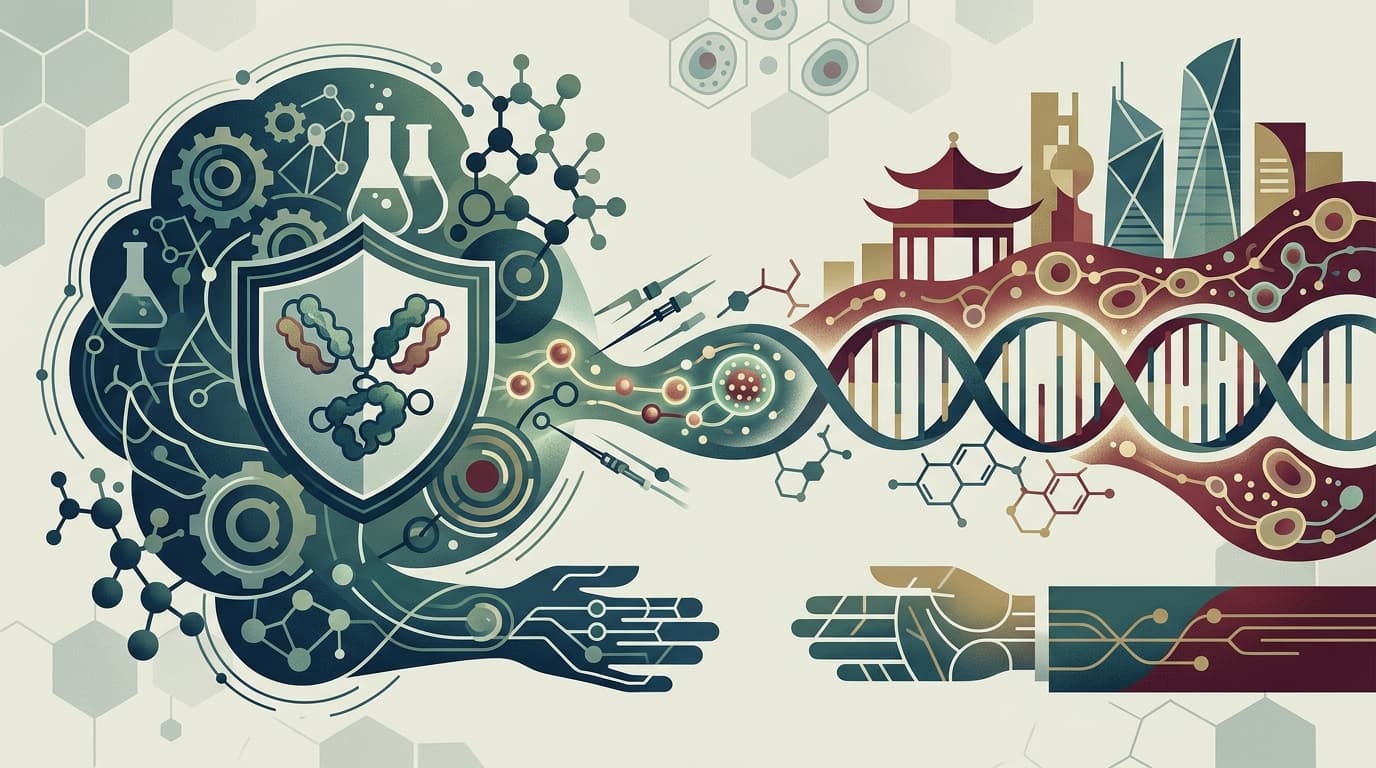

Sandoz just committed up to $322 million to license biosimilars from a Chinese company most people have never heard of. The deal with Shanghai Henlius signals something bigger: China's biologics ecosystem has gone from follower to supplier for the world's largest biosimilar company.
For decades, the flow of biological medicines moved in one direction: Western pharma developed them, and the rest of the world waited. Chinese companies licensed in. They manufactured. They followed.
Not anymore. Sandoz, the world's largest biosimilar company, just signed a deal to license up to 10 biosimilars from Shanghai Henlius Biotech, a Chinese biologics developer most people outside the industry have never heard of. The initial package covers three copycat versions of blockbuster drugs, with an option for a fourth and room to expand dramatically. Total potential payments: up to $322 million.
This isn't a one-off shopping trip. It's a strategic bet that China can be the factory floor for the next generation of complex biological medicines headed to Western patients.
The first three biosimilars in the deal target some familiar brand names:
Sandoz also grabbed an option on a fourth asset: a recombinant human hyaluronidase, which is an enzyme that helps deliver other drugs under the skin instead of through an IV. Think of it as a biological delivery hack.
Henlius handles all the development and manufacturing. Sandoz gets exclusive commercialization rights everywhere outside China. It's a clean split: one side builds, the other side sells.
The financial structure is milestone-based, meaning Henlius earns payments as drugs clear regulatory hurdles. About $100.5 million is expected to land in near-term invoiced payments in 2026 alone.
This isn't even the first time Sandoz has dialed Henlius. Back in April 2025, the two companies struck a separate global deal for an (a copy of the cancer immunotherapy Yervoy), worth up to . That earlier agreement covered the U.S., Europe, Japan, Canada, and Australia.

AstraZeneca killed its Phase 3 lung cancer trial of volrustomig after the bispecific antibody couldn't outperform Keytruda. The fallout raises uncomfortable questions about whether the industry's obsession with "two-in-one" cancer drugs has been oversold.


Join thousands of biotech professionals who start their day with our free, daily briefing.
So within roughly 16 months, Sandoz has committed over $600 million in potential payments to a single Chinese partner. That's not dabbling; that's a relationship.
And Henlius isn't the only dance partner. In March 2026, Sandoz signed a major collaboration with Samsung Bioepis for up to five biosimilars, pushing its total pipeline toward 32 assets. The company also acquired Just-Evotec Biologics' EU manufacturing site in 2025 and picked up Cimerli (a biosimilar for the eye drug Lucentis) from Coherus in 2024.
The pattern is unmistakable. Sandoz is assembling a biosimilar empire through partnerships and acquisitions, not by building everything in-house. It's the franchise model: own the brand, outsource the kitchen.
Shanghai Henlius was founded in 2010 as a joint venture backed by Fosun Pharma, one of China's biggest pharmaceutical conglomerates. What started as a modest biosimilar shop has grown into something much more ambitious.
By early 2026, Henlius had 10 products approved across more than 60 countries. Its manufacturing network spans three facilities in Shanghai with 84,000 liters of total production capacity, all certified under GMP standards by regulators in China, the EU, and the U.S. That last part matters enormously. Getting a Chinese biologics facility approved by Western regulators is like passing the hardest driving test in the world; it signals that the quality systems are genuinely global-grade.
The company's pipeline is stacked, too. It has over 30 clinical studies running for 19 products globally, including biosimilars of nivolumab (Opdivo), pembrolizumab (Keytruda), and daratumumab (Darzalex). Several of these entered Phase 1 trials in the U.S. and China in mid-2026. Henlius isn't just copying yesterday's blockbusters. It's targeting tomorrow's patent cliffs.
Zoom out, and the Sandoz/Henlius deal fits neatly into a much larger trend. Cross-border licensing deals from China hit a record $137.7 billion in total value in 2025, up nearly tenfold from 2021. The number of Greater China out-licensing deals rose from 65 in 2021 to 186 in 2025, with 38 more announced by early 2026.
The average upfront payment from Western companies licensing Chinese assets has more than tripled, climbing from $52 million in 2022 to $172 million in 2026. Western pharma isn't just sampling; it's buying in bulk.
Most of that activity is in innovative biologics (think antibody-drug conjugates and bispecific antibodies), not biosimilars. But the Sandoz/Henlius collaboration shows the same dynamic playing out in the copycat drug space. Chinese developers have built the scientific talent, manufacturing scale, and regulatory track record to compete globally, and Western companies are responding with their wallets.
The elephant in the room is geopolitics. U.S. scrutiny of Chinese biotech deals has intensified, and any legislative action targeting China-origin pharmaceutical supply chains could complicate Sandoz's plans. The BIOSECURE Act and similar proposals have already spooked parts of the industry, even though they've primarily targeted contract research organizations rather than drug licensing.
There's also execution risk. Most of the Henlius biosimilars in this deal are still early in development. Getting a biosimilar approved is cheaper than developing a novel drug, but it's still a multi-year, multi-hurdle process. Biosimilars of complex monoclonal antibodies require extensive analytical and clinical work to prove they're sufficiently similar to the original.
And competition is fierce. Every major biosimilar player is eyeing the same patent cliffs. Being first to market matters enormously in biosimilars, where early entrants often capture the lion's share of prescriptions.
Sandoz is placing a big, deliberate bet that China's biologics ecosystem has matured enough to supply Western markets with high-quality biosimilars. The company already has the commercial infrastructure to sell these drugs globally. What it needs is pipeline, and Henlius is delivering it at a pace (and price) that in-house development can't match.
For Henlius and Fosun Pharma, the deal validates years of investment in manufacturing quality and regulatory credibility. For the broader industry, it's another data point in what's becoming an undeniable trend: the flow of biological innovation no longer runs in just one direction.
The West used to export its medicines to China. Now China is exporting the medicines back.
RiboX just got FDA clearance to test the world's first circular RNA-based therapy that builds CAR-T cells inside the body, no factory required. It's a collision of two massive biotech trends, and the implications for autoimmune disease are enormous.