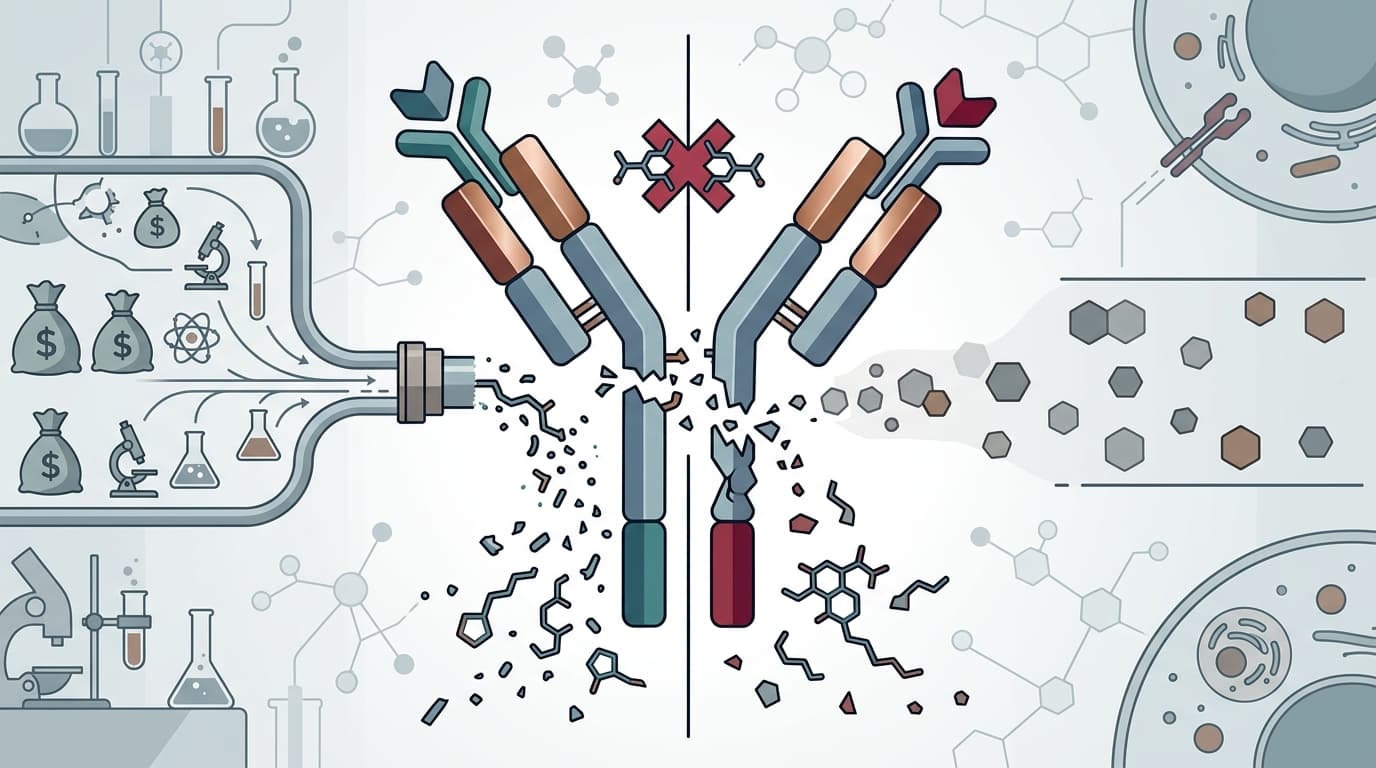

AstraZeneca killed its Phase 3 lung cancer trial of volrustomig after the bispecific antibody couldn't outperform Keytruda. The fallout raises uncomfortable questions about whether the industry's obsession with "two-in-one" cancer drugs has been oversold.
Imagine ordering a combo meal because you're convinced two items together will be better than the best burger on the menu. Now imagine it tastes worse. That's roughly what just happened to AstraZeneca's most ambitious cancer experiment.
The pharma giant pulled the plug on its Phase 3 eVOLVE-Lung02 trial this week after an independent review board concluded the drug wasn't going to win. The drug in question, volrustomig, was supposed to be the future of lung cancer treatment. Instead, it couldn't beat the current standard of care. And the ripple effects could chill an entire corner of the oncology world.
To understand why this matters, you need to know what volrustomig was trying to do.
Most modern cancer immunotherapies work by blocking a single checkpoint, a molecular "off switch" that tumors exploit to hide from your immune system. Drugs like Keytruda (pembrolizumab) block one of these switches called PD-1, and they've become the backbone of cancer treatment. Billions in revenue. Standard of care across dozens of tumor types.
Volrustomig is a bispecific antibody, which means it's engineered to grab two targets at once: PD-1 and CTLA-4. Think of it like a bouncer who can check IDs with both hands simultaneously. The idea is compelling on paper. If blocking one checkpoint works well, blocking two at the same time with a single molecule should work even better, right?
That was the theory. The clinic had other plans.
The eVOLVE-Lung02 trial tested volrustomig plus chemotherapy against Keytruda plus chemotherapy in patients with first-line metastatic non-small cell lung cancer (the most common type of lung cancer). The trial specifically focused on patients whose tumors had low PD-L1 expression, a biomarker that helps predict who responds to checkpoint drugs. These are the patients who need better options the most.
The trial had two co-primary endpoints: progression-free survival (how long before the cancer grows back) and (how long patients live). After an interim look at the data, the Independent Data Monitoring Committee delivered the verdict: volrustomig was .

Sandoz just committed up to $322 million to license biosimilars from a Chinese company most people have never heard of. The deal with Shanghai Henlius signals something bigger: China's biologics ecosystem has gone from follower to supplier for the world's largest biosimilar company.


Join thousands of biotech professionals who start their day with our free, daily briefing.
AstraZeneca didn't release the actual numbers. We don't know the hazard ratios or survival curves. But "unlikely to meet either primary endpoint" is about as definitive as it gets in clinical trial language. It's the equivalent of a coach pulling the starters in the fourth quarter because the game is out of reach.
One silver lining: there were no new safety signals. The drug didn't hurt people. It just didn't help them enough.
This isn't just an AstraZeneca problem. It's an industry wake-up call.
Bispecific antibodies have been the hottest trend in oncology drug development over the past few years. The logic was seductive: combine two proven mechanisms into one elegant molecule, reduce pill burden, and potentially unlock deeper immune responses. Companies have been racing to build these "Swiss Army knife" drugs, and the pipeline is packed. A 2026 review found 192 bispecific trials in colorectal cancer alone.
But the excitement has been running ahead of the evidence, at least in solid tumors. While bispecifics have found real success in blood cancers (think CD20×CD3 drugs for lymphoma), the solid tumor story has been far rockier. Tumor biology is more complex when you're dealing with physical masses rather than circulating cancer cells. Solid tumors build walls of suppressive immune cells around themselves. They can lose the very targets that bispecifics are designed to hit.
A recent meta-analysis of 104 CD3-based bispecific trials found that nearly 98% of solid tumor patients experienced treatment-related side effects, with over 45% hitting severe (grade 3 or higher) toxicity. The safety profile in this particular trial was cleaner, but the broader pattern shows just how hard this class of drugs is to develop.
The eVOLVE-Lung02 failure joins a growing list of bispecific setbacks. Programs targeting PSMA (for prostate cancer) and others have been shelved in recent years. The dream of bispecifics as universal checkpoint inhibitor replacements is looking increasingly like a mirage.
Before you assume AstraZeneca is abandoning the whole approach, some context: the company said its other Phase 3 volrustomig trials are continuing. Studies in cervical cancer, head and neck squamous cell carcinoma, and mesothelioma are all still active. It's possible that volrustomig works in cancers with different biology, even if it couldn't outperform Keytruda in lung cancer.
AstraZeneca also has rilvegostomig, a PD-1/TIGIT bispecific, moving through clinical development. Different target pair, different mechanism, potentially different outcome. The company isn't walking away from bispecifics; it's learning which battles to pick.
And that might be the most important lesson here. The failure wasn't really about bispecifics being broken. It was about the specific bet that two checkpoints would be better than one in a population where even single-checkpoint therapy struggles. Trying to beat Keytruda plus chemo in low-PD-L1 lung cancer is like challenging the defending champion on their home court. The bar was always sky-high.
The bispecific antibody field is at an inflection point. The hype cycle promised that these dual-targeting molecules would be the next generation of cancer immunotherapy, replacing checkpoint inhibitors the way smartphones replaced flip phones. Reality, as usual, is more nuanced.
What the data actually supports is a complementary role, not a substitutive one. Bispecifics will likely carve out niches where they genuinely outperform simpler drugs: specific tumor types, specific biomarker populations, specific combination regimens. The companies that win will be the ones who figure out where bispecifics add value, not the ones who assume they add value everywhere.
For now, Keytruda and its checkpoint inhibitor cousins remain the kings of oncology. They're not perfect, but they've earned their throne through years of clinical validation. Anyone who wants to dethrone them needs to bring real, measurable improvement; not just a fancier molecular design.
AstraZeneca learned that the hard way this week. The rest of the industry should be taking notes.
RiboX just got FDA clearance to test the world's first circular RNA-based therapy that builds CAR-T cells inside the body, no factory required. It's a collision of two massive biotech trends, and the implications for autoimmune disease are enormous.