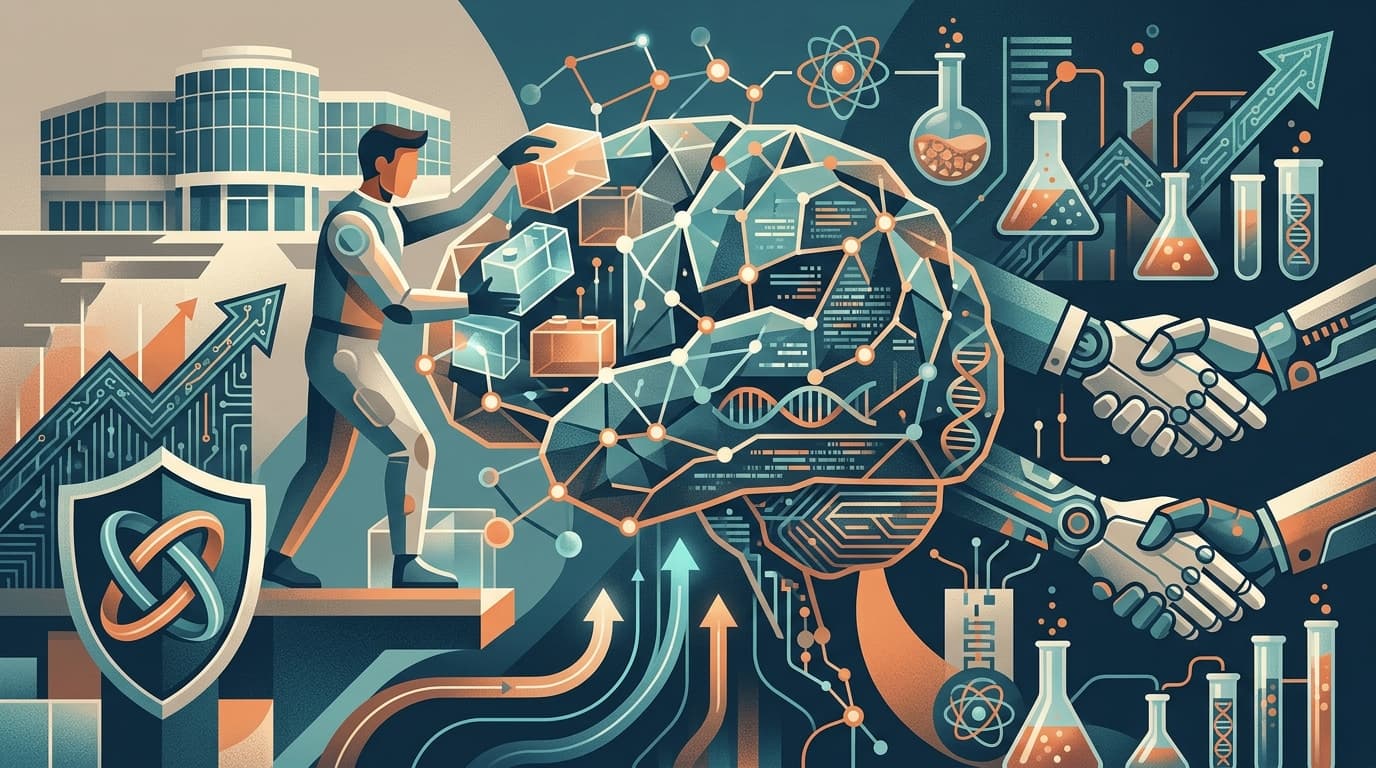
Roche Just Built Pharma's Biggest AI Brain. Here's Why It Matters.
Roche deployed over 3,500 NVIDIA GPUs to build pharma's largest AI computing setup, and it's not just a flex. The move signals that GPU-accelerated drug discovery is graduating from pilot programs to full-scale enterprise deployment, with billions of dollars and years of patient waiting on the line.
3,500 GPUs Walk Into a Lab
Imagine you're trying to find one perfect recipe out of billions of possible ingredient combinations. You could spend decades tasting each one. Or you could build the world's fastest kitchen, staffed by thousands of tireless chefs who can simulate flavors before a single dish is cooked.
Roche just built that kitchen.
The Swiss pharma giant expanded its partnership with NVIDIA in March 2026, deploying 2,176 new Blackwell GPUs on-premises across the U.S. and Europe. Combined with existing hardware and cloud resources, Roche now runs more than 3,500 GPUs dedicated to drug discovery, manufacturing, and diagnostics. It's the largest announced AI computing setup in the pharmaceutical industry. No one else comes close.
And that fact alone tells you something important about where drug development is headed.
From Science Project to Assembly Line
For years, "AI in drug discovery" lived in the same category as jetpacks and flying cars: perpetually five years away from maturity. Pharma companies ran pilot programs, published splashy press releases, and quietly shelved most of the results. A stunning stat from industry analysts captures the problem: 95% of enterprise generative AI pilots failed to deliver measurable business impact, largely because they weren't wired into real workflows.
Roche is betting that the era of science projects is over. Instead of bolting AI onto the side of its R&D process, the company is embedding it into the foundation. Think of it less like adding a turbocharger to an old car and more like designing a new engine from scratch.
The technical backbone of this effort has a name that sounds like it belongs in a Marvel movie: the "AI factory." It's a hybrid-cloud system (part on-premises hardware, part cloud computing) that connects researchers across Roche's global operations. The on-premises setup matters because pharma companies guard their proprietary data like dragons sitting on gold. Keeping GPUs in-house means sensitive molecular data and patient information never have to leave Roche's walls.
Get tomorrow's biotech intelligence before your competitors.
Join thousands of biotech professionals who start their day with our free, daily briefing.
What 3,500 GPUs Actually Do All Day
So what does a pharmaceutical AI factory produce? Not widgets. Not software. Predictions.
At the heart of Roche's strategy is something its biotech arm Genentech calls "Lab-in-the-Loop." Picture a relay race between computers and scientists. AI models analyze mountains of biological data (protein structures, genomic sequences, molecular interactions) and predict which drug candidates are most likely to work. Then lab scientists run real experiments to test those predictions. The results feed back into the AI, which gets smarter with each cycle.
Genentech has been refining this approach for over five years, and the numbers are starting to speak for themselves.
The NVIDIA partnership supercharges this loop with specific tools. BioNeMo trains biological foundation models (think of them as AI brains specialized in understanding proteins and molecules) on Roche's proprietary datasets. Parabricks accelerates genomics work. Omniverse creates digital twins of manufacturing facilities, essentially virtual replicas where engineers can test production changes without risking a single real batch.
That last one is particularly interesting for anyone following the GLP-1 craze. Digital twins are projected to boost manufacturing capacity by 25 to 40% and cut lead times by 15 to 20% across the industry. When demand for weight-loss drugs is outstripping supply worldwide, those percentages translate into real medicine reaching real patients.
The Arms Race Nobody's Talking About
Roche isn't operating in a vacuum. This expansion dropped just weeks after Eli Lilly and NVIDIA announced a co-innovation AI lab in the Bay Area with up to $1 billion in investment over five years. Lilly already runs the most powerful DGX SuperPOD (NVIDIA's top-tier computing cluster) in biopharma.
See the pattern? The two biggest players in pharma are locked in a GPU arms race, and NVIDIA is the arms dealer supplying both sides. It's a beautiful business model, honestly. Whether Roche or Lilly "wins" the AI drug discovery race, Jensen Huang's company sells the shovels.
But the competition extends well beyond Big Pharma. AI-native biotechs like Insilico Medicine, Recursion, and Iambic Therapeutics are advancing AI-designed drugs into human trials across oncology and fibrosis. Insilico moved a drug for idiopathic pulmonary fibrosis (a scarring lung disease) from discovery to preclinical candidate nomination in under 18 months, and from discovery to Phase 1 trials in under 30 months. For context, traditional drug discovery typically takes four to six years before reaching that milestone.
These smaller companies have demonstrated Phase 1 success rates materially higher than industry averages, while shortening discovery timelines by 40 to 50%. They're proving the concept works. Now companies like Roche are trying to prove it works at scale.
Why Scale Changes Everything
This is the part that gets underappreciated. Running AI on a handful of drug programs is interesting. Running it across an entire R&D organization with a $14 to $15 billion annual research budget (roughly 25% of Roche's total sales) is transformational.
Wafaa Mamilli, Roche's Chief Digital and Technology Officer, framed it plainly: "Every day saved means a life-changing medicine or diagnostic reaches a patient sooner." It sounds like corporate boilerplate until you do the math. The average drug costs $2.5 billion to develop and takes 12 to 15 years from concept to pharmacy shelf. Even a 10% improvement in speed or efficiency represents hundreds of millions of dollars and, more importantly, years of patient waiting.
Aviv Regev, who heads Genentech's Research and Early Development, was more pointed: the AI factory "shortens the path from biological insight to life-saving medicine." Translation: they want to collapse the gap between discovering what causes a disease and having something that treats it.
Roche is applying this thinking beyond drug discovery too. Digital twins predict cell-line performance, improving manufacturing product yield by 10% and quality by 40%. AI models help select neoantigens (unique markers on cancer cells) for personalized cancer vaccines. It's not one flashy application; it's AI seeping into every crevice of the operation.
The Skeptic's Corner
Before we crown Roche the king of AI pharma, some caveats.
Neither Roche nor NVIDIA disclosed financial terms for this expanded partnership. We don't know the dollar commitment, the contract length, or whether any exclusivity provisions exist. For a deal this significant, the lack of transparency is notable.
There's also the uncomfortable question of ROI. Roche reportedly generated roughly $0.5 to $0.7 billion in incremental revenue from AI-driven efficiencies in 2024, primarily through predictive alerts and workflow improvements. That's real money, but it's a fraction of the company's approximately $66 billion in annual sales. The truly transformative value (faster drug approvals, higher success rates, novel targets) remains largely promissory.
And then there's the broader industry context. The AI in drug discovery market is growing at a healthy clip, reaching roughly $3 billion in 2026. But $3 billion is a rounding error compared to global pharma R&D spending. We're still in early innings.
What This Means for the Rest of Us
The Roche/NVIDIA partnership matters less for what it is today and more for what it signals about tomorrow. When a top-five pharma company with over $14 billion in annual R&D spending decides that AI infrastructure is a core strategic asset (not a side experiment), the rest of the industry takes notice.
The AI in drug discovery market is projected to reach critical mass by the end of the decade. Finding the right biological target remains the hardest, most expensive part of making a drug. That's exactly where GPU-accelerated computing shines: crunching through genomic, proteomic, and disease pathway data to separate signal from noise.
The playbook is becoming clear. Step one: build massive compute infrastructure. Step two: train proprietary AI models on your unique data. Step three: embed those models into every stage of R&D, manufacturing, and commercialization. Step four: hope it all works before your competitors figure it out.
Roche is all-in on this playbook. Lilly is too. The question isn't whether AI will reshape drug development. It's whether the companies investing billions today will be the ones who capture the value, or whether nimbler AI-native biotechs will eat their lunch.
Either way, NVIDIA wins. Some companies just know how to pick a lane.
4 min read
The $400M Bet That AI Can Design Better Drugs Than Humans
Generate Biomedicines just raised $400 million in the largest biotech IPO since 2024, betting that AI can design better drugs than humans. With a Phase 3 asthma program, a generative biology platform, and the Moderna-incubator Flagship Pioneering behind it, this is the biggest test yet of whether AI drug design can survive public markets.