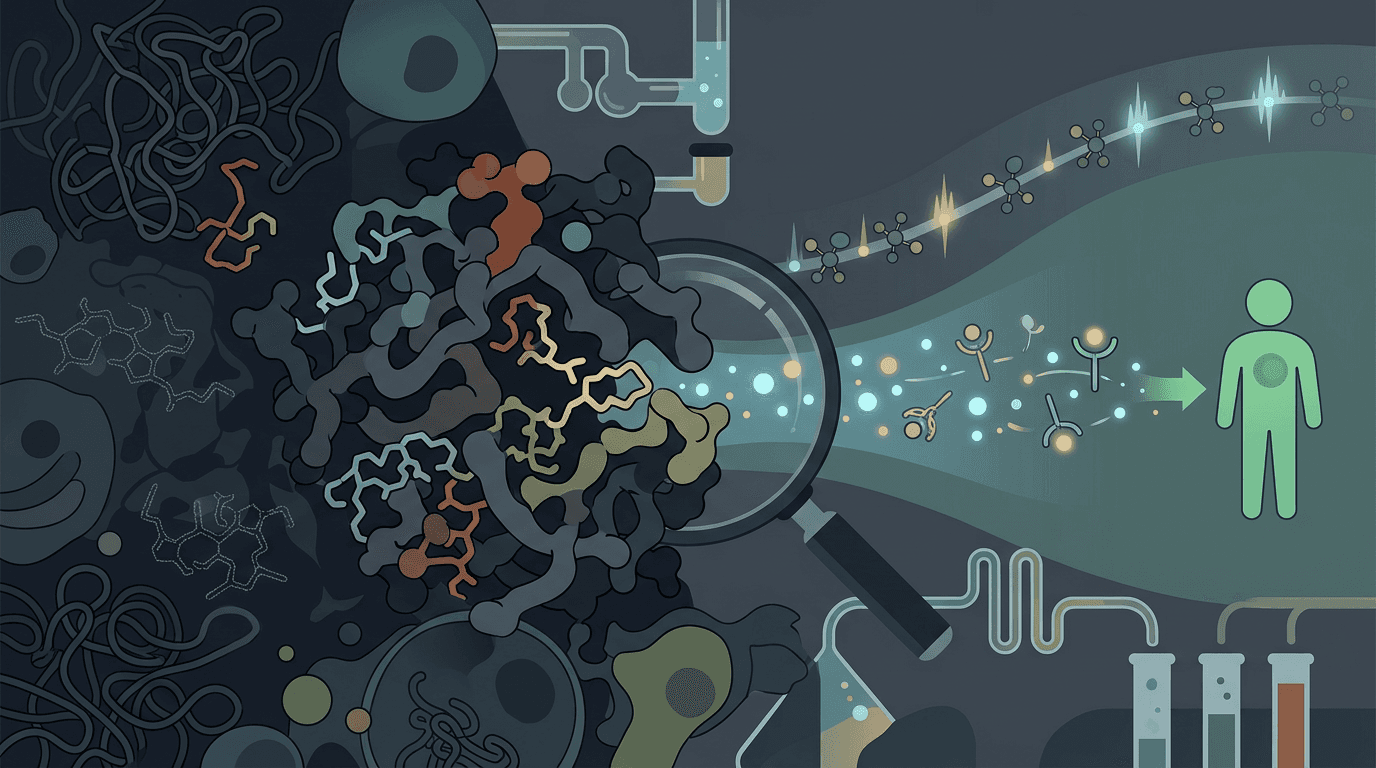

For 40 years, KRAS was the protein oncologists couldn't touch. Revolution Medicines just showed up at AACR 2026 with clinical data across multiple drugs and tumor types that suggest the "undruggable" era is officially over. Wall Street is already betting big.
For four decades, KRAS was oncology's white whale. Scientists knew this mutated protein was fueling some of the deadliest cancers on the planet: pancreatic, lung, colorectal. They also knew they couldn't touch it. The protein's surface was too smooth, too slippery, with no obvious place for a drug to grab hold. Researchers literally called it "undruggable."
Then, at AACR 2026 last week, Revolution Medicines walked onto the stage and dropped a pile of clinical data suggesting they've not only drugged KRAS, but they might be building the most comprehensive arsenal against it that oncology has ever seen.
Think of KRAS like a light switch that gets stuck in the "on" position, telling cells to grow and divide nonstop. It shows up everywhere: over 90% of pancreatic cancers carry KRAS mutations, along with roughly 38% of colorectal cancers and 25–30% of non-small cell lung cancers. For years, the best oncologists could do was attack the wiring downstream, hoping to slow the signal. It rarely worked well enough.
The first real crack came in 2021, when Amgen's sotorasib (Lumakras) became the first approved drug to directly target a specific KRAS mutation called G12C. Mirati's adagrasib (Krazati) followed in 2022. Both were historic milestones, but they came with a catch: they only worked on that one mutation subtype. In lung cancer, where G12C is the most common KRAS variant, response rates hovered around 37 to 43%. In colorectal cancer, they barely moved the needle. And in pancreatic cancer, where KRAS mutations are nearly universal but G12C is rare, these drugs were mostly irrelevant.
Revolution Medicines looked at this landscape and decided to think bigger.
If sotorasib and adagrasib are like keys that fit one specific lock, Revolution's lead drug daraxonrasib (the artist formerly known as RMC-6236) is more like a master key. It's a pan-RAS(ON) inhibitor, meaning it targets multiple KRAS mutations (G12D, G12V, G12R, G12C, and others) while they're in their active, signaling state.
This matters enormously for pancreatic cancer, where the dominant mutations are G12D and G12V, not G12C. A drug that only hits G12C is like bringing a snow shovel to a beach; technically a tool, but not the right one.

Roche's new oral pill fenebrutinib cut MS relapses by up to 59% and matched its own blockbuster infusion in progressive disease. But a troubling death imbalance in clinical trials has analysts watching the FDA's next move closely.


Join thousands of biotech professionals who start their day with our free, daily briefing.

The AACR data made the case convincingly. In previously untreated metastatic pancreatic cancer patients, daraxonrasib monotherapy delivered an objective response rate of 47%, with 92% of patients achieving disease control. At six months, 83% of patients were still alive and 71% hadn't seen their cancer progress.
Those numbers get even better in combination with chemotherapy: 58% response rate, 90% overall survival at six months, and 84% progression-free survival. For a cancer where the standard chemotherapy regimens (FOLFIRINOX, gemcitabine/nab-paclitaxel) have been the grim default for years, these are striking improvements.
The drug had already hit its mark in a Phase 3 trial, showing median overall survival of 13.2 months versus just 6.7 months for chemotherapy in previously treated pancreatic cancer. Revolution is now pursuing FDA approval with a priority review voucher.
What separates Revolution from the pack isn't just daraxonrasib. It's the breadth of their KRAS portfolio. At AACR, the company also showcased zoldonrasib, a KRAS G12D-selective inhibitor built for patients with that specific mutation.
The Phase 1 data in G12D-mutant lung cancer patients (who had already failed immunotherapy) showed a confirmed response rate of 52% and a median progression-free survival of 11.1 months. For context, these are patients who've already been through the treatment wringer. Safety looked manageable too: 13% experienced serious side effects, with only 5% discontinuing treatment. No grade 4 or 5 events were reported.
Revolution plans to launch a pivotal Phase 3 combination trial called Rasolve-308 in first-line lung cancer in the first half of 2026. They're also advancing elironrasib, a G12C-selective inhibitor designed to work in patients whose cancer has already outsmarted existing G12C drugs like sotorasib and adagrasib.
And then there's RM-055, a new catalytic RAS inhibitor still in preclinical stages. In animal models, it drove deep, durable tumor shrinkage across pancreatic, lung, and colorectal cancer models, including tumors that had become resistant to other RAS inhibitors. Think of it as the backup plan for when cancers learn to dodge the first wave of drugs.
The market's reaction tells its own story. Revolution Medicines stock has surged roughly 170% over the past year, with shares recently trading around $152.
Analyst sentiment is overwhelmingly bullish. Out of 18 to 19 analysts covering the stock, the consensus is a firm "Buy" or "Strong Buy." Raymond James has a $175 price target. Needham is even higher at $186. Leerink Partners raised its target to $171 after the AACR presentations. Jefferies initiated with a "Strong Buy" at $140.
The company recently raised $2 billion through a combination of stock and convertible notes, which caused a brief 3.6% dip on dilution concerns. But most analysts view the cash raise as fuel for the Phase 3 programs ahead, not a red flag.
Revolution isn't operating in a vacuum. Amgen and Bristol-Myers Squibb (which acquired Mirati) are expanding their G12C programs. Astellas has setidegrasib, a G12D degrader that competes directly with zoldonrasib. Immuneering's atebimetinib, a MEK inhibitor (which blocks signaling downstream of RAS), showed 64% twelve-month survival in first-line pancreatic cancer and could compete on tolerability.
But Revolution's advantage is coverage. While competitors focus on individual mutations, Revolution has drugs targeting G12C, G12D, G12V, and a pan-RAS catch-all, plus a next-generation molecule in preclinical development. It's the difference between fielding one good player and having a deep bench.
Forty years ago, scientists identified KRAS as a cancer driver and threw up their hands. A decade ago, the first direct inhibitors started working in the lab. Five years ago, the first one reached patients. Now, Revolution Medicines is building what looks like a comprehensive playbook against the most common oncogenic mutation family in solid tumors.
The data from AACR 2026 doesn't close the book on KRAS. Survival numbers in several cohorts are still maturing, resistance will inevitably emerge, and the real test comes in larger Phase 3 trials and regulatory reviews. But for the millions of cancer patients whose tumors are driven by KRAS mutations (particularly the roughly 67,000 Americans diagnosed with pancreatic cancer each year), this is the most promising moment in four decades of trying.
The "undruggable" target finally has a lot of drugs pointed at it. And the early results suggest they're hitting the mark.
Generate Biomedicines just raised $400 million in the largest biotech IPO since 2024, betting that AI can design better drugs than humans. With a Phase 3 asthma program, a generative biology platform, and the Moderna-incubator Flagship Pioneering behind it, this is the biggest test yet of whether AI drug design can survive public markets.