
Roche terminated both its Huntington's disease ASO programs in a single announcement, including its decade-long flagship partnership with Ionis. The double failure raises hard questions about whether the field's best strategy for tackling the disease actually works in humans.
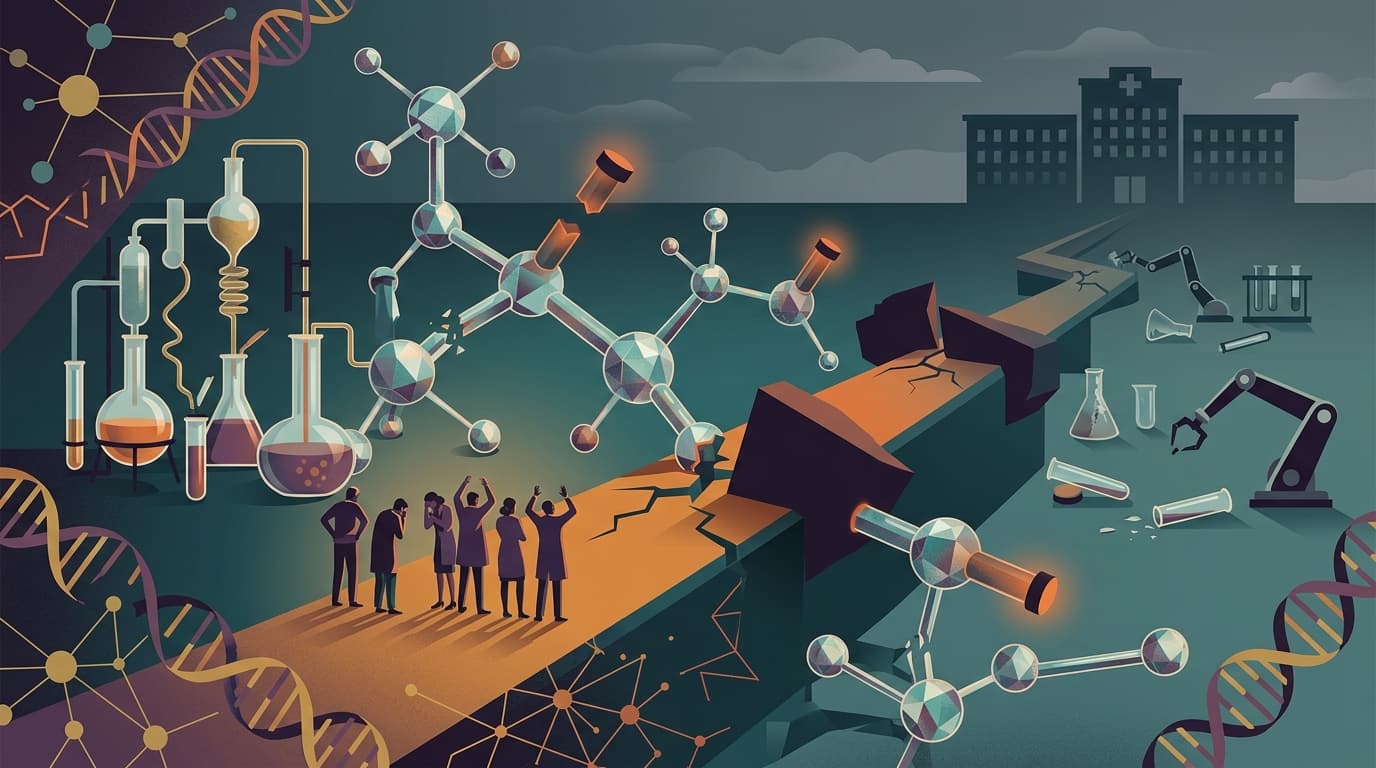
Imagine spending over a decade building a house, only to discover the foundation was poured wrong. That's roughly what happened to Roche this week.
The pharma giant delivered a double blow to the Huntington's disease field, terminating its selective HTT-lowering drug RG6496 and reporting disappointing results from the Phase 2 trial of tominersen. Both drugs targeted the huntingtin protein (HTT), the toxic molecule that drives the disease. Both failed. And the combined news sends a chilling message to a field that was already questioning whether its best ideas actually work.
The first casualty is tominersen, an antisense oligonucleotide (ASO) that Roche and Ionis have been developing since 2013. ASOs are short stretches of synthetic genetic material designed to silence a specific gene. In this case, the target was HTT: shut down the gene, stop the toxic protein, slow the disease. Simple concept. Brutal execution.
Tominersen had already stumbled once before. In 2021, an independent safety board recommended halting the Phase 3 GENERATION-HD1 trial after treated patients actually did worse than those on placebo. Not just "no benefit." Active harm. Brain scans showed increased ventricular volume (a sign of brain shrinkage), and a biomarker called neurofilament light, which signals nerve damage, spiked in treated patients.
Roche didn't give up. Instead, the company pivoted to a Phase 2 trial called GENERATION-HD2, testing tominersen in earlier-stage patients at lower doses. The logic: maybe we picked the wrong patients and gave too much drug.
That trial just reported results. Tominersen successfully lowered HTT in spinal fluid, proving the drug hit its target. But it didn't slow disease progression one bit over 16 months. The key clinical measures didn't budge. Target engagement without clinical benefit is like perfectly cooking a meal that nobody wants to eat.
The second program, , was supposed to be the smarter version. Unlike tominersen, which lowers all huntingtin protein (both the toxic mutant and the healthy "wild-type" version your brain actually needs), RG6496 was designed to be selective. It would target only the bad copy, leaving the good one intact.

China just added semaglutide to its essential medicines list, making it the second GLP-1 drug prioritized for the world's largest diabetes population. With 233 million patients, expiring patents, and a wave of domestic competitors, the move could reshape the global GLP-1 market in ways Novo Nordisk and Eli Lilly didn't plan for.


Join thousands of biotech professionals who start their day with our free, daily briefing.
It barely got off the ground. The Phase 1 trial, called POINT-HD, had a planned enrollment of 40 patients but was terminated early by Roche. The problem wasn't human safety data; after a single dose, no major concerns appeared. The problem was animal studies showing the drug couldn't be given repeatedly over time, which is exactly what a chronic disease like Huntington's requires.
Roche says the two decisions were independent, data-driven events that happened to land at the same time. That may be true. But losing both your non-selective and your selective approach in the same announcement is the biotech equivalent of your car's engine and transmission failing on the same road trip.
The core idea behind HTT-lowering is scientifically sound. Huntington's disease is caused by a single gene mutation. In animal models, reducing the toxic protein improves symptoms and extends lifespan. The preclinical data is about as clean as it gets in neurodegeneration.
So why does it keep failing in humans? Experts point to several suspects.
The delivery problem. Tominersen is injected into spinal fluid, and from there it has to travel into the brain. But CSF delivery creates a gradient: surfaces near the fluid (like the cortex) get plenty of drug, while deep structures like the striatum, where Huntington's does its worst damage, may not get enough. It's like watering a garden with a sprinkler that only reaches the edges.
The wild-type dilemma. Your healthy huntingtin protein isn't just sitting around. It plays roles in nerve cell maintenance and intracellular transport. Tominersen lowers all huntingtin, good and bad. Some researchers believe that wiping out healthy HTT could actively harm neurons, offsetting any benefit from reducing the toxic version.
The timing trap. By the time patients enter clinical trials, significant brain damage has already occurred. Mouse studies suggest that the benefits of HTT-lowering diminish as the disease progresses. We may be intervening too late.
Neurologist Daniel Claassen captured the mood of the field, warning that Roche's attempt to rescue tominersen by focusing on a younger subgroup was based on post hoc analysis, which he called "fraught with difficulty." He added that many investigators worry that "new trials of tominersen, which appear to have a detrimental effect on participants, may be difficult to justify."
Despite the wreckage, Roche's exit doesn't close the book on HTT-lowering. Several programs remain active, each taking a different angle.
uniQure's AMT-130 is a one-time gene therapy delivered directly into the brain via surgery. It reported positive Phase 1/2 results after 36 months of follow-up in September 2025, with confirmed HTT lowering. Direct delivery sidesteps the CSF distribution problem entirely.
PTC Therapeutics' votoplam (PTC-518), partnered with Novartis, is an oral drug that alters how HTT genetic instructions are processed. It has shown confirmed HTT reduction and is reportedly moving toward Phase 3. An oral pill would be transformative for patient convenience.
Wave Life Sciences' WVE-003 is an allele-specific ASO designed to lower only the mutant copy of huntingtin, similar in concept to the now-dead RG6496 but with different chemistry.
And in a twist, Roche itself is still in the game through a gene therapy (RG6662/SPK-10001) acquired from Spark Therapeutics, which dosed its first patient in June 2025.
For Ionis, the financial sting is surprisingly mild. The company's 2026 revenue guidance of $875-900 million doesn't depend on Huntington's. Its value story runs through ATTR treatments, lipid-lowering drugs, and other late-stage assets. RBC analyst Luca Issi had already written that tominersen was "likely the end of the road" back when the Phase 3 trial was halted in 2021.
But the symbolic damage is harder to quantify. Tominersen was supposed to validate antisense technology in neurodegeneration on the biggest stage. Its failure feeds a broader unease about whether the pharmaceutical industry can crack brain diseases using genetic approaches.
The Huntington's community, for its part, has been through this before and remains remarkably resilient. As one specialist noted, the failed trials provide "a solid base" to design better ones. The HTT-lowering hypothesis isn't dead. But the easy version of the story (find the gene, silence it, cure the disease) clearly is.
The next chapter will require better delivery, more precise targeting, and probably earlier intervention. It will also require something the field is currently short on: patience.
Samsung Bioepis just posted the first-ever Phase 3 data for a Keytruda copycat, and it matched the $32 billion original on every measure. With at least ten companies racing to build biosimilar versions of the world's best-selling drug, the countdown to cheaper cancer immunotherapy has officially begun.