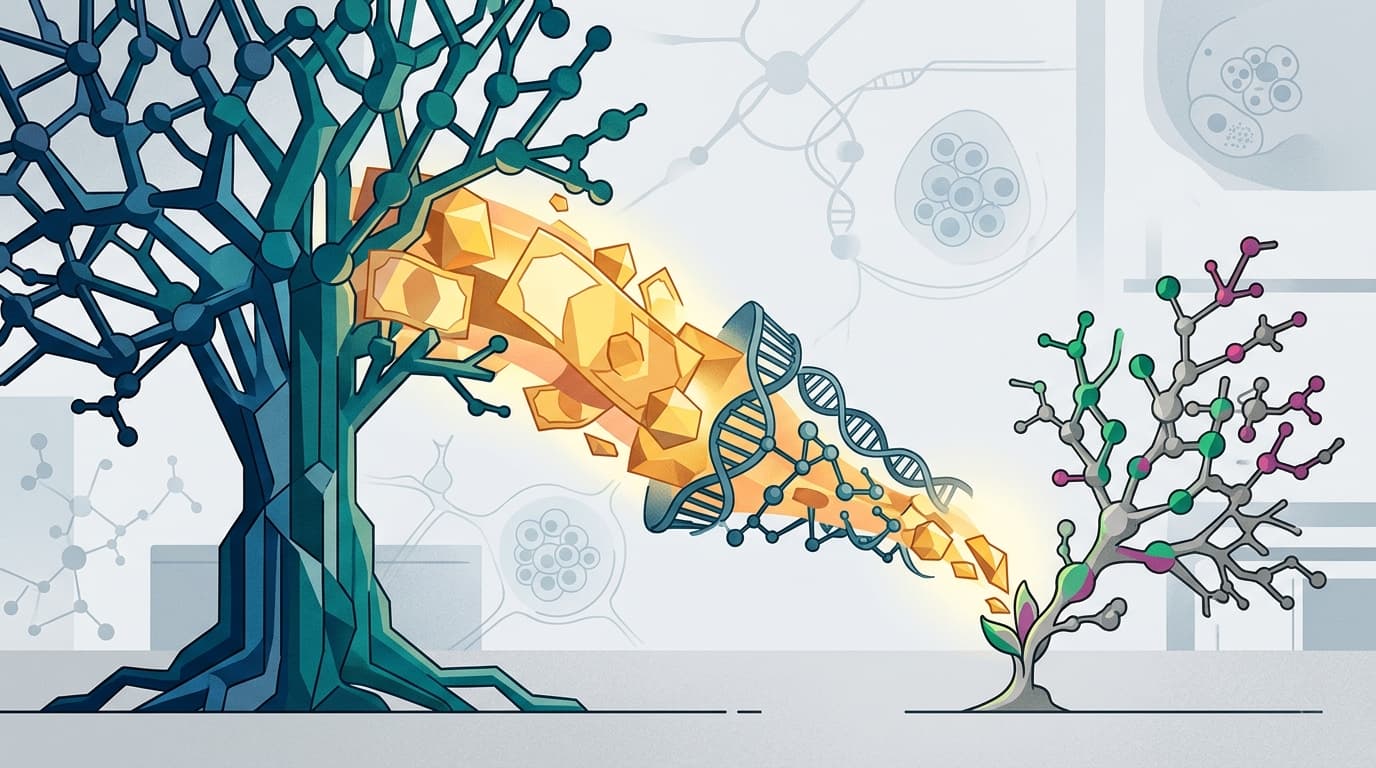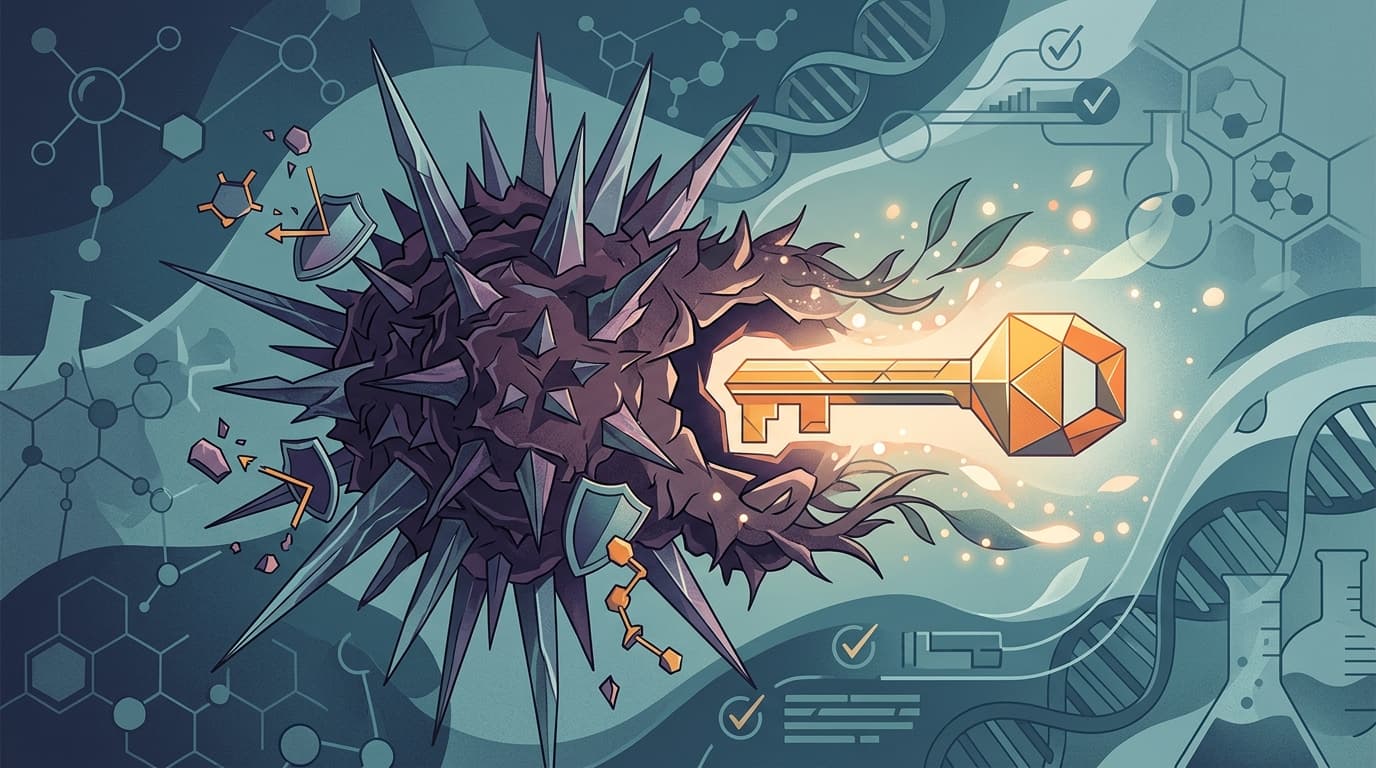

For 40 years, scientists called the KRAS gene "undruggable." Revolution Medicines just proved them wrong with an FDA-approved pancreatic cancer therapy that roughly doubled survival. The era of RAS-targeted oncology has officially arrived.
For 40 years, cancer researchers stared at the same villain and couldn't lay a glove on it.
The KRAS gene is mutated in over 90% of pancreatic cancers. Scientists knew it was driving the disease. They knew shutting it down could save lives. But the protein it produces had no obvious place for a drug to grab onto. No pocket, no groove, no handle. The field had a name for it: "undruggable."
That word is starting to look very outdated. Revolution Medicines' pancreatic cancer drug, daraxonrasib (brand name: RASONQUE), has gone from experimental compound to FDA-approved therapy, and the company is now shipping it to patients with metastatic pancreatic cancer. In a disease where survival is measured in months, this drug roughly doubled how long patients lived compared to standard chemotherapy.
Let that sink in for a moment. Pancreatic cancer, one of oncology's bleakest diagnoses, just got its first real precision weapon.
Pancreatic cancer is the final boss of oncology. The overall five-year survival rate sits at roughly 13%. For patients whose cancer has already spread (the metastatic stage), that number craters to about 3%. Standard treatment is still mostly chemotherapy, and the median survival for advanced disease is less than a year.
To put that in perspective: if you were diagnosed with metastatic pancreatic cancer today, your doctor's best tools would buy you, on average, fewer months than it takes for a new season of your favorite show to drop.
The root of the problem is biological. About 92% of pancreatic tumors carry KRAS mutations. KRAS is like a broken light switch stuck in the "on" position, constantly telling cancer cells to grow and divide. For decades, drug developers tried to flip that switch off and failed. The protein's surface was too smooth, too featureless. There was simply nothing for a small molecule to latch onto.
The breakthrough started in 2013, when a researcher named Kevan Shokat found a hidden pocket in one version of the KRAS protein (called G12C). Think of it like discovering a secret keyhole on a smooth marble wall. Suddenly, drug designers had something to work with.

Eli Lilly just agreed to pay up to $2.875 billion for a four-year-old biotech with one Phase 1 drug and zero revenue. The deal is the latest in Lilly's multi-billion-dollar immunology shopping spree, and it says a lot about where big pharma thinks the next blockbusters will come from.


Join thousands of biotech professionals who start their day with our free, daily briefing.
That discovery kicked off a race. Amgen's sotorasib became the first approved KRAS G12C inhibitor in 2021. Mirati's adagrasib followed in 2022. Both were genuine milestones, but they had a limitation: they only worked on the G12C mutation, which is relatively common in lung cancer but accounts for a small slice of pancreatic tumors.
Pancreatic cancer needed something broader. It needed a drug that could hit multiple versions of mutant KRAS, not just one.
Enter Revolution Medicines.
Daraxonrasib (originally known as RMC-6236) takes a fundamentally different approach. Instead of targeting one specific KRAS mutation, it's a RAS(ON) multi-selective inhibitor. In plain English: it blocks the RAS protein when it's in its active, growth-signaling state, regardless of which specific mutation turned it on.
Imagine the earlier KRAS drugs as keys designed for one specific lock. Daraxonrasib is more like a doorstop; it doesn't care which lock you have because it blocks the whole door from opening.
The clinical data backs up the concept. In the Phase 1/2 trial published in the New England Journal of Medicine, previously treated pancreatic cancer patients with KRAS G12X mutations (covering multiple G12 subtypes) showed encouraging response rates. The disease control rate hit 92%, and median overall survival reached 13.2 months.
Those numbers might not sound dramatic if you're used to hearing about cancer cures, but context matters enormously here. In a cancer where the standard of care buys less than a year, 13.2 months of median survival represents a seismic shift.
Revolution Medicines didn't wait for the typical regulatory timeline. The company began shipping daraxonrasib to physicians and patients through an FDA-authorized early access program as early as May 2026. By late August, the FDA granted full approval, and the drug hit the market as RASONQUE for adults with metastatic pancreatic cancer who had already tried at least one prior treatment (or weren't candidates for aggressive chemo).
The approval was anchored by RASolute 302, a global Phase 3 trial that randomized patients to either daily RASONQUE or standard chemotherapy. The results showed the drug roughly doubled survival versus chemo, a finding compelling enough for the FDA to move quickly.
And the company isn't stopping at second-line treatment. An ongoing Phase 3 trial called RASolute 303 is testing daraxonrasib in previously untreated metastatic pancreatic cancer, both alone and combined with chemotherapy. Early first-line data already looks promising: a 47% response rate and 92% disease control rate in untreated patients. The FDA also granted Breakthrough Therapy Designation for daraxonrasib plus chemo in the first-line setting, which is regulatory speak for "we think this is important enough to fast-track."
The market has noticed. Revolution Medicines' stock (RVMD) was trading around $205 in late September, with analysts lining up to raise their targets. Goldman Sachs initiated coverage with a Buy rating and a $267 price target. Bank of America bumped its target to $265. The consensus across nearly 20 analysts skews heavily bullish, with targets ranging from $179 to $320.
The excitement isn't just about one drug for one cancer, either. Revolution's pipeline includes multiple RAS-targeted compounds: zoldonrasib for KRAS G12D mutations, elironrasib for KRAS G12C, and RMC-5127 for KRAS G12V. Daraxonrasib itself is showing strong signals in lung cancer too, with a 38% response rate and nearly 10 months of progression-free survival in non-small cell lung cancer patients.
The real story here isn't about one company's market cap. It's about a 40-year-old scientific problem that the field is finally solving.
KRAS mutations don't just drive pancreatic cancer. They're found across lung, colorectal, and other deadly cancers. Every advance in this space opens doors for millions of patients who currently have few good options. Daraxonrasib's multi-selective approach could be the template for an entire generation of RAS-targeted therapies.
For pancreatic cancer patients specifically, RASONQUE represents something that has been vanishingly rare in their world: genuine hope backed by real data. A disease that was once defined by what medicine couldn't do is slowly being redefined by what it can.
The "undruggable" target has been drugged. And the best part? We're probably still in the early innings.
Novo Nordisk just dropped $1.4 billion on a macrocycle startup days after another billion-dollar delivery deal. The injection giant is betting its future on pills, and the reason has everything to do with Eli Lilly.