A Single Shot Silenced a Disease Gene for Months. ALS Research Just Got Weird.
A small Chinese biotech just published Nature Medicine data showing a single spinal injection of an RNA drug silenced a disease gene in ALS patients for months. The biomarker numbers rival the only approved therapy, and the delivery platform could unlock treatments for a whole category of brain diseases.
Getting drugs into the brain is one of the hardest problems in medicine. The blood-brain barrier acts like a velvet rope at an exclusive club: almost nothing gets in. For RNA therapies, which are fragile molecular instructions designed to silence disease-causing genes, cracking the CNS (central nervous system) has been a decade-long headache.
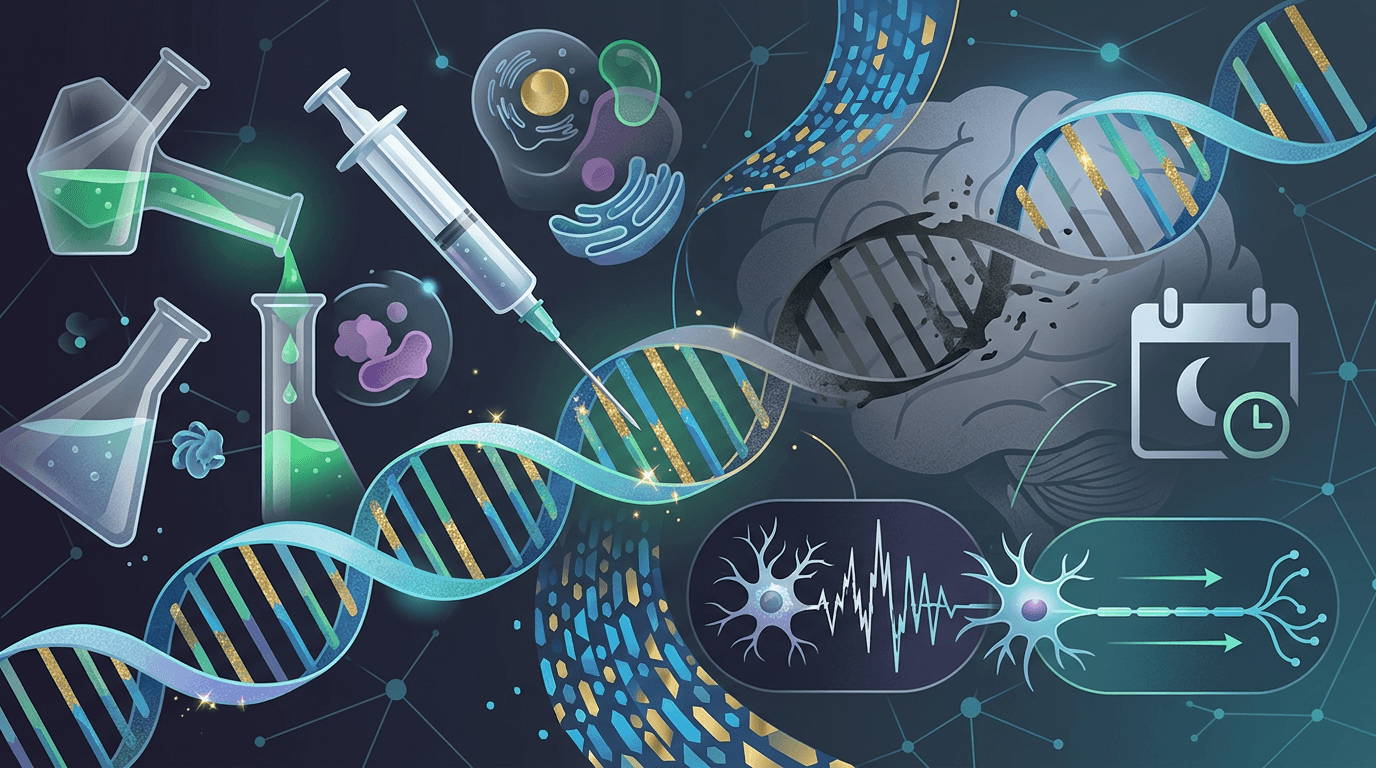
So when a small Chinese biotech called Ractigen Therapeutics published data in Nature Medicine showing that a single spinal injection of its RNA drug knocked down a disease gene by up to 69% in ALS patients and kept it suppressed for months, the neuroscience world took notice.
The Bouncer Problem
To understand why this matters, think about how most RNA medicines work today. The blockbuster ones, like Alnylam's liver-targeted drugs, use a molecular "delivery tag" called GalNAc to hitch a ride into liver cells. It works beautifully. But the brain? Completely different story. There's no equivalent shortcut.
The workaround for brain diseases has been antisense oligonucleotides (ASOs), single-stranded molecules that can be injected directly into spinal fluid via lumbar puncture. Biogen's tofersen (brand name Qalsody), the only approved drug for SOD1-ALS, uses this approach. It works, but it requires repeated spinal injections, and its pivotal trial actually missed its main clinical endpoint. It got approved based on biomarker changes, not on proving patients got functionally better.
Ractigen's RAG-17 takes a different path. It's a double-stranded siRNA (small interfering RNA), a type of molecule that's traditionally been terrible at getting into brain tissue on its own. The company's trick is something called the SCAD platform, which attaches a synthetic, non-targeting accessory oligonucleotide to the siRNA. The siRNA duplex itself incorporates self-delivering chemical features inspired by ASO chemistry, while the accessory strand functions as an aptamer-like scaffold for protein binding, promoting CNS distribution and cellular uptake without needing fancy nanoparticles or viral delivery systems.
Get tomorrow's biotech intelligence before your competitors.
Join thousands of biotech professionals who start their day with our free, daily briefing.
Six Patients, One Big Question
The Nature Medicine paper covers both animal studies and the first time RAG-17 was tested in humans. The human data come from two early trials: an investigator-initiated study of six SOD1-ALS patients treated with multiple doses over 240 days, and a separate single-dose Phase I study in China.
The safety profile was clean. No serious adverse events. No dose-limiting toxicities. The worst side effects were mild headaches and muscle tremors in a couple of patients. For a drug injected directly into spinal fluid, that's a reassuring start.
But the biomarker data stole the show.
In the six-patient study, five out of six patients saw their CSF SOD1 protein drop by more than 50%. The group average hit roughly 69% reduction by Day 240. That's the disease-driving protein, measured right where it matters: in the fluid surrounding the brain and spinal cord.
The NfL Number That Turned Heads
Neurofilament light chain, or NfL, is a protein that leaks out of damaged nerve cells. It's become the go-to blood test for measuring how fast someone's neurons are dying. Higher NfL means more damage. Lower NfL, ideally, means the therapy is protecting nerve cells.
In the multi-dose study, plasma NfL dropped by an average of 62%, with some patients reaching 85% below their starting levels. In the single-dose Phase I trial, the numbers got even more dramatic: the 180 mg dose group saw NfL plummet up to 81% by Day 150 after just one injection.
For context, tofersen's accelerated approval was built largely on NfL reductions as a surrogate marker. RAG-17 is posting numbers in that same ballpark, and possibly better, from a single shot. That's the detail that has analysts paying attention.
Functional Hints (With a Giant Asterisk)
The trials weren't designed to prove RAG-17 slows ALS progression. With six patients and no placebo group, you can't make that claim. But the exploratory data are intriguing.
Patients in the multi-dose study lost an average of just 2.17 points on the ALSFRS-R (the standard ALS function scale) over 240 days. That works out to about 0.29 points per month, which is slower than typical untreated SOD1-ALS decline. Lung function stayed stable in most patients; two actually improved. In the highest single-dose cohort, three patients showed zero functional decline at Day 90.
Promising? Sure. Proof? Not even close. These are tiny, uncontrolled datasets. The real test comes in the Phase II multiple-dose trial, which started dosing patients in January 2026 and already has two cohorts enrolled.
Why the Platform Matters More Than the Drug
RAG-17 targets SOD1-ALS, a condition affecting roughly 2% of all ALS patients. That's a small market. What makes this story bigger is what it implies about the SCAD delivery platform itself.
If you can reliably get siRNA into the human CNS, keep it there, and silence a gene for months with a single injection, you've potentially unlocked a whole category of brain diseases. Huntington's. Spinocerebellar ataxias. Certain forms of dementia. Ractigen already has RAG-21, an siRNA targeting FUS-mutant ALS, with FDA Orphan Drug Designation. And RAG-18, a small activating RNA for Duchenne muscular dystrophy, has dosed its first patient in an investigator-initiated trial.
In monkey studies from the paper, a single spinal injection produced up to 91% SOD1 mRNA reduction in the lumbar spinal cord lasting 72 days. That kind of durability, if it holds in humans across different targets, could mean patients need only a few injections per year instead of monthly visits for lumbar punctures.
The Competitive Chessboard
Ractigen isn't operating in a vacuum. Biogen's tofersen owns the market today. UniQure's AMT-162 is pursuing a one-time gene therapy approach using an AAV viral vector. Alnylam and Regeneron are collaborating on their own CNS-targeted siRNA for SOD1. Even AL-S Pharma is developing an antibody against misfolded SOD1 protein.
Each approach has trade-offs. Gene therapy offers a permanent fix but can't be dialed back if something goes wrong. ASOs are proven but need frequent dosing. RAG-17 sits in a sweet spot: more durable than ASOs, more adjustable than gene therapy, and manufactured with standard chemistry rather than complex biological processes.
The Nature Medicine publication gives Ractigen something money can't easily buy: scientific credibility in a top-tier journal. For a privately held company with roughly $55 million raised, operating primarily out of Suzhou and Shanghai, that's a significant stamp of legitimacy.
What Comes Next
The Phase II trial is the real test. It's randomized, double-blind, and placebo-controlled, exactly the kind of rigorous design needed to separate real clinical benefit from biomarker noise and placebo effects. If RAG-17 can maintain its biomarker performance under repeated dosing while showing functional stabilization in a controlled setting, the implications go well beyond SOD1-ALS.
For now, the takeaway is simple: getting RNA drugs into the brain just got a lot more plausible. And that's a story worth watching.
Clinical & Regulatory5 min read
Wegovy Just Became a Liver Drug.
India just approved Wegovy for fatty liver disease, making it the second country to clear a GLP-1 drug for MASH. With nearly 40% of Indian adults affected by fatty liver and zero prior approved treatments, Novo Nordisk's latest label expansion could reshape both the Indian pharma market and the global MASH treatment landscape.