Jasper Therapeutics was six months from running out of cash. Instead of folding, it engineered a three-party deal involving a reverse merger, $132 million in rescue financing, and a licensing play that could challenge a drug the FDA wants to pull from the market.
A Company With $28.7 Million and a Prayer
Imagine your bank account is draining at $76 million a year. You've got $28.7 million left. Your auditors have formally told the world they doubt you'll survive. That was Jasper Therapeutics at the end of 2025: a one-drug biotech staring down the clock with its lead asset, briquilimab, still nowhere near a pivotal trial.
So what do you do when the money's almost gone and your stock is toxic? You get creative. Really creative.
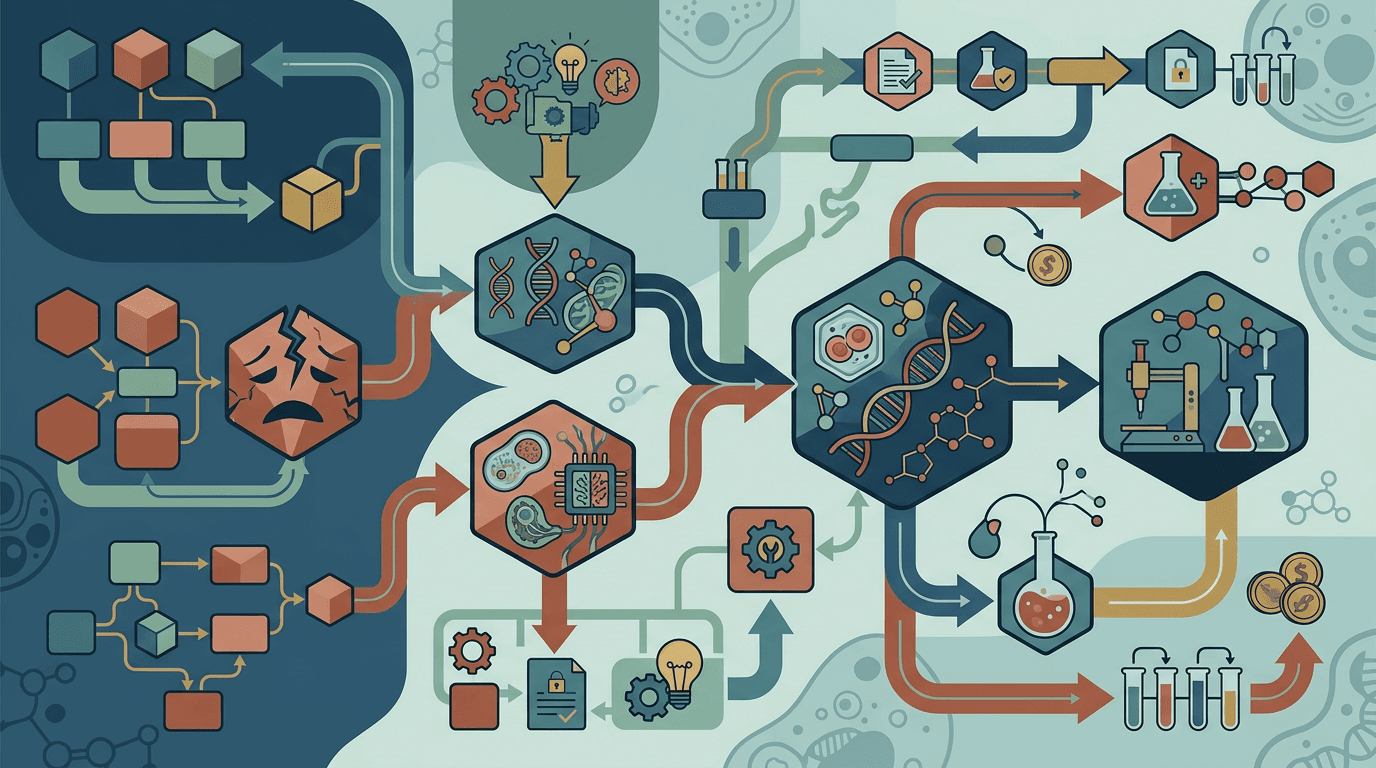
Jasper just pulled off one of the most intricate survival transactions in recent biotech memory, a three-party deal involving a reverse merger, a $132 million rescue financing, an asset license, and contingent value rights. It reads less like a corporate announcement and more like a heist movie script.
The Three-Card Monte
The deal, announced July 16, works like this. Kira Pharmaceuticals, a private immunology company with a complement-focused pipeline, merges into Jasper. Jasper keeps its Nasdaq listing and ticker (JSPR). Meanwhile, Kira's anti-C5a antibody KP-301 gets spun out via an exclusive worldwide license to Mirador Therapeutics.
Think of it like a corporate organ transplant. Jasper's old body (the public listing, the briquilimab program) gets a new heart (Kira's pipeline and $132 million in fresh capital). And one of Kira's kidneys (KP-301) goes to a different patient entirely: Mirador.
On a fully diluted basis, legacy Jasper shareholders end up owning roughly 6.7% of the combined company. Kira's former owners get about 49.9%, and the new investors who put up the $132 million PIPE take 43.5%. If you were a Jasper shareholder before this deal, you went from owning the whole house to renting a room in it.
Why Jasper Was Running on Fumes
The numbers tell a brutal story. Jasper posted a net loss of $75.8 million in 2025 alone. By year-end, it had just $28.7 million in cash and stockholders' equity of a mere $4.2 million. Management included going-concern warnings in both its mid-year and year-end SEC filings, essentially telling investors: we might not make it.
Get tomorrow's biotech intelligence before your competitors.
Join thousands of biotech professionals who start their day with our free, daily briefing.
The company had already raised $30 million in an emergency stock offering in September 2025, but that only bought time through the first half of 2026. Its planned Phase 2b trial of briquilimab in chronic spontaneous urticaria (a debilitating skin condition marked by persistent hives) was explicitly described as "pending capital availability." Translation: no money, no trial.
With the asthma program paused and preclinical work suspended, Jasper had become what analysts politely call a "single-asset story" and what everyone else calls a company with no Plan B.
The Rescue Package, Decoded
The merger itself is structured as a tax-free, all-stock deal. No cash changes hands between Jasper and Kira. Instead, Kira shareholders received a mix of Jasper voting common stock and non-voting convertible preferred shares. Each preferred share converts into 61 shares of common stock, subject to ownership caps and Nasdaq approval rules.
The real lifeline is the PIPE (private investment in public equity): roughly 4.7 million preferred shares sold to new investors for $132 million in gross proceeds. That cash is expected to fund the combined company into the second half of 2028, giving it actual runway to advance Kira's lead asset KP-104 through Phase 2 and push briquilimab toward a potential FDA filing.
To sweeten the dilution pill for legacy Jasper holders, the deal includes contingent value rights worth up to $30 million. These CVRs pay out only if briquilimab earns an FDA Priority Review Voucher, and even then, only when that voucher gets monetized or the company gets acquired. It's a lottery ticket, but it's something.
Mirador Gets the Complement Asset
Meanwhile, Mirador Therapeutics quietly walks away with what could be a valuable prize. KP-301 is a long-acting anti-C5a antibody designed to block a key piece of the complement system (part of your immune system's rapid-response team that, when overactive, attacks your own blood vessels).
Mirador paid $12 million upfront for exclusive global rights, with Kira eligible for development and sales milestones on top. The company plans to start a Phase 1 trial by the end of 2026 and move into a Phase 2 study in ANCA-associated vasculitis (a rare, severe autoimmune disease that inflames small blood vessels) in the first half of 2027.
Why the Timing Is Fascinating
KP-301 is being positioned as a rival to Tavneos (avacopan), the first-in-class oral C5a receptor inhibitor that Amgen acquired for $3.7 billion when it bought ChemoCentryx in 2022.
But then the floor fell out. In April 2026, the FDA proposed to withdraw Tavneos's U.S. approval, citing concerns that the drug hadn't actually been shown to be effective and that the original application contained "untrue statements of material fact." Serious liver injury cases added fuel to the fire. Two months later, Europe's drug regulator recommended revoking its EU authorization too.
Amgen is fighting both actions, and Tavneos remains on the market for now. But the regulatory cloud creates a rare opening. If Tavneos stumbles, the ANCA vasculitis market could be wide open for a next-generation complement inhibitor. That's exactly where KP-301 wants to play.
The Bigger Picture: Survival Gets Creative
This Jasper/Kira/Mirador transaction is a textbook example of what's become a defining pattern in 2025 and 2026 biotech. Distressed companies aren't just selling themselves at fire-sale prices anymore. They're engineering multi-layered deals that combine mergers, licensing, CVRs, and structured financings to stretch every dollar.
The numbers across the industry back this up. Licensing deal structures now put only 15 to 20% of total value upfront, with the rest loaded into milestones and royalties. About 67% of preclinical deals use option-based structures. CVRs and earn-outs have become standard tools for bridging the gap between what sellers think their assets are worth and what buyers will pay today.
For Jasper, the alternative was grim: run out of cash, shelve briquilimab, and watch the stock go to zero. Instead, it found a way to bring in $132 million, absorb a promising pipeline, and give its original shareholders at least a sliver of upside through the CVR.
Whether it works depends on whether KP-104 and briquilimab deliver clinical results over the next two years. But for a company that was six months from the lights going out, the deal buys something priceless: time.
Clinical & Regulatory5 min read
Wegovy Just Became a Liver Drug.
India just approved Wegovy for fatty liver disease, making it the second country to clear a GLP-1 drug for MASH. With nearly 40% of Indian adults affected by fatty liver and zero prior approved treatments, Novo Nordisk's latest label expansion could reshape both the Indian pharma market and the global MASH treatment landscape.