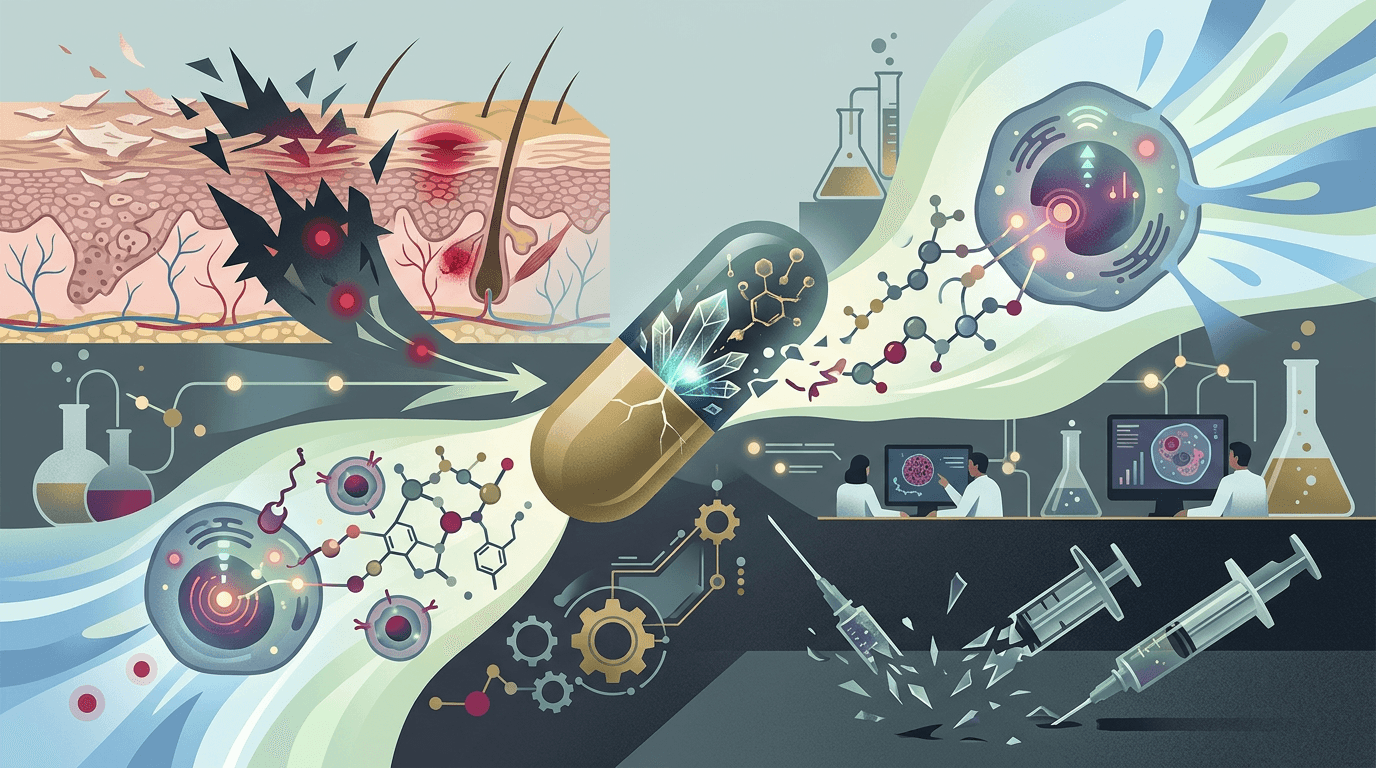
The Pill That Wants to Kill the Needle in Psoriasis
J&J just got FDA approval for the first oral pill that rivals injectable biologics in clearing psoriasis. ICOTYDE beat the only other oral option head-to-head, and it's gunning for three more diseases next.
Imagine you're one of the roughly 8 million Americans living with psoriasis. Your dermatologist tells you there's a treatment that can give you clear skin. Great news, right? There's just one catch: you have to inject yourself. Maybe every two weeks. Maybe monthly. Either way, you're sticking a needle into your own body on a regular schedule.
For millions of patients, that's been the price of clear skin for years. The best drugs on the market (biologics like AbbVie's Skyrizi and J&J's own Tremfya) require injections. They work incredibly well, but needles are a dealbreaker for a lot of people.
On March 18, J&J changed the equation. The FDA approved ICOTYDE (icotrokinra), a once-daily pill that delivers biologic-level skin clearance without a single injection. It's the first oral peptide ever approved for moderate-to-severe plaque psoriasis, and it could reshape one of the biggest markets in dermatology.
A Pill That Punches Like a Biologic
Let's get into what makes ICOTYDE unusual, because "oral psoriasis drug" isn't new. There are already pills on the market for psoriasis. Bristol Myers Squibb's Sotyktu (deucravacitinib), a TYK2 inhibitor, launched a few years ago as a convenient oral option. But Sotyktu's efficacy has always lagged behind the injectable biologics. It was the reliable sedan in a market full of sports cars.
ICOTYDE is trying to be both: the convenience of a pill with the horsepower of a biologic.
The drug is a cyclic peptide (think of it as a tiny, precisely folded protein chain) that blocks the IL-23 receptor on immune cells. IL-23 is a key signal that tells your immune system to go haywire in psoriasis. By blocking its receptor with picomolar affinity (extraordinarily tight binding), ICOTYDE shuts down the inflammatory cascade before it even starts. It's essentially doing the same job as injectable IL-23 blockers like Skyrizi and Tremfya, just in pill form.
That distinction matters. Previous oral psoriasis drugs worked through different, often less targeted mechanisms. ICOTYDE is the first to bring the precision of biologic-class targeting to a once-daily tablet.
Get tomorrow's biotech intelligence before your competitors.
Join thousands of biotech professionals who start their day with our free, daily briefing.
The FDA based its decision on a massive clinical program called ICONIC, which enrolled over 2,500 patients across four Phase 3 trials. The headline results from the flagship ICONIC-LEAD study tell the story clearly.
At 16 weeks, 65% of patients on ICOTYDE achieved clear or almost clear skin (measured by an Investigator's Global Assessment score of 0 or 1). Only 8% of placebo patients hit that mark. Half the ICOTYDE group achieved PASI 90, which means a 90% reduction in the severity and area of their plaques, compared to just 4% on placebo.
Those numbers kept climbing. By week 24, nearly three-quarters of patients had clear or almost clear skin. And 40% had achieved total clearance: no visible plaques at all.
But the real flex? The head-to-head data against Sotyktu.
Beating the Only Other Oral Option
In the ICONIC-ADVANCE 1 and ADVANCE 2 trials, J&J did something bold: they put ICOTYDE directly against BMS's Sotyktu, currently the only other oral drug specifically designed for moderate-to-severe plaque psoriasis. ICOTYDE showed superiority on key measures at both 16 and 24 weeks, with roughly 70% of patients achieving clear or almost clear skin overall.
That's not a small gap. It's the difference between a drug that's "pretty good for a pill" and one that genuinely challenges injectables.
The safety profile sealed it. Across the trials, adverse events occurred in about 49% of ICOTYDE patients versus nearly 49% on placebo. No new safety signals emerged through a full year of treatment. For context, many biologics come with boxed warnings about infections and other risks.
Why Dermatologists Are Paying Attention
Psoriasis treatment has a dirty secret: a huge chunk of patients never get on the best drugs.
The journey typically goes like this. You start with topical creams. When those fail, your doctor might try phototherapy (medical UV light treatments). If that doesn't work, you graduate to systemic therapies, which either means pills or injections. The most effective options have always been the injectables, but many patients stall before getting there. Needle anxiety, insurance hurdles, the hassle of specialty pharmacy shipments; all of it creates friction.
ICOTYDE could short-circuit that whole bottleneck. The FDA approved it as a first-line systemic therapy for adults and adolescents 12 and older (weighing at least 40 kg, or about 88 pounds) who are candidates for systemic treatment or phototherapy. That means doctors don't have to send patients through a gauntlet of failures first. They can start with ICOTYDE.
The drug also showed strong results in notoriously difficult areas. In trials, 66% to 72% of patients saw scalp psoriasis clear up (versus 11% on placebo), and 77% to 85% saw improvement in genital psoriasis (versus 21% on placebo). These are areas where patients suffer the most but often get the least relief.
The Competitive Fallout
This approval sends ripples across a massive market. Global psoriasis treatment spending sits around $34 billion in 2025, with plaque psoriasis making up the largest segment. Biologics have owned the premium tier, generating billions for AbbVie (Skyrizi), J&J (Tremfya), Novartis (Cosentyx), and UCB (Bimzelx).
Now J&J finds itself in the unusual position of potentially cannibalizing its own injectable franchise with an oral one. Tremfya brought in strong revenue as an IL-23 blocker; ICOTYDE targets the same pathway in a more convenient format. How J&J manages that tension will be one of the more interesting commercial stories in dermatology over the next few years.
BMS should be worried too. Sotyktu was supposed to be the oral alternative that captured needle-averse patients. ICOTYDE just beat it head-to-head. Twice.
STAT News described the approval as potentially "roiling" a multibillion-dollar competitive landscape. That feels about right.
Beyond Skin: The Bigger Play
Psoriasis is just the opening act. J&J is running ICOTYDE through a pipeline that could make it a multi-indication blockbuster.
Psoriatic arthritis is already in Phase 3 trials (ICONIC-PSA 1 and 2), which makes natural sense; about 30% of psoriasis patients develop joint inflammation. Ulcerative colitis is right behind it. A Phase 2b trial called ANTHEM-UC showed 63.5% of patients on the highest dose achieving clinical response at 12 weeks, compared to 27% on placebo. That earned it a Phase 3 promotion (ICONIC-UC), which started in October 2025 with an estimated completion in January 2028.
Crohn's disease rounds out the lineup with a Phase 2b/3 program underway.
If ICOTYDE can replicate its psoriasis success in inflammatory bowel disease and psoriatic arthritis, we're looking at a drug that could compete across multiple multi-billion-dollar markets, all with the convenience of a daily pill. That's the kind of franchise drug that makes pharmaceutical executives very, very happy.
The Origin Story You Didn't Know
ICOTYDE didn't start inside J&J's labs. It came from a 2017 collaboration between Janssen (J&J's pharma arm) and a small biotech called Protagonist Therapeutics, which specialized in developing peptide-based drugs. J&J now holds exclusive worldwide rights for Phase 2 development and beyond.
It's a nice reminder that some of the most important drugs in the world start as bets placed on small companies with clever science. Protagonist's peptide engineering platform turned out to be the key that unlocked an oral drug capable of matching injectable biologics.
What Happens Next
The commercial launch details haven't been fully laid out yet, and Wall Street analysts are still digesting the news (no major revenue forecasts have dropped yet). But the strategic picture is clear.
J&J's John Reed, M.D., Ph.D., EVP of Innovative Medicine R&D, called this a "pivotal moment for people with plaque psoriasis."
For patients, the math is simple. An oral pill that clears skin as well as (or close to) the best injectables, with a safety profile that looks like placebo, and no needles? That's not an incremental improvement. That's a category shift.
The psoriasis market just got its biggest shakeup in years. The question now isn't whether ICOTYDE will find patients. It's how many it can take from the competition before they figure out their response.
Clinical & Regulatory
5 min read
Bicycle Therapeutics Just Torched Its Best Shot at a Blockbuster
Bicycle Therapeutics gutted its lead cancer drug, cut 30% of staff, and is betting what's left on a backup candidate with its own baggage. The company that pioneered bicycle toxin conjugates just learned that inventing a category doesn't guarantee you'll win in it.