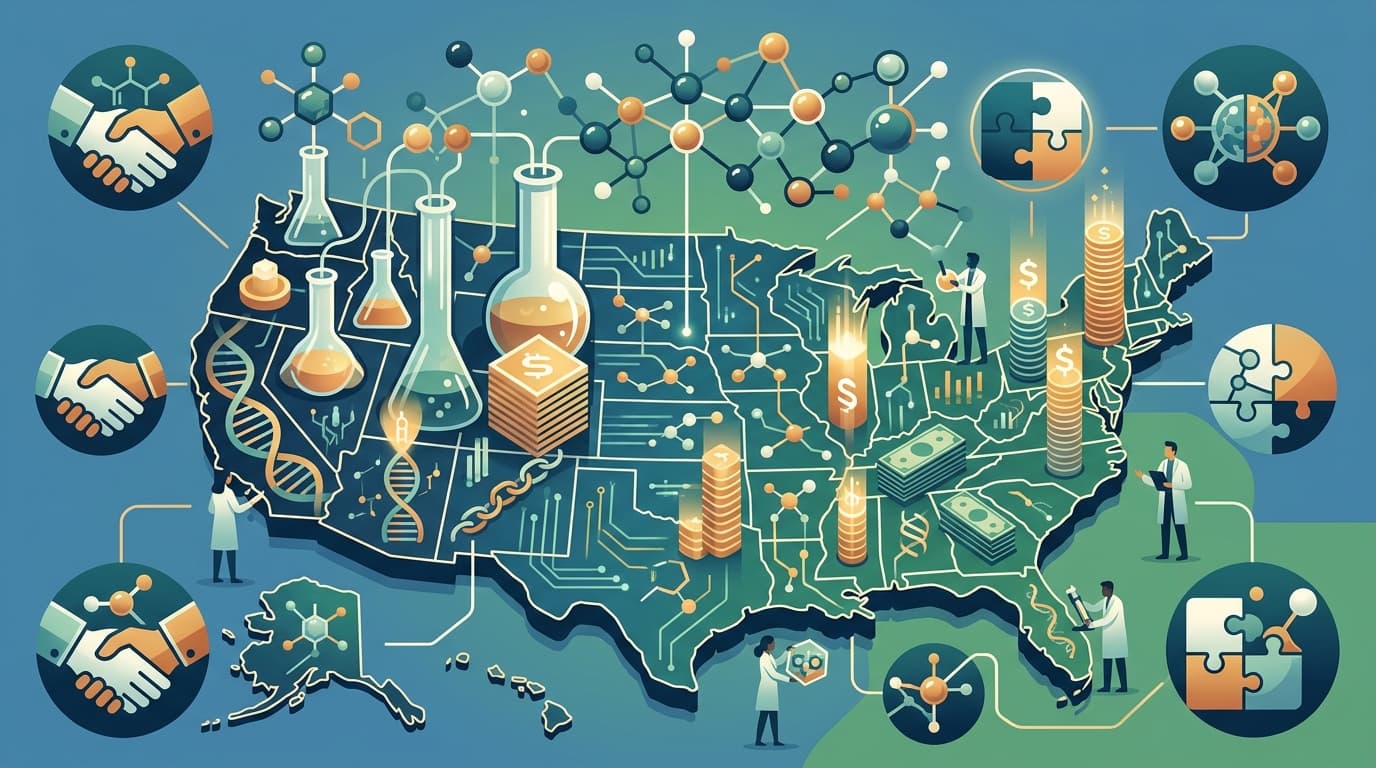
Pharma companies have pledged a jaw-dropping $292 billion to build U.S. factories in just six months, driven by tariff threats that could double the cost of imported drugs. The numbers are historic, but turning promises into actual plants is a whole different game.
The Biggest Shopping Spree in Pharma History
Imagine every major pharmaceutical company on Earth walked into the same Home Depot and said, "We'll take everything." That's essentially what happened over the past six months.
According to Endpoints News, biopharma companies have collectively pledged at least $292 billion toward building and expanding U.S. manufacturing. That's not a typo. In roughly half a year, the industry committed more capital to American factories than the entire GDP of Finland.
And if you zoom out beyond the strict six-month window, the number gets even wilder. Including CDMOs (contract manufacturers that make drugs on behalf of other companies) and later announcements, total pledges surpass $480 billion. We're talking about 22 new manufacturing sites and roughly 44,000 new jobs.
So what's driving this frenzy? Two words: tariff terror.
The Stick That Started a Stampede
The Trump administration dropped a bombshell in late 2025: a 100% tariff on imported branded and patented drugs, effective October 1. The message was blunt. If you want to sell medicines in America, make them in America.
But the policy wasn't just a blunt hammer. It was more like a choose-your-own-adventure book with increasingly painful endings. Companies that didn't invest in U.S. manufacturing faced the full 100% tariff. Those that pledged new facilities before January 2029 could negotiate it down to 20%. And firms willing to cut deals on drug pricing for federal programs? They could potentially drop to zero percent.
The threats went even further. Administration officials floated tariffs as high as 150% to 250% on certain pharmaceutical imports. For an industry that spent decades shipping production to China and India precisely to save money, the math suddenly didn't work anymore.
It was like telling every restaurant in town that imported ingredients would cost double starting next month. You'd see a whole lot of people planting gardens real fast.
Get tomorrow's biotech intelligence before your competitors.
Join thousands of biotech professionals who start their day with our free, daily briefing.
Who's Writing the Biggest Checks
The commitments are staggering, and the biggest names in pharma are leading the charge.
Merck tops the list with a headline figure of $70 billion in U.S. manufacturing investments, including a $1 billion vaccine facility that opened in North Carolina's Research Triangle Park in March 2025. Johnson & Johnson pledged $55 billion over four years, with a major biologics plant going up in Wilson, North Carolina. Roche and AstraZeneca each committed around $50 billion, spreading projects across Massachusetts, Indiana, Maryland, Virginia, California, and Texas.
Bristol Myers Squibb earmarked $40 billion over five years. Gilead committed $32 billion through 2030. GSK pledged $30 billion, anchored by a $1.2 billion facility in Upper Merion, Pennsylvania.
Then there's Eli Lilly, whose $27 billion plan for four new U.S. plants was described as the largest pharmaceutical expansion investment in U.S. history. One of those facilities already has an address: a $5 billion site in Goochland County, Virginia.
Novartis committed $23 billion across ten U.S. sites (seven of them brand new), including radioligand therapy plants in Florida and Texas. Even Sanofi put down $20 billion by 2030, though it hasn't announced specific locations yet.
North Carolina: The New Pharma Capital?
If you're looking for the geographic winner of this reshoring wave, look no further than North Carolina. Between J&J's biologics expansion in Wilson, Merck's vaccine plant in Research Triangle Park, Fujifilm Diosynth's massive biomanufacturing hub in Holly Springs (which supports both J&J and Regeneron), and Biogen's $2 billion expansion in RTP, the Tar Heel State is quickly becoming pharma's favorite zip code.
Other hotspots include California (Novartis's San Diego innovation hub, Gilead's Foster City campus), Pennsylvania (Roche gene therapy, GSK's Upper Merion plant), and Texas (Novartis radioligand manufacturing).
Why Skeptics Aren't Popping Champagne Yet
Before you start picturing gleaming new factories dotting the American landscape by Christmas, some important caveats.
First, these are pledges, not completed projects. Building a pharmaceutical manufacturing plant isn't like opening a Starbucks. New facilities typically take three to seven years to build, and complex ones like biologics or ATMP plants can take five to seven or more years. Most of these investments are spread across four to ten year timelines, with capital spending heavily back-loaded.
Second, some of these "new" commitments were already in the works before the tariff threats materialized. Companies are repackaging existing plans under the reshoring banner, making the headline numbers look bigger than the truly incremental spending.
Third, there are real bottleneck problems. The industry faces talent shortages in advanced biologics and sterile manufacturing. Specialized equipment has long lead times. Cleanroom construction capacity isn't infinite. You can pledge billions, but if you can't hire the people or buy the gear, timelines slip.
Finally, analysts note a fundamental uncertainty: will these policies survive a change in administration? Companies making decade-long capital commitments have to weigh the risk of policy whiplash. A future president could reverse the tariffs, leaving expensive U.S. plants competing against cheaper overseas production with no tariff advantage.
The Deeper Problem These Billions Are Trying to Solve
The reshoring wave isn't just about dodging tariffs. It's about fixing a vulnerability that COVID-19 exposed in painful detail.
Today, an estimated 47% of active pharmaceutical ingredients (the actual chemical compounds that make drugs work) by value come from outside the U.S. When supply chains broke during the pandemic, American hospitals faced shortages of basic ICU medications.
India, often pitched as the diversification play away from China, has its own dependency problem: it imports a huge share of raw materials and intermediates from Chinese suppliers. So "diversifying" to India doesn't fully solve the single-country concentration risk.
True supply chain resilience means building capacity not just for finished pills and vials, but for the upstream ingredients that go into them. Several of the new pledges (particularly Lilly's API plants and Novartis's chemical drug substance facilities) target exactly this gap.
The Bottom Line
What we're witnessing is the pharmaceutical industry's version of the CHIPS Act moment. Just as semiconductor companies raced to build U.S. fabs after Congress dangled billions in subsidies, pharma is now racing to build U.S. plants because the alternative (paying 100%+ tariffs) is financially unbearable.
The numbers are real, the strategic logic is sound, and the construction cranes will eventually appear. But 2026 is a mobilization year, not a victory lap. The pledges are the easy part. Turning $290 billion in promises into actual factories, actual drugs, and actual supply chain resilience? That's the hard part, and it will play out over the rest of this decade.
For now, the pharma industry has placed the biggest bet on American manufacturing in its history. Whether it pays off depends on execution, politics, and whether the next administration decides to keep the rules of the game intact.
Deals & M&A
5 min read
The $2 Stock That Just Sold for $1.1 Billion
Esperion Therapeutics once traded above $115. It was languishing under $2 when ARCHIMED swooped in with a $1.1 billion take-private deal. The cholesterol drug everybody forgot about might be the smartest private equity bet of the year.