BMS Just Gave 30,000 Employees an AI Brain. Here's the Plan.
Bristol Myers Squibb is deploying Anthropic's Claude AI to more than 30,000 employees across every major function, from drug discovery to the sales force. It's the biggest enterprise AI bet in pharma, and BMS is racing a $15 billion patent cliff to prove it works.
Picture every drug company you've ever heard of. Now picture the mountain of data each one sits on: decades of clinical trials, manufacturing records, safety reports, and scientific papers buried across hundreds of disconnected systems. Most of that knowledge might as well be locked in a vault.
Bristol Myers Squibb just hired a locksmith.
The Biggest AI Bet in Pharma (So Far)
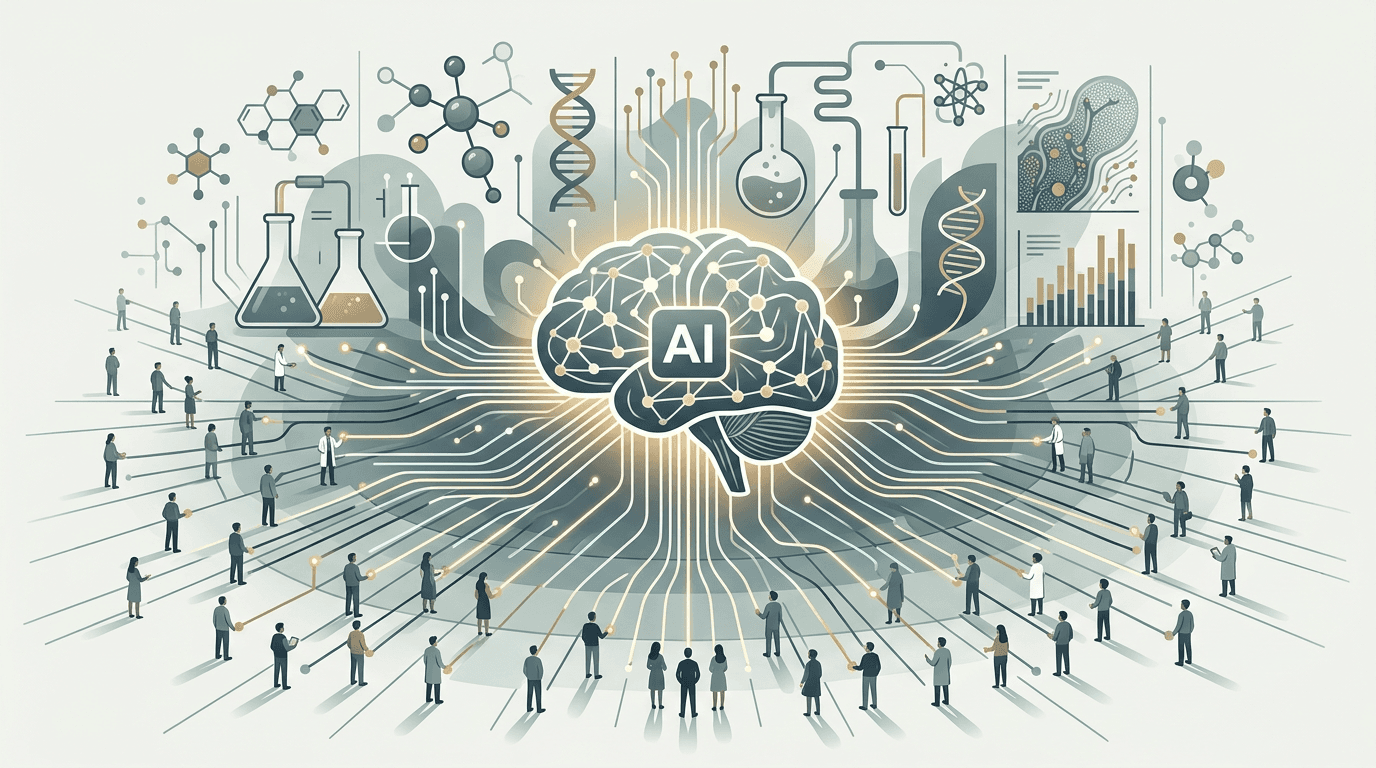
On May 20, BMS announced a strategic agreement with Anthropic to deploy Claude Enterprise across its entire global operation. Not a pilot. Not a sandbox for the data science team. We're talking about more than 30,000 employees getting access to an AI system that's designed to reach into the company's deepest data vaults and actually do something useful with what it finds.
The deployment spans research, clinical development, manufacturing, commercial operations, and corporate functions. If you think of a typical pharma company as a city, this isn't BMS installing a smart thermostat in one building. It's rewiring the whole grid.
Greg Meyers, BMS's chief digital and technology officer, put it bluntly: "Most enterprise AI stops at the chatbot. The real prize is the untapped value still trapped behind decades of data silos, and this collaboration is how we reach it."
That quote tells you everything about BMS's ambition here. They're not interested in a fancy search bar. They want an intelligence layer that sits on top of thousands of internal systems and connects the dots humans can't connect fast enough.
What Claude Will Actually Do
BMS outlined three priority areas, and they're far more concrete than the usual corporate AI word salad.
First: speeding up the engineering team. BMS developers and data scientists will use Claude Code (Anthropic's coding tool) to build software faster and standardize how AI gets built across the company. Think of it as giving every engineer a highly capable co-pilot who never sleeps.
Second: embedding AI agents into the workflows that move drugs forward. This is where it gets interesting. In research, Claude will chew through decades of proprietary molecular and clinical data to help scientists spot patterns and accelerate target discovery in oncology, hematology, neuroscience, and immunology. In clinical development, it will help draft clinical study reports (the massive documents that summarize trial results) and patient safety narratives directly from underlying data. The goal is to .
Get tomorrow's biotech intelligence before your competitors.
Join thousands of biotech professionals who start their day with our free, daily briefing.
compress the gap between locking trial data and filing with regulators
Manufacturing gets AI-powered root-cause analysis. When something goes wrong on a production line, Claude helps trace the problem and generate corrective action reports. On the commercial side, it turns scattered field insights from sales reps and medical science liaisons into structured intelligence, so the right information reaches the right doctors at the right time.
Third: connecting Claude to BMS's institutional memory. Through secure connectors, the system plugs into scientific repositories, clinical databases, regulatory archives, and commercial knowledge bases. Eric Kauderer-Abrams, Anthropic's head of life sciences, described a system that could "generate a clinical study report from underlying trial data, surface scientific context from decades of internal research, and trace root causes of manufacturing deviations in real time."
That's not a chatbot. That's an operating system for a pharmaceutical company.
Why This Matters Beyond BMS
Let's zoom out. BMS isn't the first pharma company to experiment with AI. Sanofi branded itself "AI-first." Eli Lilly launched TuneLab, an industrial-grade AI platform. Pfizer, Merck, AstraZeneca, and Roche all have significant AI programs in discovery, trial design, and regulatory document drafting.
But this deal stands out for a few reasons.
Scale and scope. Most pharma AI deployments are still concentrated in R&D or limited to specific teams. BMS is deploying across the entire value chain, from the lab bench to the sales force, for tens of thousands of employees. That's a fundamentally different commitment.
The "agentic" framing. BMS and Anthropic are explicitly positioning this as a move beyond conversational AI toward agents that actually execute tasks within workflows. Drafting regulatory documents, investigating manufacturing deviations, synthesizing research; these aren't prompts and responses. They're multi-step processes embedded in how the company operates.
Timing against the patent cliff. BMS has more than $15 billion in revenue at risk from patent expirations by 2030. The company is betting on roughly 10 new product launches to fill that gap, with at least six registration-ready data packages expected by 2026. Compressing development timelines by even a few months per program could be worth billions. AI isn't a nice-to-have here; it's a survival tool.
BMS has also committed $40 billion over five years to U.S. R&D and manufacturing, with a chunk dedicated to computational capabilities. This Anthropic deal is the latest piece of an AI strategy that's been building for over three years, including partnerships with NVIDIA (for supercomputing infrastructure), Accenture (for a clinical trial accelerator called Workbench), and Eightfold AI (for internal talent matching).
The Fine Print Nobody's Talking About
Financial terms? Not disclosed. Contract length? Not disclosed. Pricing model, IP ownership over models fine-tuned on BMS data, data residency specifics? All confidential.
What we do know: BMS calls this a "strategic agreement," not an exclusive deal. The company has maintained a multi-vendor AI strategy for years, giving employees access to multiple frontier models through a proprietary internal platform. Claude is being positioned as the core intelligence layer, but it's not the only game in town.
The governance language is heavy on security, audit controls, and compliance with global regulatory standards (GxP, pharmacovigilance, the works). Standard forward-looking disclaimers remind investors that there's no guarantee any of these AI ambitions will actually pay off.
What Anthropic Gets Out of This
For Anthropic, landing a top-five pharma company as an enterprise client is a massive validation play. The AI company has been expanding aggressively into healthcare and life sciences, with reported customers or partners including Novo Nordisk, AbbVie, Genmab, and Sanofi. It's building HIPAA-ready tooling and connectors for clinical trial systems, regulatory workflows, and drug-target databases.
Consulting giants like Deloitte, Accenture, PwC, and KPMG are all building implementation practices around Claude for regulated industries. BMS is the kind of lighthouse account that makes every other pharma CEO's strategy team pick up the phone.
The Real Question
BMS shares ticked up in pre-market trading after the announcement. Analyst tone has been constructive but cautious: optimistic about productivity gains, realistic about how hard it is to deploy AI in regulated environments where every document could end up in front of the FDA.
The real test won't show up in a press release. It'll show up in whether BMS can file regulatory submissions faster, catch manufacturing problems sooner, and get its pipeline drugs to patients before the patent cliff bites. The company is betting that an AI layer over 30,000 employees and thousands of data sources will make the difference.
If it works, every pharma company on earth will be scrambling to catch up. If it doesn't, it'll be the most expensive chatbot in pharmaceutical history.
Deals & M&A
5 min read
The $2 Stock That Just Sold for $1.1 Billion
Esperion Therapeutics once traded above $115. It was languishing under $2 when ARCHIMED swooped in with a $1.1 billion take-private deal. The cholesterol drug everybody forgot about might be the smartest private equity bet of the year.