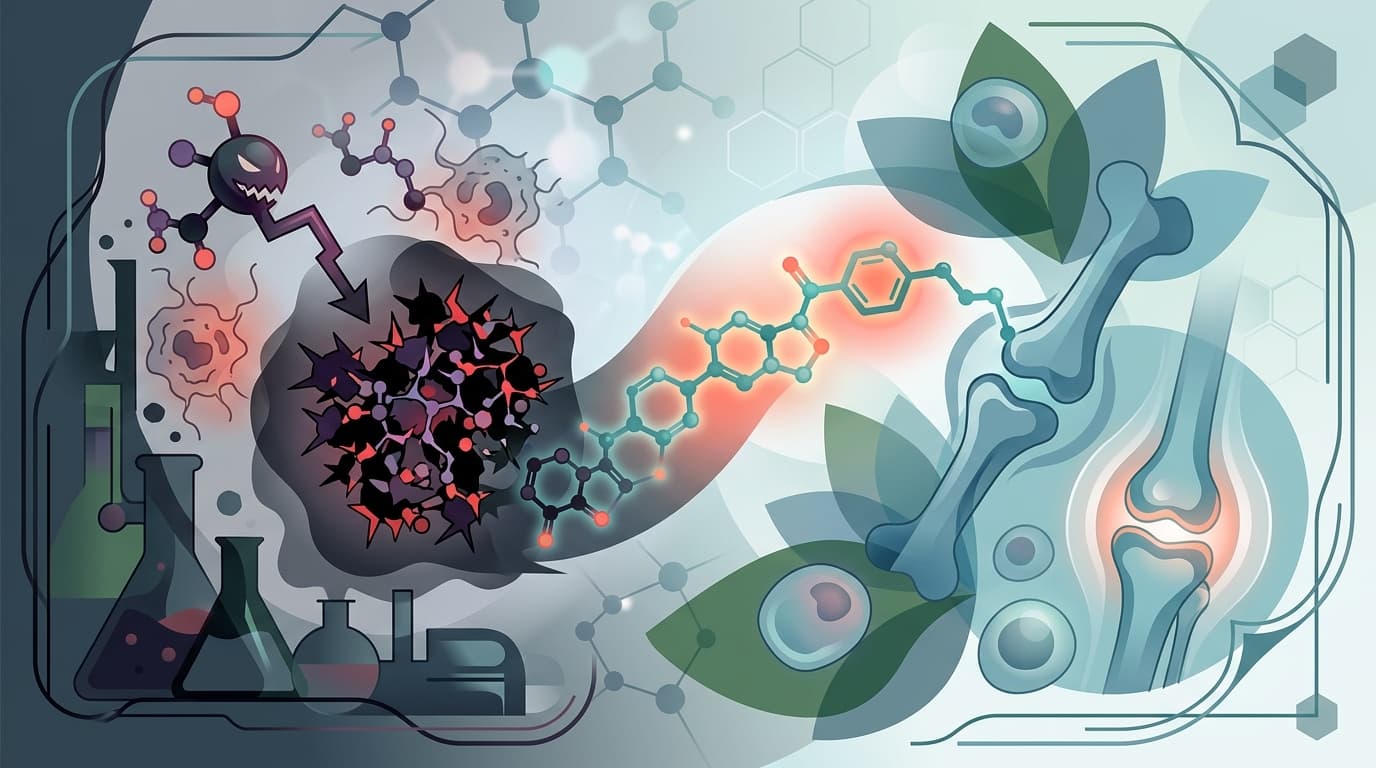

AnaptysBio's rosnilimab does the exact opposite of cancer immunotherapy, activating PD-1 instead of blocking it, and just posted "JAK-like" efficacy in a 424-patient rheumatoid arthritis trial. If the results hold up, it could open an entirely new treatment lane for autoimmune disease while sidestepping JAK inhibitors' serious safety baggage.
If you've followed oncology at all over the past decade, you know PD-1. It's the immune checkpoint that cancer drugs like Keytruda block to unleash T cells against tumors. Billions of dollars in revenue. Nobel Prize-winning science. The whole deal.
Now imagine doing the exact opposite: instead of releasing the brakes on the immune system, you slam them harder. That's what AnaptysBio just showed works in rheumatoid arthritis, and the results are raising eyebrows across the industry.
AnaptysBio's drug, rosnilimab, is a PD-1 agonist antibody. Where cancer immunotherapies block PD-1 to rev up the immune system, rosnilimab activates PD-1 to calm it down. Think of PD-1 like a volume knob on your immune system. Oncology drugs crank it to 11. Rosnilimab turns it way down.
The logic is elegant. In autoimmune diseases like rheumatoid arthritis (RA), the immune system attacks the body's own tissues. Overactive T cells flood the joints, causing inflammation and pain. Rosnilimab works in two ways: it sends an inhibitory signal to those rogue T cells and it depletes the most aggressive ones (the cells with the highest PD-1 levels). The company reported roughly 90% reductions in these PD-1-high pathogenic T cells.
It's a molecular bouncer that both tells troublemakers to quiet down and escorts the worst offenders out of the building.
In a 424-patient phase 2b trial, rosnilimab hit its primary endpoint at Week 12. The drug beat placebo across all three doses on DAS28-CRP, a standard measure of RA disease activity. It also nailed key secondary goals, including ACR20, ACR50, and CDAI low disease activity.
But the real story came at the six-month mark. Responses didn't plateau; they deepened. Patients kept getting better through Week 28, with strong results on CDAI remission and ACR70 (the toughest bar to clear, requiring 70% improvement in symptoms). That deepening trajectory is what prompted AnaptysBio to describe the profile as "JAK-like" and even "best-in-disease."

Novo Nordisk partnered with Anthropic to deploy Claude AI across its drug development pipeline, adding to deals with OpenAI and NVIDIA. The world's most valuable pharma company wants to become 'the most AI-driven healthcare company,' and the broader industry is sprinting to keep up.


Join thousands of biotech professionals who start their day with our free, daily briefing.
For context, JAK inhibitors are currently the heavy hitters of RA treatment. They're the drugs other drugs get compared to. Claiming your results look "JAK-like" is the biotech equivalent of a college quarterback saying he throws like Patrick Mahomes. You better have the tape to back it up.
JAK inhibitors (tofacitinib, baricitinib, upadacitinib, and others) are genuinely effective in RA. Meta-analyses consistently show they roughly double ACR20 response rates compared to placebo. In head-to-head comparisons, some JAK regimens have even outperformed adalimumab, the blockbuster TNF inhibitor that dominated RA for years.
So matching that efficacy would be a huge deal for any new drug. But there's a catch that makes JAK-like efficacy with a non-JAK mechanism especially interesting.
JAK inhibitors carry an FDA boxed warning, the most serious safety label the agency can slap on a drug. The concern stems largely from the ORAL Surveillance trial, which found increased rates of major cardiovascular events, blood clots, cancer, and death in older RA patients with cardiovascular risk factors.
The FDA applied the warning to tofacitinib, baricitinib, and upadacitinib. Even though the last two weren't studied in an equally large safety trial, the agency reasoned that their shared mechanism likely meant shared risk.
In practice, this means many rheumatologists steer certain patients away from JAK inhibitors entirely, especially those over 50 or anyone with a history of heart problems or clotting. These patients are left choosing among TNF inhibitors, IL-6 blockers, abatacept, or rituximab, all of which work but none of which match JAK-level efficacy for everyone.
This is the gap rosnilimab is trying to fill: JAK-level results through a completely different mechanism, potentially without the cardiovascular baggage.
What makes this story bigger than one drug or one company is the precedent it could set. If PD-1 agonism genuinely delivers JAK-caliber efficacy in RA, it validates an entirely new therapeutic approach for autoimmune disease. That's not an incremental improvement; it's a new lane on the highway.
Rosnilimab also showed activity in patients who had already tried and failed advanced therapies, including JAK inhibitors themselves. That's a notoriously tough population to treat. Showing benefit there suggests the drug isn't just a me-too option; it might work where existing treatments have already struck out.
The company has hinted at broader ambitions, too, with ulcerative colitis mentioned as another potential target. If PD-1 agonism works across multiple autoimmune conditions, AnaptysBio could be sitting on a platform, not just a product.
Phase 2b is promising, but it's still the middle innings. AnaptysBio will need a large phase 3 trial to confirm these results, and regulators will want to see a clean long-term safety profile. The deepening responses through six months are encouraging on that front, but the real test is durability over years, not months.
The company also noted that rosnilimab could work with monthly dosing, which would be a convenience win over some existing biologics that require more frequent injections.
For the broader RA landscape, the implications are significant. If this drug reaches the market with a safety profile that avoids the JAK boxed warning territory, it could become the go-to option for exactly the patients who need effective treatment but can't risk cardiovascular or thrombotic side effects. That's a large and growing population.
The irony is almost too perfect: the same immune checkpoint that revolutionized cancer treatment might now transform autoimmune disease. Just in reverse. Sometimes the best ideas in medicine aren't new discoveries; they're old ones viewed from the other side of the mirror.
Roche just signed a deal worth up to $1 billion with a three-year-old startup that can screen 300,000+ bispecific antibody combinations at once. The real story isn't the price tag; it's what it says about the future of drug discovery.