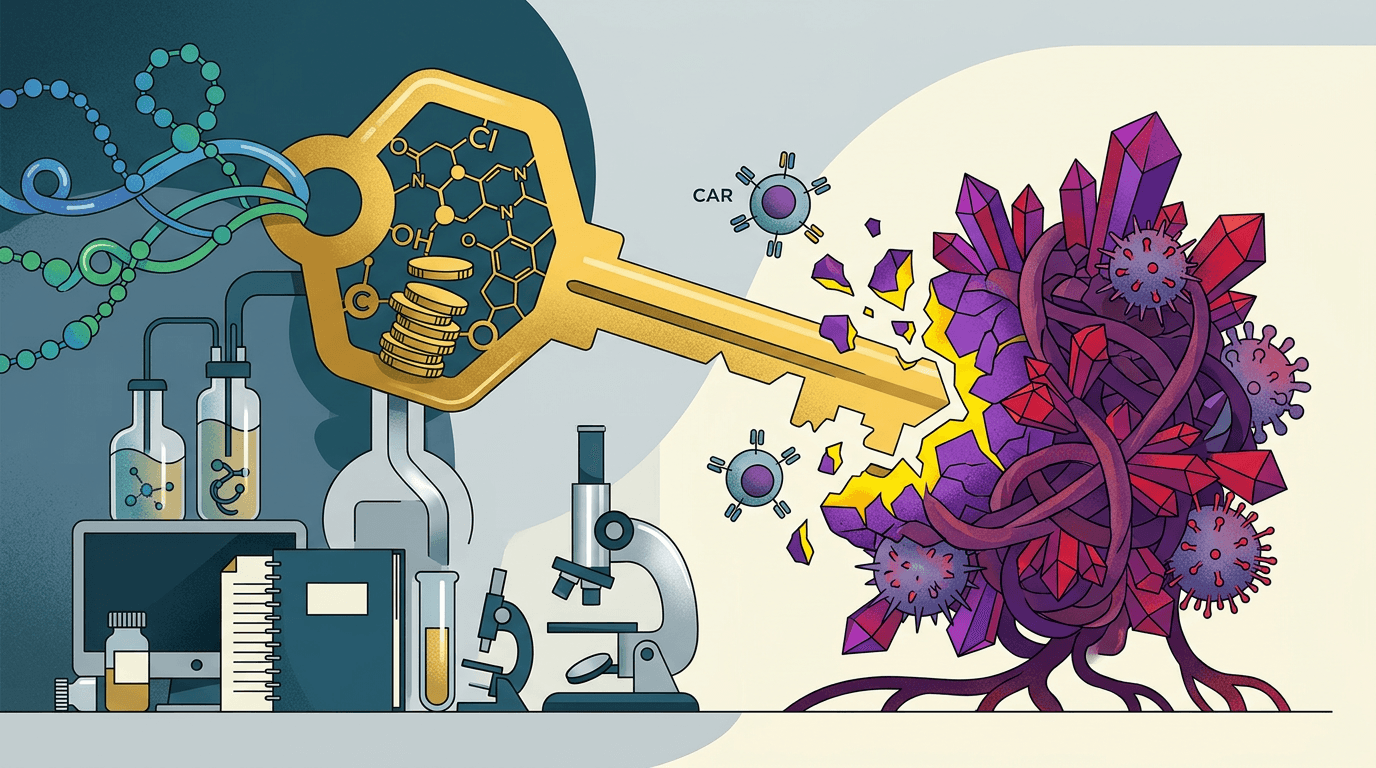

CAR-T therapies have conquered blood cancers but never beaten a solid tumor. Shanghai-based Oricell just raised $110 million to change that, armed with early liver cancer data that has serious investors lining up. If it works, it would be a historic first for cell therapy.
Six FDA-approved CAR-T therapies exist today. Every single one treats blood cancer. Not one has cracked solid tumors, which account for roughly 90% of adult cancers. That's the equivalent of building a fire department that only responds to kitchen fires.
Shanghai-based Oricell Therapeutics just raised over $110 million in a pre-IPO round, betting it can change that. The target: liver cancer. The therapy: a CAR-T cell treatment called Ori-C101. If it works, it would become the first CAR-T therapy ever approved for a solid tumor, anywhere in the world.
That's not incremental progress. That's moon landing territory for cell therapy.
To understand why this matters, you need to understand why CAR-T therapies crush blood cancers but flounder against solid tumors. Think of it like a SWAT team. In blood cancer, the bad guys are out in the open, circulating through your bloodstream. CAR-T cells (genetically engineered immune cells) find them easily and take them out.
Solid tumors are a completely different game. They're fortified compounds. Dense walls of tissue block the T cells from getting inside. The tumor microenvironment (the neighborhood surrounding the cancer) is actively hostile: low oxygen, metabolic waste, and immunosuppressive cells that essentially tell your immune system to stand down. Even when CAR-T cells manage to infiltrate, they get exhausted quickly, like soldiers fighting in quicksand.
There's also the targeting problem. Blood cancers tend to display consistent, tumor-specific markers on their surface (like CD19). Solid tumors? Their surfaces are a mosaic. The markers vary from cell to cell, and many overlap with healthy tissue. Hit the wrong target, and you damage organs the patient actually needs.
Researchers have been trying to crack this code since around 2015. Early attempts targeting proteins like HER2 showed modest responses but came with serious toxicity and frequent relapse. Until now, nobody has come close to a registrational finish line.
Oricell's approach zeroes in on (Glypican-3), a protein commonly found on the surface of hepatocellular carcinoma (HCC), the most common form of liver cancer. It's a smart pick: GPC3 is heavily expressed on liver tumors but mostly absent from healthy adult tissue, which reduces the risk of friendly fire.

Eli Lilly's new obesity pill Foundayo logged just 1,390 prescriptions in its first week, sending shares down 2% while rival Novo Nordisk climbed. But history says blockbuster drug launches almost never start with a bang, and the real test comes on April 30.


Join thousands of biotech professionals who start their day with our free, daily briefing.

The early data looks genuinely encouraging. In a Phase 1 study of 10 patients with advanced liver cancer, Oricell tested Ori-C101 across three dose levels. Nine of ten patients achieved disease control overall, with six of nine evaluable patients achieving disease control at dose level 2 and above. Every patient at the highest dose level had a measurable tumor response. One patient achieved a complete response that lasted at least nine months without relapse.
For a disease where advanced-stage options are brutally limited, those numbers turn heads. The company presented these results at ASCO, oncology's biggest annual conference, and the reception was warm enough to fuel the fundraising frenzy that followed.
The $110 million round, which closed on April 9, was co-led by Vivo Capital, Beijing Medical and Health Care Industry Investment Fund, and Qiming Venture Partners, alongside a major undisclosed global healthcare fund. The investor list also includes an international sovereign wealth fund, E-Town Capital, and several other institutional players.
This isn't Oricell's first big raise, either. The company pulled in $125 million in a Series B back in 2022, followed by a $45 million B1 in 2023 and a $70 million Series C1 that had its initial closing announced in January 2026. The funding trajectory tells a clear story: each round has been larger and more heavily subscribed as the clinical data matures.
Vivo Capital's managing partner called solid tumors "the industry's toughest nut to crack," while noting that Oricell has distinguished itself through "best-in-class clinical data" and a pragmatic development roadmap. When a seasoned healthcare VC uses the phrase "best-in-class" outside of a pitch deck, it's worth paying attention.
Zoom out, and this round fits a broader pattern. China's biotech sector is experiencing a genuine confidence rebound after a brutal funding winter. The Hang Seng Biotech Index surged 64% in 2025, and Chinese biotechs inked a staggering $136 billion in out-licensing agreements that same year (roughly a third of the global total in Q1 alone).
Hong Kong's Chapter 18A listing rules continue to serve as a launchpad for pre-revenue biotechs. For a company like Oricell, the path from pre-IPO round to public listing is well-worn.
The domestic VC market remains sluggish (sitting near a seven-year low), but companies are finding creative alternatives through public markets, partnerships, and licensing deals. Oricell's raise suggests that, for companies with strong clinical assets, capital is available.
Oricell plans to use the fresh funds for pivotal trials of Ori-C101: the kind of large, registrational studies that regulators need to see before granting approval. No specific timeline has been announced, but the company has signaled that IPO preparations are underway.
Beyond liver cancer, Oricell has a diversified pipeline. Its other program, OriCAR-017 for multiple myeloma, has already secured IND (permission to test in humans) approvals in both the U.S. and China, plus FDA Orphan Drug and Fast Track designations. The company is also developing next-generation approaches, including in vivo CAR-T therapies that would skip the expensive, weeks-long manufacturing process entirely by reprogramming a patient's T cells inside their body.
Competitors are circling the same prize. Eureka Therapeutics has a Phase 1/2 candidate (ECT204) in liver cancer, and AstraZeneca is running a Phase 1 study with AZD7003. But Oricell appears to be the furthest along, with the most compelling early data and the deepest war chest.
The cell therapy field has been waiting over a decade for someone to breach the solid tumor wall. With $110 million in fresh capital, a clean Phase 1 dataset, and pivotal trials on the horizon, Oricell is making the most credible attempt yet. Whether they actually pull it off is the roughly $373,000-or-more-per-dose question (that's what CAR-T treatments start at). But for the first time, the finish line doesn't feel imaginary.
Filspari just became the first FDA-approved treatment for FSGS, a rare kidney disease that's been without an approved therapy forever. The twist? The pivotal trial technically missed its main goal. How Travere pulled off the approval anyway is a story worth reading.